Mirmonsef Paria, Modur Sharada, Burgad Derick, Gilbert Douglas, Golub Elizabeth T, French Audrey L, McCotter Kerrie, Landay Alan L, Spear Greg T
From the 1Department of Immunology/Microbiology, Rush University Medical Center, Chicago, IL; 2Department of Epidemiology, Johns Hopkins Bloomberg School of Public Health, Baltimore, MD; 3Ruth M. Rothstein CORE Center, Cook County Health and Hospitals System, Chicago, IL; and 4Department of Medicine, Rush University Medical Center, Chicago, IL.
Menopause. 2015 Jul;22(7):702-9. doi: 10.1097/GME.0000000000000397.
Previous studies have suggested that glycogen expression in the vaginal epithelium decreases during menopause, resulting in reduced levels of lactobacilli. However, free glycogen in genital fluids and its relationship with Lactobacillus levels have not been compared in premenopausal and postmenopausal women.
Eighty-two cervicovaginal lavage samples were collected at different phases of the menstrual cycle from 11 premenopausal (4 HIV-uninfected and 7 HIV-infected) and 12 postmenopausal (7 HIV-uninfected and 5 HIV-infected) women during a 1- to 3-month period. Free glycogen was quantified in genital fluids. Lactobacillus levels were quantified by real-time polymerase chain reaction. Estrogen and progesterone levels in blood were determined by enzyme-linked immunosorbent assay.
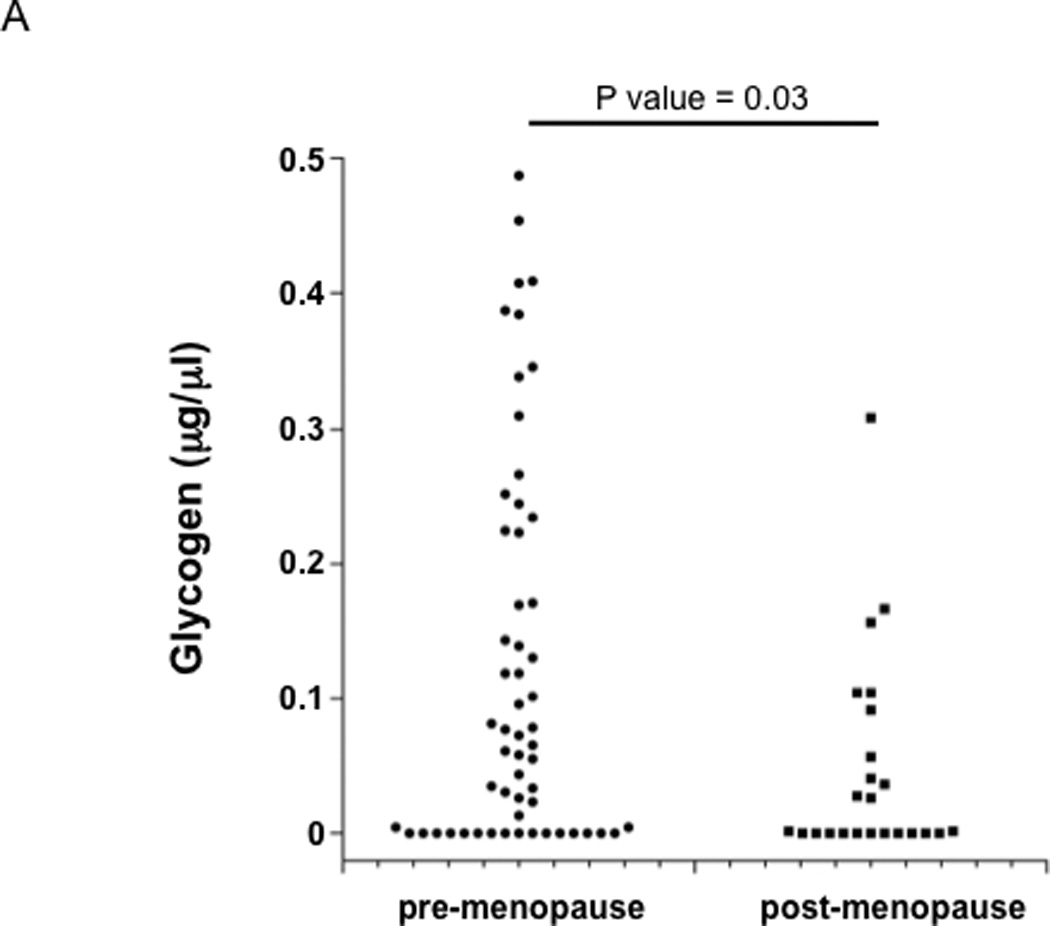
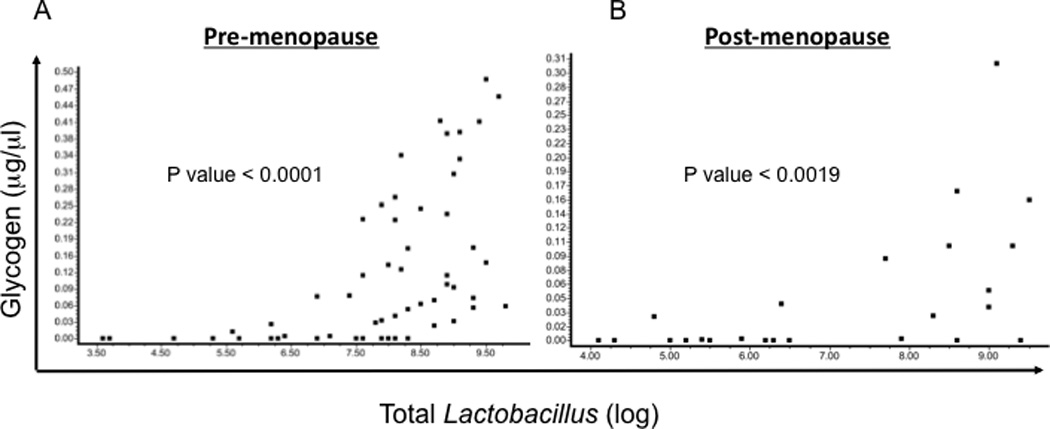
Free glycogen was detected in both premenopausal and postmenopausal women. Across all samples, those from postmenopausal women had significantly lower levels of free glycogen than those from premenopausal women (median, 0.002 vs 0.065 μg/μL, respectively; P = 0.03). Lactobacillus levels correlated positively with free glycogen in both premenopausal (Spearman r = 0.68, P < 0.0001) and postmenopausal (r = 0.60, P < 0.002) women. Samples from premenopausal women had higher Lactobacillus levels and lower vaginal pH (median log, 8.1; median pH, 4) than those from postmenopausal women (median log, 7.1; median pH, 4.6), although these differences were not significant. HIV status had no significant effect on these relationships.
Free glycogen is detected in both premenopausal and postmenopausal women and correlates with Lactobacillus in both groups. These results point to the complexity of the relationship between menopause and vaginal microbiota and indicate that more careful studies of the role of glycogen are warranted.
以往研究表明,绝经期间阴道上皮中的糖原表达会减少,导致乳酸杆菌水平降低。然而,尚未对绝经前和绝经后女性生殖道分泌物中的游离糖原及其与乳酸杆菌水平的关系进行比较。
在1至3个月的时间内,从11名绝经前(4名未感染HIV和7名感染HIV)和12名绝经后(7名未感染HIV和5名感染HIV)女性的月经周期不同阶段收集了82份宫颈阴道灌洗样本。对生殖道分泌物中的游离糖原进行定量。通过实时聚合酶链反应对乳酸杆菌水平进行定量。采用酶联免疫吸附测定法测定血液中的雌激素和孕酮水平。
在绝经前和绝经后女性中均检测到游离糖原。在所有样本中,绝经后女性的游离糖原水平显著低于绝经前女性(中位数分别为0.002与0.065μg/μL;P = 0.03)。绝经前(Spearman r = 0.68,P < 0.0001)和绝经后(r = 0.60,P < 0.002)女性的乳酸杆菌水平均与游离糖原呈正相关。绝经前女性的样本比绝经后女性的样本具有更高的乳酸杆菌水平和更低的阴道pH值(中位数对数,8.1;中位数pH值,4),尽管这些差异并不显著。HIV感染状态对这些关系没有显著影响。
在绝经前和绝经后女性中均检测到游离糖原,且在两组中均与乳酸杆菌相关。这些结果表明绝经与阴道微生物群之间关系的复杂性,并表明有必要对糖原的作用进行更深入的研究。