Bossou Yélian Marc, Serssar Youssra, Allou Amel, Vitry Sandrine, Momas Isabelle, Seta Nathalie, Menotti Jean, Achard Sophie
Environmental Epidemiology Unit, Paris-Descartes University, Sorbonne Paris Cité, EA 4064, 75006 Paris, France.
Viral Neuroimmunology Unit, Pasteur Institute, 75015 Paris, France.
Toxins (Basel). 2017 Jun 22;9(7):197. doi: 10.3390/toxins9070197.
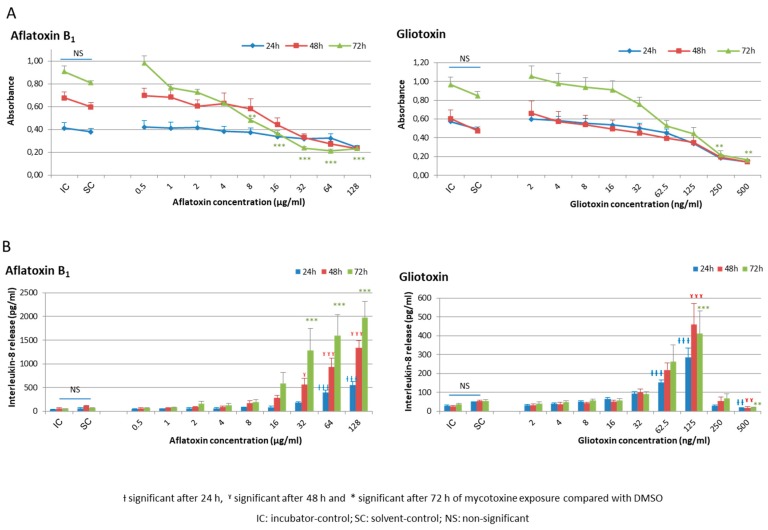
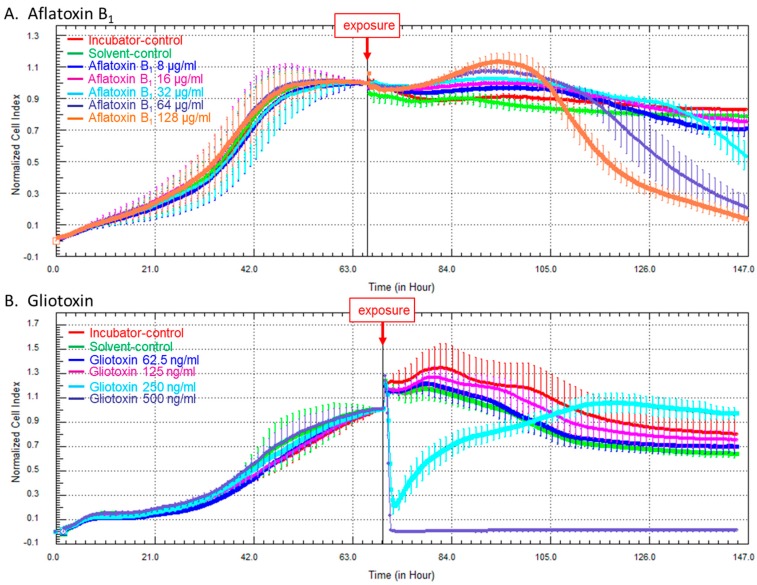
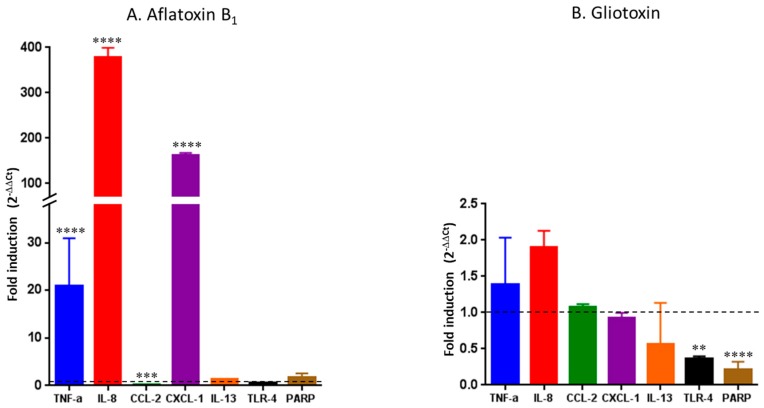
Exposure to molds and mycotoxins not only contributes to the onset of respiratory disease, it also affects the ocular surface. Very few published studies concern the evaluation of the effect of mycotoxin exposure on ocular cells. The present study investigates the effects of aflatoxin B₁ (AFB₁) and gliotoxin, two mycotoxins secreted by molds, on the biological activity of the human corneal epithelial (HCE) cells. After 24, 48, and 72 h of exposure, cellular viability and inflammatory response were assessed. Both endpoint cell viability colorimetric assays and continuous cell impedance measurements, providing noninvasive real-time assessment of the effect on cells, were performed. Cytokine gene expression and interleukin-8 release were quantified. Gliotoxin appeared more cytotoxic than AFB₁ but, at the same time, led to a lower increase of the inflammatory response reflecting its immunosuppressive properties. Real-time cell impedance measurement showed a distinct profile of cytotoxicity for both mycotoxins. HCE cells appeared to be a well-suited in vitro model to study ocular surface reactivity following biological contaminant exposure. Low, but persistent inflammation, caused by environmental factors, such as fungal toxins, leads to irritation and sensitization, and could be responsible for allergic manifestations which, in turn, could lead to mucosal hyper-reactivity.
接触霉菌和霉菌毒素不仅会引发呼吸道疾病,还会影响眼表。很少有已发表的研究关注霉菌毒素暴露对眼细胞影响的评估。本研究调查了黄曲霉毒素B₁(AFB₁)和胶霉毒素(由霉菌分泌的两种霉菌毒素)对人角膜上皮(HCE)细胞生物活性的影响。在暴露24、48和72小时后,评估细胞活力和炎症反应。进行了终点细胞活力比色测定和连续细胞阻抗测量,后者可对细胞效应进行非侵入性实时评估。对细胞因子基因表达和白细胞介素-8释放进行了定量分析。胶霉毒素似乎比AFB₁更具细胞毒性,但同时,其引发的炎症反应增加幅度较低,这反映了它的免疫抑制特性。实时细胞阻抗测量显示两种霉菌毒素的细胞毒性特征明显不同。HCE细胞似乎是研究生物污染物暴露后眼表反应性的合适体外模型。由真菌毒素等环境因素引起的低度但持续的炎症会导致刺激和致敏,并可能引发过敏表现,进而导致粘膜高反应性。