Takahashi Masahiro, Takahashi Masanobu, Komine Keigo, Yamada Hideharu, Kasahara Yuki, Chikamatsu Sonoko, Okita Akira, Ito Shukuei, Ouchi Kota, Okada Yoshinari, Imai Hiroo, Saijo Ken, Shirota Hidekazu, Takahashi Shin, Mori Takahiro, Shimodaira Hideki, Ishioka Chikashi
Department of Medical Oncology, Tohoku University Hospital, Aoba-ku, Sendai, Miyagi, Japan.
Department of Clinical Oncology, Institute of Development, Aging and Cancer, Tohoku University, Aoba-ku, Sendai, Miyagi, Japan.
PLoS One. 2017 Jun 22;12(6):e0179694. doi: 10.1371/journal.pone.0179694. eCollection 2017.
Some elderly cancer patients, even with good Eastern Cooperative Oncology Group performance status (ECOG-PS), have poor survival outcomes and cannot tolerate standard therapy. Few studies have detailed the associations between the G8 screening tool, ECOG-PS, and overall survival (OS) in such patients.
Cancer patients, aged 70 years or older, were assessed for G8 and classified into three groups according to their G8 score: <11 as the low score group, 11-14 as the intermediate score group, and >14 as the high score group. We retrospectively analyzed the association between G8 score and OS in all patients and for each ECOG-PS-categorized group.
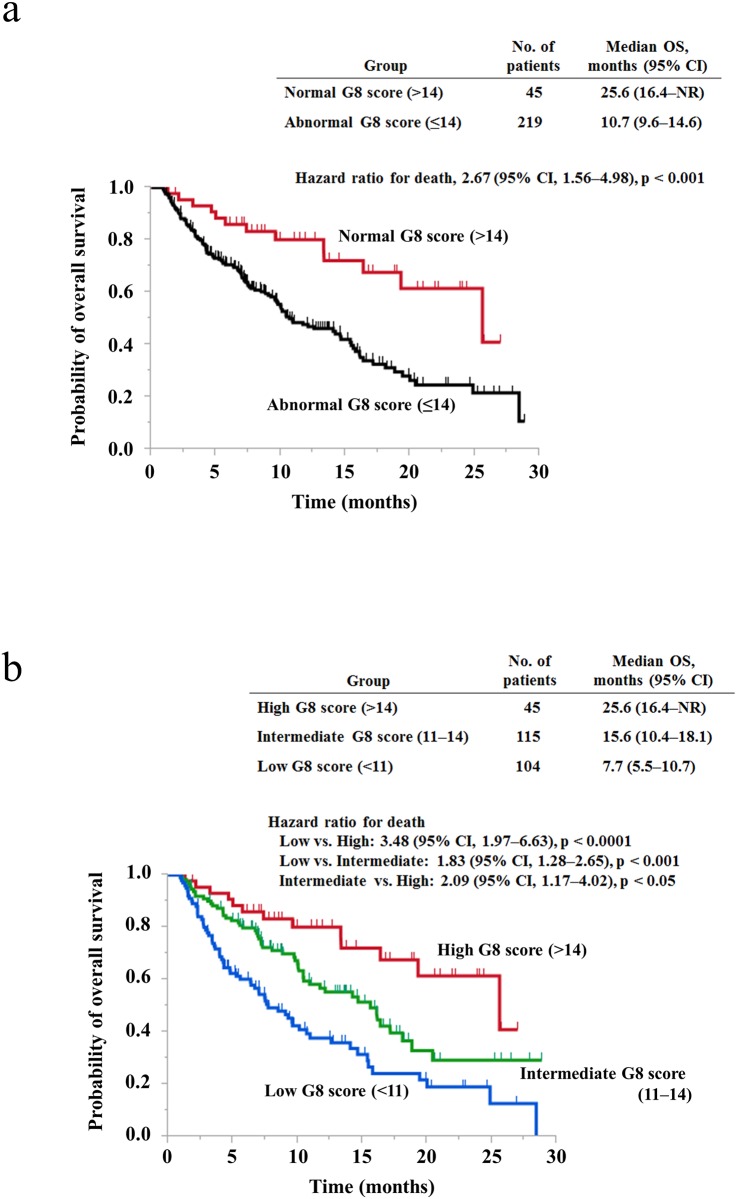
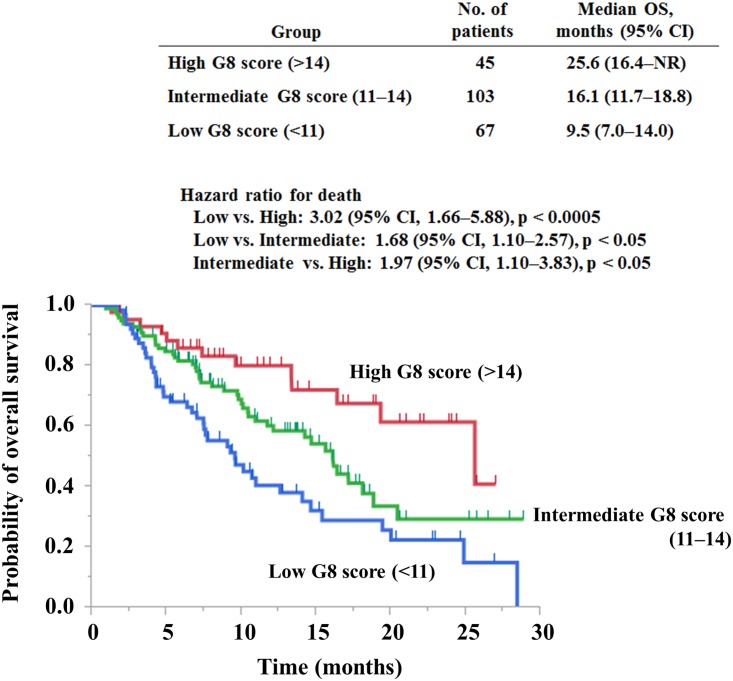
Out of 264 enrolled patients, most patients (87%) with solid tumor were categorized as TNM stage IV. ECOG-PS was 0 or 1 in 215 patients and ≥2 in 48; there was missing data for one patient. Among all patients, the low score group with a median OS of 7.7 months survived significantly less than both the high score group with a median OS of 25.6 months [Hazard ratio (HR) 3.48; 95% confidence interval (CI), 1.96-6.63; p < 0.0001] and the intermediate score group with a median of 15.6 months (HR 1.83; 95% CI, 1.28-2.65; p < 0.001). In the multivariate analysis, TNM stage and G8 score were independent prognostic factors for OS. When patients with an ECOG-PS of 0 or 1 were analyzed, patients with a lower G8 score showed significantly shorter OS than patients with a higher score when any two groups were compared.
This novel classification of the G8 score contributes to prompt identification of patients with poor prognosis and improved the prognostic value of ECOG-PS. Using G8 with ECOG-PS may be helpful in deciding treatment for elderly patients with advanced cancer.
一些老年癌症患者,即使东部肿瘤协作组体能状态(ECOG-PS)良好,生存结局也较差且无法耐受标准治疗。很少有研究详细阐述G8筛查工具、ECOG-PS与这类患者总生存期(OS)之间的关联。
对70岁及以上的癌症患者进行G8评估,并根据G8评分分为三组:<11分为低分组合,11 - 14分为中等评分组,>14分为高分组合。我们回顾性分析了所有患者以及每个ECOG-PS分类组中G8评分与OS之间的关联。
在264例入组患者中,大多数实体瘤患者(87%)被归类为TNM分期IV期。215例患者的ECOG-PS为0或1,48例患者的ECOG-PS≥2;1例患者有缺失数据。在所有患者中,中位OS为7.7个月的低分组合生存期显著短于中位OS为25.6个月的高分组合[风险比(HR)3.48;95%置信区间(CI),1.96 - 6.63;p < 0.0001]和中位OS为15.6个月的中等评分组(HR 1.83;95% CI,1.28 - 2.65;p < 0.001)。在多变量分析中,TNM分期和G8评分是OS的独立预后因素。当对ECOG-PS为0或1的患者进行分析时,比较任意两组,G8评分较低的患者OS显著短于评分较高的患者。
G8评分的这种新分类有助于快速识别预后不良的患者,并提高了ECOG-PS的预后价值。将G8与ECOG-PS结合使用可能有助于决定老年晚期癌症患者的治疗方案。