Constant Deborah, Harries Jane, Daskilewicz Kristen, Myer Landon, Gemzell-Danielsson Kristina
Women's Health Research Unit, School of Public Health and Family Medicine, University of Cape Town, Cape Town, South Africa.
Division of Epidemiology & Biostatistics, School of Public Health and Family Medicine, University of Cape Town, Cape Town, South Africa.
PLoS One. 2017 Jun 22;12(6):e0179600. doi: 10.1371/journal.pone.0179600. eCollection 2017.
To evaluate feasibility of self-assessment of medical abortion outcome using a low-sensitivity urine pregnancy test, checklist and text messages. The study assessed whether accurate self-assessment required a demonstration of the low-sensitivity urine pregnancy test or if verbal instructions suffice.
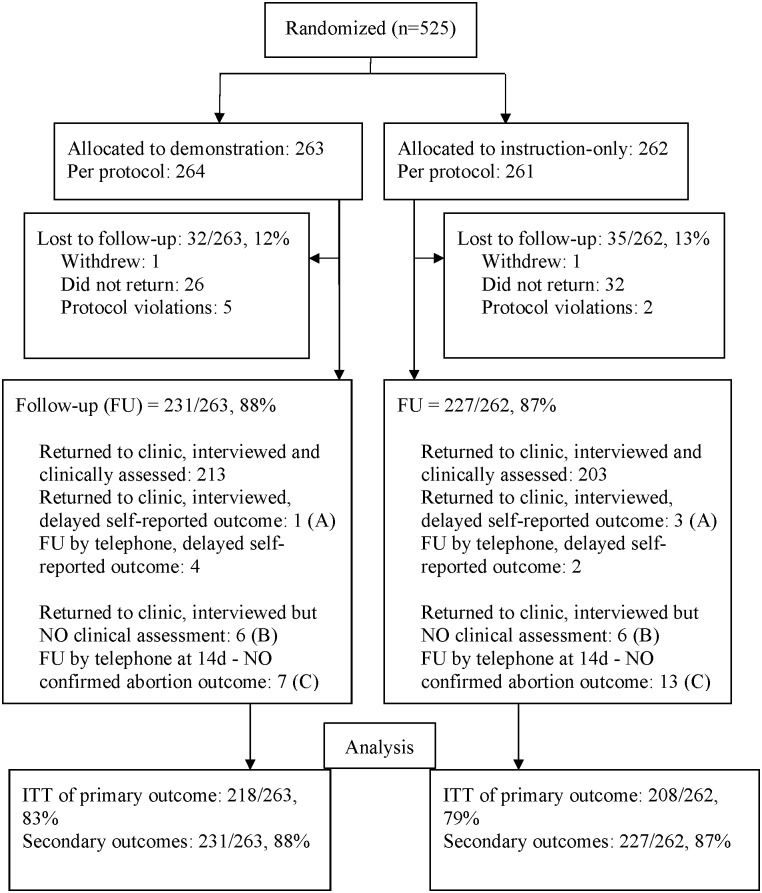
This non-inferiority trial enrolled 525 adult women from six public sector abortion clinics. Eligible women were undergoing medical abortion at gestations within 63 days. Consenting women completed a baseline interview, received standard care with mifepristone and home-administration of misoprostol. All were given a low-sensitivity urine pregnancy test and checklist for use 14 days later, sent text reminders, and asked to attend in-clinic follow-up after two weeks. Women were randomly assigned 1:1 to an instruction-only group (n = 262; issued with pre-scripted instructions on the low-sensitivity pregnancy test), or a demonstration group (n = 263; performed practice tests guided by lay health workers). The primary outcome was accurate self-assessment of incomplete abortion, defined as needing additional misoprostol or vacuum aspiration. Analysis was by intention to treat and a non-inferiority margin was set to six percentage points. Women's acceptability of their abortion procedure and preferences for follow-up were also assessed.
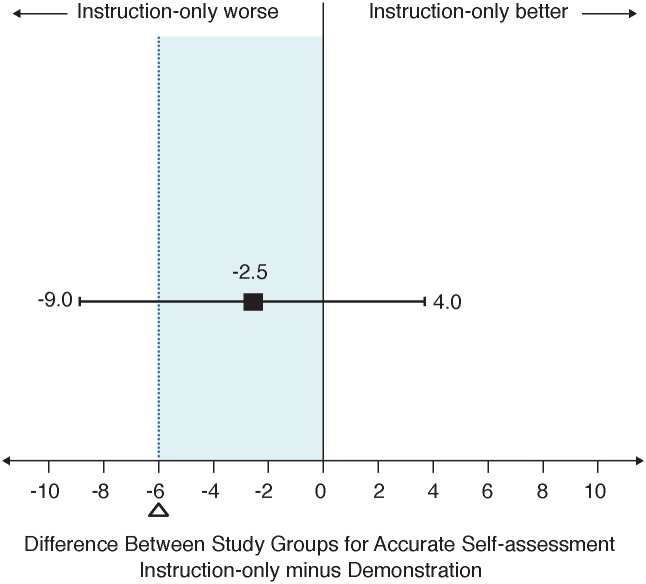
Follow-up was 81% for abortion outcome, confirmed in-clinic at two weeks or self-reported within six months. Non-inferiority of instruction-only to a demonstration was inconclusive for accurate self-assessment (risk difference for instruction-only -demonstration: -2.5%; 95%CI: -9% to 4%). Comparing instruction-only to demonstration groups, 99% and 100% found the pregnancy test easy to do; and 91% and 93% respectively chose the pregnancy test, checklist and text messages for abortion outcome assessment in the future.
Routine self-assessment using a low-sensitivity pregnancy test, checklist and text messages is feasible and preferred by women attending South African primary care abortion clinics. Counselling with additional emphasis on prompt recognition of ongoing pregnancies is recommended.
ClinicalTrials.gov NCT02231619.
评估使用低灵敏度尿液妊娠试验、检查表和短信进行药物流产结局自我评估的可行性。该研究评估准确的自我评估是否需要演示低灵敏度尿液妊娠试验,或者口头指导是否足够。
这项非劣效性试验招募了来自六个公共部门堕胎诊所的525名成年女性。符合条件的女性在妊娠63天内接受药物流产。同意参与的女性完成了基线访谈,接受了米非司酮标准护理和在家自行服用米索前列醇。所有女性都被给予了一个低灵敏度尿液妊娠试验和检查表,供14天后使用,收到了短信提醒,并被要求在两周后到诊所进行随访。女性被随机1:1分配到仅接受指导组(n = 262;收到关于低灵敏度妊娠试验的预先编写的指导)或演示组(n = 263;在非专业卫生工作者的指导下进行实践测试)。主要结局是对不完全流产的准确自我评估,定义为需要额外的米索前列醇或真空吸引。分析采用意向性分析,非劣效性界值设定为6个百分点。还评估了女性对其堕胎程序的可接受性以及对随访的偏好。
堕胎结局的随访率为81%,在两周内在诊所确认或在六个月内自我报告。仅接受指导组与演示组在准确自我评估方面的非劣效性尚无定论(仅接受指导组与演示组的风险差异:-2.5%;95%CI:-9%至4%)。比较仅接受指导组与演示组,99%和100%的人认为妊娠试验易于操作;91%和93%的人分别选择妊娠试验、检查表和短信用于未来的堕胎结局评估。
使用低灵敏度妊娠试验、检查表和短信进行常规自我评估是可行的,并且受到南非初级保健堕胎诊所女性的青睐。建议进行咨询,并特别强调及时识别持续妊娠。
ClinicalTrials.gov NCT02231619。