Hida Naoki, Aboukilila Mohamed Y, Burow Dana A, Paul Rakesh, Greenberg Marc M, Fazio Michael, Beasley Samantha, Spitale Robert C, Cleary Michael D
Molecular and Cell Biology Unit, Quantitative and Systems Biology Graduate Program, University of California, Merced, CA 95343, USA.
Department of Chemistry, Johns Hopkins University, Baltimore, MD 21218, USA.
Nucleic Acids Res. 2017 Sep 6;45(15):e138. doi: 10.1093/nar/gkx551.
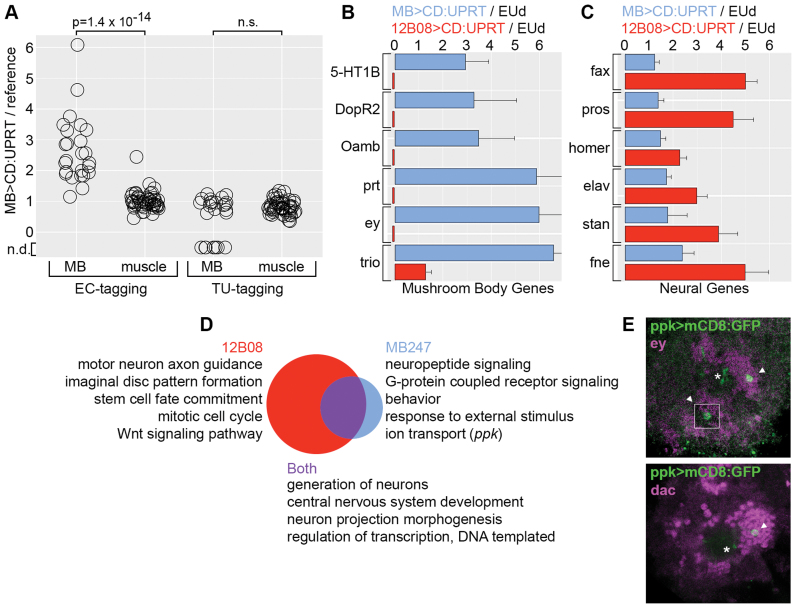
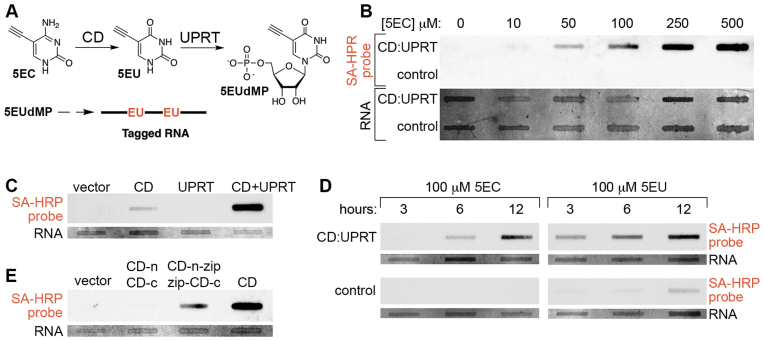
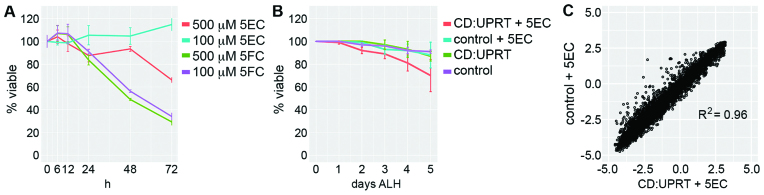
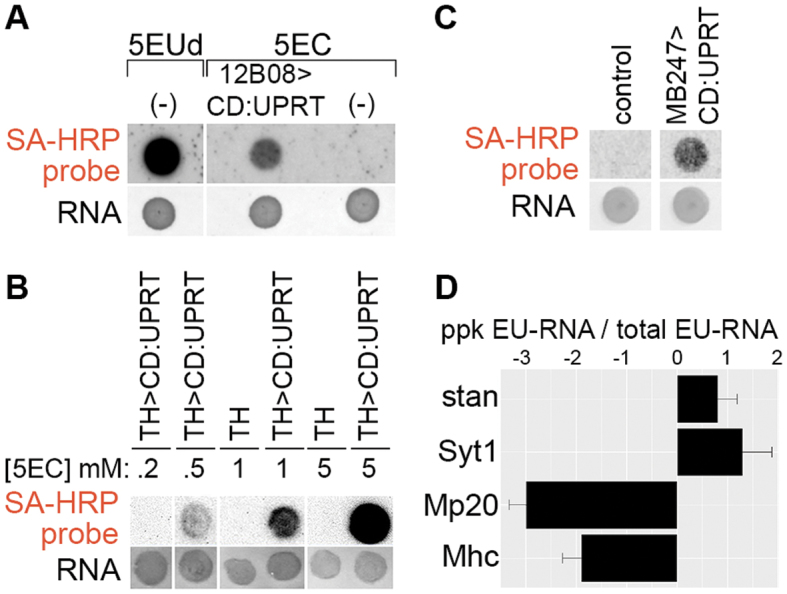
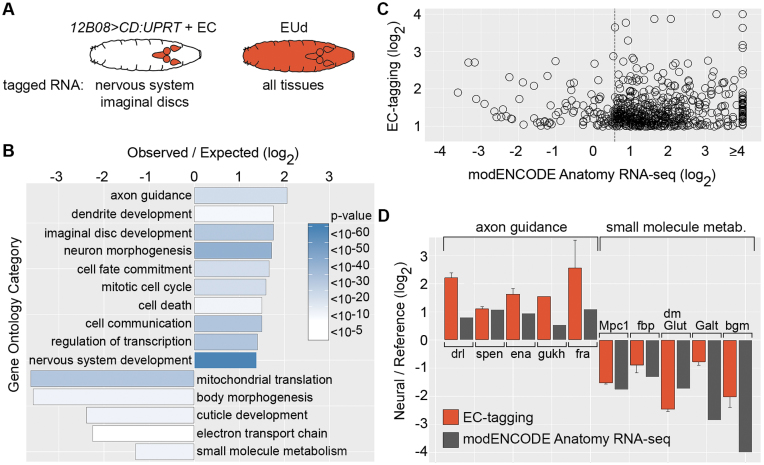
Purification of cell type-specific RNAs remains a significant challenge. One solution involves biosynthetic tagging of target RNAs. RNA tagging via incorporation of 4-thiouracil (TU) in cells expressing transgenic uracil phosphoribosyltransferase (UPRT), a method known as TU-tagging, has been used in multiple systems but can have limited specificity due to endogenous pathways of TU incorporation. Here, we describe an alternative method that requires the activity of two enzymes: cytosine deaminase (CD) and UPRT. We found that the sequential activity of these enzymes converts 5-ethynylcytosine (EC) to 5-ethynyluridine monophosphate that is subsequently incorporated into nascent RNAs. The ethynyl group allows efficient detection and purification of tagged RNAs. We show that 'EC-tagging' occurs in tissue culture cells and Drosophila engineered to express CD and UPRT. Additional control can be achieved through a split-CD approach in which functional CD is reconstituted from independently expressed fragments. We demonstrate the sensitivity and specificity of EC-tagging by obtaining cell type-specific gene expression data from intact Drosophila larvae, including transcriptome measurements from a small population of central brain neurons. EC-tagging provides several advantages over existing techniques and should be broadly useful for investigating the role of differential RNA expression in cell identity, physiology and pathology.
细胞类型特异性RNA的纯化仍然是一项重大挑战。一种解决方案是对目标RNA进行生物合成标记。通过在表达转基因尿嘧啶磷酸核糖转移酶(UPRT)的细胞中掺入4-硫尿嘧啶(TU)来进行RNA标记,即所谓的TU标记法,已在多个系统中使用,但由于TU掺入的内源性途径,其特异性可能有限。在此,我们描述了一种需要两种酶活性的替代方法:胞嘧啶脱氨酶(CD)和UPRT。我们发现这些酶的顺序活性将5-乙炔基胞嘧啶(EC)转化为5-乙炔基尿苷单磷酸,随后该单磷酸被掺入新生RNA中。乙炔基可实现对标记RNA的高效检测和纯化。我们表明,“EC标记”发生在经工程改造以表达CD和UPRT的组织培养细胞和果蝇中。通过一种分裂CD方法可实现额外的控制,即从独立表达的片段中重新组装功能性CD。我们通过从完整的果蝇幼虫中获取细胞类型特异性基因表达数据,包括来自少量中枢脑神经元的转录组测量数据,证明了EC标记的敏感性和特异性。与现有技术相比,EC标记具有多个优点,对于研究差异RNA表达在细胞特性、生理学和病理学中的作用应具有广泛的用途。