Wolf T J A, Myhre R H, Cryan J P, Coriani S, Squibb R J, Battistoni A, Berrah N, Bostedt C, Bucksbaum P, Coslovich G, Feifel R, Gaffney K J, Grilj J, Martinez T J, Miyabe S, Moeller S P, Mucke M, Natan A, Obaid R, Osipov T, Plekan O, Wang S, Koch H, Gühr M
Stanford PULSE Institute, SLAC National Accelerator Laboratory, 2575 Sand Hill Road, Menlo Park, CA, 94025, USA.
Department of Chemistry, Norwegian University of Science and Technology, NO-7491, Trondheim, Norway.
Nat Commun. 2017 Jun 22;8(1):29. doi: 10.1038/s41467-017-00069-7.
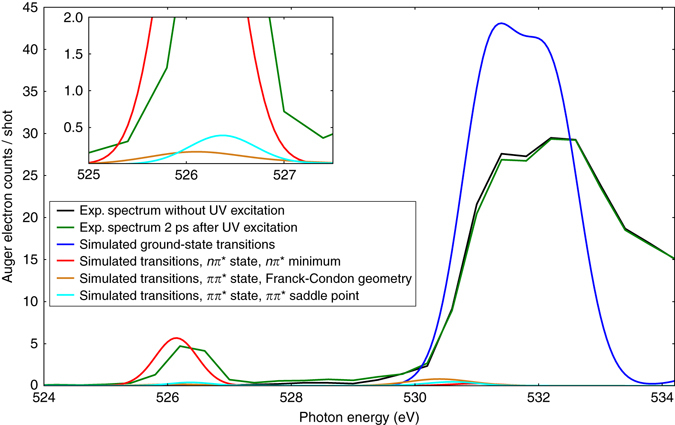
Many photoinduced processes including photosynthesis and human vision happen in organic molecules and involve coupled femtosecond dynamics of nuclei and electrons. Organic molecules with heteroatoms often possess an important excited-state relaxation channel from an optically allowed ππ* to a dark nπ* state. The ππ*/nπ* internal conversion is difficult to investigate, as most spectroscopic methods are not exclusively sensitive to changes in the excited-state electronic structure. Here, we report achieving the required sensitivity by exploiting the element and site specificity of near-edge soft X-ray absorption spectroscopy. As a hole forms in the n orbital during ππ*/nπ* internal conversion, the absorption spectrum at the heteroatom K-edge exhibits an additional resonance. We demonstrate the concept using the nucleobase thymine at the oxygen K-edge, and unambiguously show that ππ*/nπ* internal conversion takes place within (60 ± 30) fs. High-level-coupled cluster calculations confirm the method's impressive electronic structure sensitivity for excited-state investigations.Many photo-induced processes such as photosynthesis occur in organic molecules, but their femtosecond excited-state dynamics are difficult to track. Here, the authors exploit the element and site selectivity of soft X-ray absorption to sensitively follow the ultrafast ππ*/nπ* electronic relaxation of hetero-organic molecules.
包括光合作用和人类视觉在内的许多光诱导过程都发生在有机分子中,并且涉及原子核和电子的飞秒动力学耦合。含有杂原子的有机分子通常拥有一个重要的从光学允许的ππ态到暗nπ态的激发态弛豫通道。ππ*/nπ内转换很难研究,因为大多数光谱方法对激发态电子结构的变化并非具有唯一的敏感性。在此,我们报告通过利用近边软X射线吸收光谱的元素和位点特异性实现了所需的灵敏度。由于在ππ/nπ内转换过程中n轨道中形成了一个空穴,杂原子K边处的吸收光谱会出现一个额外的共振峰。我们以氧K边处的核碱基胸腺嘧啶为例演示了这一概念,并明确表明ππ/nπ内转换发生在(60±30)飞秒内。高水平耦合簇计算证实了该方法在激发态研究方面令人印象深刻的电子结构灵敏度。许多光诱导过程(如光合作用)发生在有机分子中,但其飞秒激发态动力学很难追踪。在此,作者利用软X射线吸收的元素和位点选择性来灵敏地追踪杂有机分子超快的ππ/nπ*电子弛豫过程。