Garoushi Sufyan K, Hatem Marwa, Lassila Lippo V J, Vallittu Pekka K
Department of Biomaterials Science, Turku Clinical Biomaterials Centre, TCBC, Institute of Dentistry, University of TurkuTurkuFinland.
Department of Restorative Dentistry & Periodontology, Institute of Dentistry, Libyan International Medical UniversityBenghaziLibya.
Acta Biomater Odontol Scand. 2015 Apr 14;1(1):6-12. doi: 10.3109/23337931.2015.1017576. eCollection 2015 Jan.
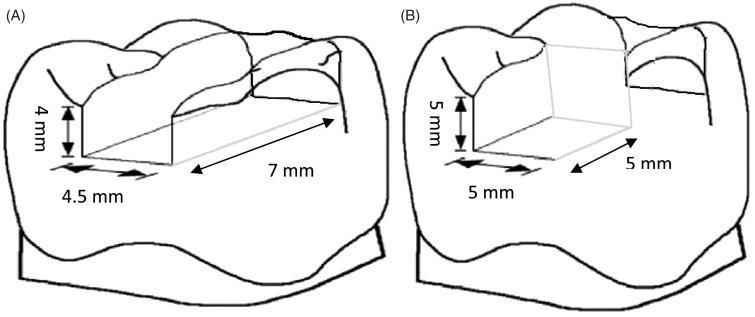
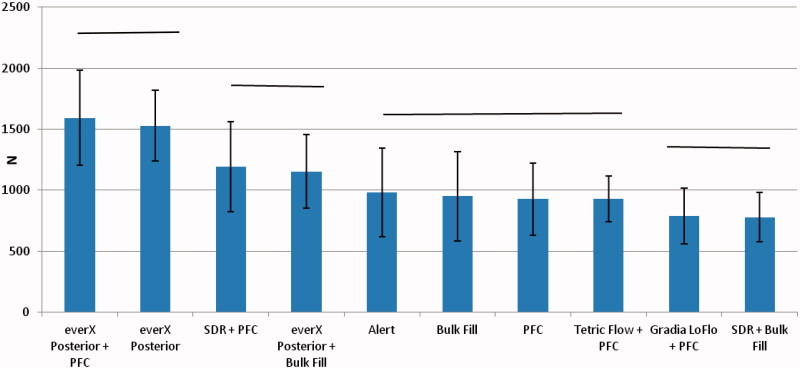
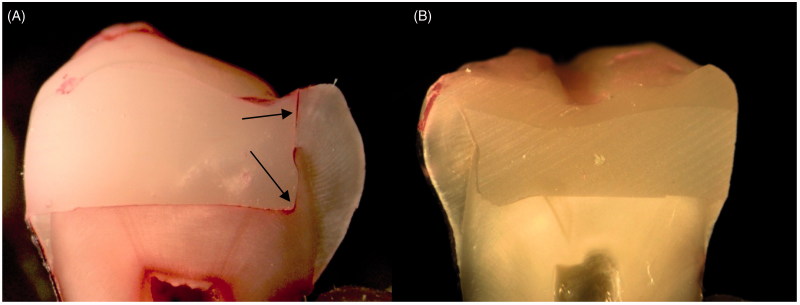
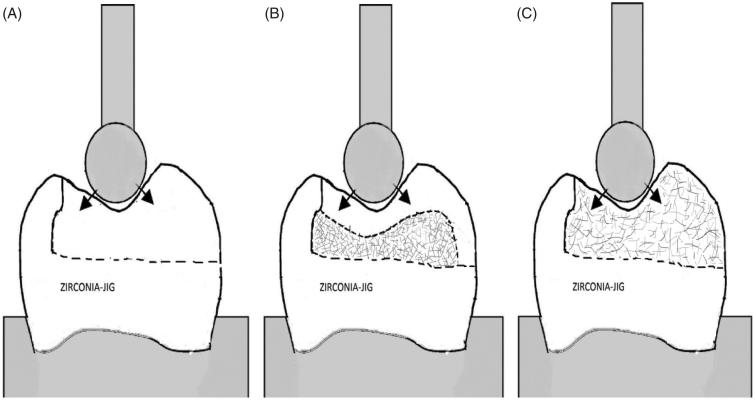
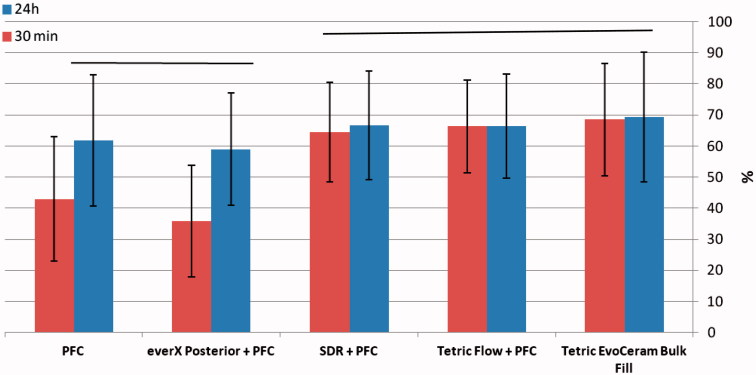
: To determine the marginal microleakage of Class II restorations made with different composite base materials and the static load-bearing capacity of direct composite onlay restorations. : Class II cavities were prepared in 40 extracted molars. They were divided into five groups ( = 8/group) depending on composite base material used (everX Posterior, SDR, Tetric EvoFlow). After Class II restorations were completed, specimens were sectioned mid-sagitally. For each group, sectioned restorations were immersed in dye. Specimens were viewed under a stereo-microscope and the percentage of cavity leakage was calculated. Ten groups of onlay restorations were fabricated ( = 8/group); groups were made with composite base materials (everX Posterior, SDR, Tetric EvoFlow, Gradia Direct LoFlo) and covered by 1 mm layer of conventional (Tetric N-Ceram) or bulk fill (Tetric EvoCeram Bulk Fill) composites. Groups made only from conventional, bulk fill and short fiber composites were used as control. Specimens were statically loaded until fracture. Data were analyzed using ANOVA ( = 0.05). : Microleakage of restorations made of plain conventional composite or short fiber composite base material showed statistically ( < 0.05) lower values compared to other groups. ANOVA revealed that onlay restorations made from short fiber-reinforced composite (FRC) as base or plain restoration had statistically significant higher load-bearing capacity (1593 N) ( < 0.05) than other restorations. : Restorations combining base of short FRC and surface layer of conventional composite displayed promising performance related to microleakage and load-bearing capacity.
确定使用不同复合树脂基底材料制作的Ⅱ类洞修复体的边缘微渗漏情况以及直接复合树脂高嵌体修复体的静态承载能力。
在40颗拔除的磨牙上制备Ⅱ类洞。根据所使用的复合树脂基底材料(everX Posterior、SDR、Tetric EvoFlow)将它们分为五组(每组n = 8)。完成Ⅱ类洞修复后,将标本沿矢状面切开。对于每组,将切开的修复体浸入染料中。在立体显微镜下观察标本并计算洞壁渗漏的百分比。制作十组高嵌体修复体(每组n = 8);这些组使用复合树脂基底材料(everX Posterior、SDR、Tetric EvoFlow、Gradia Direct LoFlo)制作,并覆盖1mm厚的传统复合树脂(Tetric N-Ceram)或大块充填复合树脂(Tetric EvoCeram Bulk Fill)。仅由传统复合树脂、大块充填复合树脂和短纤维复合树脂制成的组用作对照。对标本进行静态加载直至断裂。使用方差分析(α = 0.05)对数据进行分析。
与其他组相比,由普通传统复合树脂或短纤维复合树脂基底材料制成的修复体的微渗漏在统计学上(P < 0.05)显示出较低的值。方差分析显示,以短纤维增强复合树脂(FRC)为基底或普通修复体制作的高嵌体修复体在统计学上具有显著更高的承载能力(1593 N)(P < 0. < 0.05)比其他修复体。
结合短FRC基底和传统复合树脂表层的修复体在微渗漏和承载能力方面表现出良好的性能。