Health Systems Research Unit, South African Medical Research Council, Tygerberg, South Africa.
Department of Global Health, School of Public Health, Boston University, Boston, MA, USA.
AIDS Behav. 2018 Mar;22(3):722-732. doi: 10.1007/s10461-017-1830-6.
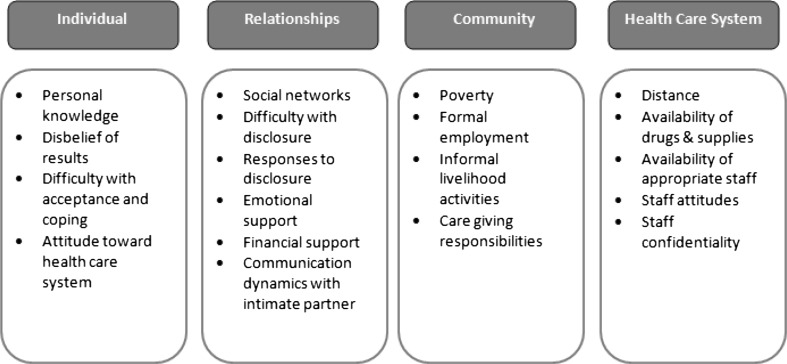
To maximize the benefits of test and treat strategies that utilize community-based HIV testing, clients who test positive must link to care in a timely manner. However, linkage rates across the HIV treatment cascade are typically low and little is known about what might facilitate or hinder care-seeking behavior. This qualitative study was conducted within a home-based HIV counseling and testing (HBHCT) intervention in South Africa. In-depth interviews were conducted with 30 HBHCT clients who tested HIV positive to explore what influenced their care-seeking behavior. A set of field notes for 196 additional HBHCT clients who tested HIV positive at home were also reviewed and analyzed. Content analysis showed that linkage to care is influenced by a myriad of factors at the individual, relationship, community, and health system levels. These factors subtly interact and at times reinforce each other. While some factors such as belief in test results, coping ability, social support, and prior experiences with the health system affect clients' desire and motivation to seek care, others such as limited time and resources affect their agency to do so. To ensure that the benefits of community-based testing models are realized through timely linkage to care, programs and interventions must take into account and address clients' emotions, motivation levels, living situations, relationship dynamics, responsibilities, and personal resources.
为了最大限度地发挥基于社区的 HIV 检测策略的优势,必须及时将检测呈阳性的客户与护理联系起来。然而,整个 HIV 治疗过程中的联系率通常较低,对于什么可能促进或阻碍寻求护理的行为知之甚少。这项定性研究是在南非的一项家庭为基础的 HIV 咨询和检测(HBHCT)干预措施中进行的。对 30 名通过 HBHCT 检测 HIV 阳性的客户进行了深入访谈,以探讨影响他们寻求护理行为的因素。还审查和分析了另外 196 名在家中通过 HBHCT 检测 HIV 阳性的客户的一套现场记录。内容分析表明,与护理的联系受到个人、关系、社区和卫生系统各级众多因素的影响。这些因素微妙地相互作用,有时相互加强。虽然一些因素,如对检测结果的信任、应对能力、社会支持和之前对卫生系统的经验,影响着客户寻求护理的愿望和动机,而另一些因素,如时间和资源有限,则影响着他们寻求护理的能力。为了确保通过及时联系护理来实现基于社区的检测模式的优势,计划和干预措施必须考虑并解决客户的情绪、动机水平、生活状况、关系动态、责任和个人资源。