Department of Chemical and Biological Engineering, Center for Micro-Engineered Materials, CMEM, University of New Mexico, Advanced Materials Lab, 1001 University Blvd. SE Suite 103, MSC 04 2790, Albuquerque, NM, 87131, USA.
Department of Chemical Science and Technologies, University of Rome Tor Vergata, Via della Ricerca Scientifica, 00133, Rome, Italy.
ChemSusChem. 2017 Aug 24;10(16):3243-3251. doi: 10.1002/cssc.201700851. Epub 2017 Aug 1.
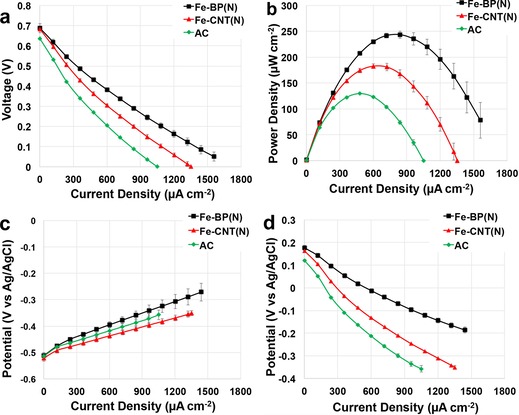
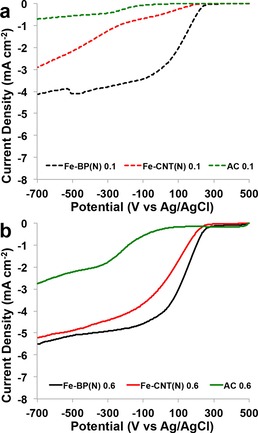
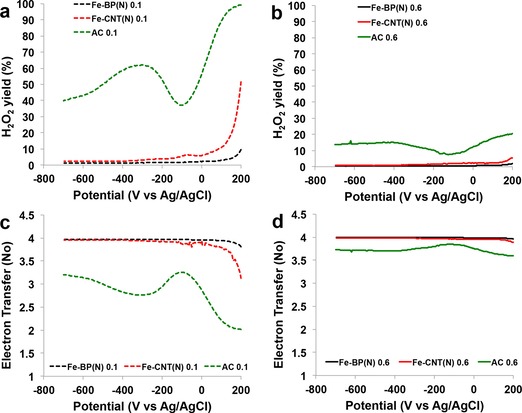
Iron(II) phthalocyanine (FePc) deposited onto two different carbonaceous supports was synthesized through an unconventional pyrolysis-free method. The obtained materials were studied in the oxygen reduction reaction (ORR) in neutral media through incorporation in an air-breathing cathode structure and tested in an operating microbial fuel cell (MFC) configuration. Rotating ring disk electrode (RRDE) analysis revealed high performances of the Fe-based catalysts compared with that of activated carbon (AC). The FePc supported on Black-Pearl carbon black [Fe-BP(N)] exhibits the highest performance in terms of its more positive onset potential, positive shift of the half-wave potential, and higher limiting current as well as the highest power density in the operating MFC of (243±7) μW cm , which was 33 % higher than that of FePc supported on nitrogen-doped carbon nanotubes (Fe-CNT(N); 182±5 μW cm ). The power density generated by Fe-BP(N) was 92 % higher than that of the MFC utilizing AC; therefore, the utilization of platinum group metal-free catalysts can boost the performances of MFCs significantly.
通过一种非传统的无热解方法合成了负载在两种不同碳载体上的铁(II)酞菁(FePc)。通过将所得材料掺入空气呼吸阴极结构中,在中性介质中的氧还原反应(ORR)中进行研究,并在运行的微生物燃料电池(MFC)配置中进行测试。旋转环盘电极(RRDE)分析表明,与活性炭(AC)相比,Fe 基催化剂具有更高的性能。负载在 Black-Pearl 炭黑[Fe-BP(N)]上的 FePc 具有更高的起始电位、半波电位的正移、更高的极限电流以及在运行的 MFC 中的更高的功率密度(243±7)μW·cm,比负载在氮掺杂碳纳米管上的 FePc(Fe-CNT(N))高 33%(182±5μW·cm)。Fe-BP(N)产生的功率密度比利用 AC 的 MFC 高 92%;因此,无贵金属催化剂的使用可以显著提高 MFC 的性能。