Kang Yu Mi, Jung Chang Hee, Cho Yun Kyung, Jang Jung Eun, Hwang Jenie Yoonoo, Kim Eun Hee, Lee Woo Je, Park Joong-Yeol, Kim Hong-Kyu
Department of Internal Medicine, Asan Medical Center, University of Ulsan College of Medicine, Seoul, Republic of Korea.
Department of Health Screening and Promotion Center, Asan Medical Center, University of Ulsan College of Medicine, Seoul, Republic of Korea.
PLoS One. 2017 Jun 23;12(6):e0179635. doi: 10.1371/journal.pone.0179635. eCollection 2017.
Some individuals with metabolically healthy obesity (MHO) convert to metabolically unhealthy obesity (MUO) phenotype, and visceral adiposity is one of proposed mechanisms underlying such conversion. Visceral adipose index (VAI) is a novel mathematical model which estimates visceral adiposity based on anthropometric and lipid profiles. We aimed to determine the association of VAI-estimated visceral adiposity with the MHO-to-MUO conversion and the predictive value of VAI in estimating such unfavorable outcomes.
A total of 2,204 Korean subjects with the MHO phenotype were enrolled and stratified by body mass index and metabolic health state according to Wildman criteria at baseline and last follow-up examinations. VAI was calculated at baseline.
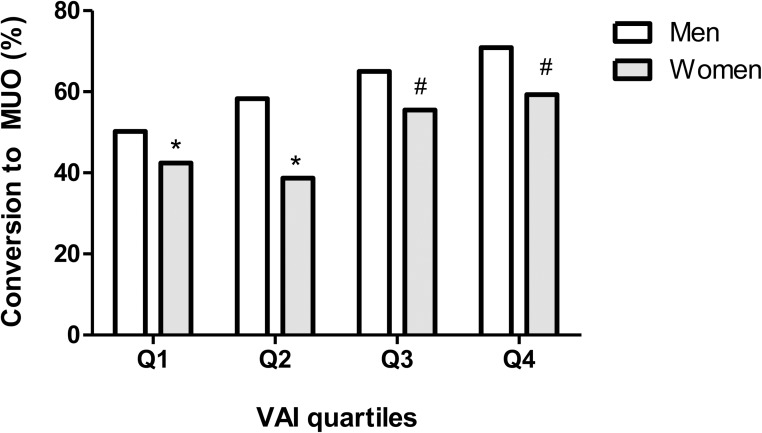
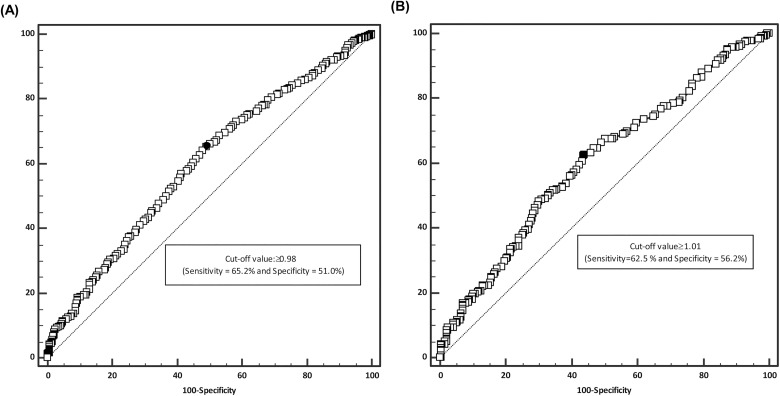
Over a median follow-up period of 41.1 months, 46.0% of subjects converted to MUO phenotype. Higher VAI quartiles were associated with a greater proportion of subjects who underwent MHO-to-MUO conversion, and also with increased odds ratios for such conversion even after multivariate analyses. The optimal VAI cut off value was around 1.00, and VAI had a greater power in the prediction of MHO-to MUO conversion than waist circumference in both genders.
MHO phenotypes with high VAI values are associated with poor future metabolic outcomes. VAI-estimated visceral adiposity is well correlated with the prognosis of MHO subjects, and VAI has a good predictive value in determining the MHO-to-MUO conversion.
一些代谢健康型肥胖(MHO)个体转变为代谢不健康型肥胖(MUO)表型,内脏脂肪过多是这种转变潜在的机制之一。内脏脂肪指数(VAI)是一种基于人体测量学和血脂谱估计内脏脂肪过多的新型数学模型。我们旨在确定VAI估计的内脏脂肪过多与MHO向MUO转变的关联以及VAI在估计此类不良结局方面的预测价值。
共纳入2204名具有MHO表型的韩国受试者,并在基线和末次随访检查时根据Wildman标准按体重指数和代谢健康状态进行分层。在基线时计算VAI。
在中位随访期41.1个月期间,46.0%的受试者转变为MUO表型。较高的VAI四分位数与更多经历MHO向MUO转变的受试者比例相关,并且即使在多变量分析后,此类转变的比值比也增加。VAI的最佳截断值约为1.00,在预测MHO向MUO转变方面,VAI在两性中的预测能力均高于腰围。
高VAI值的MHO表型与未来不良代谢结局相关。VAI估计的内脏脂肪过多与MHO受试者的预后密切相关,并且VAI在确定MHO向MUO转变方面具有良好的预测价值。