García Samuelsson Miguel, Tárraga López Pedro Juan, López-González Ángel Arturo, Paublini Hernán, Martínez-Almoyna Rifá Emilio, Ramírez-Manent José Ignacio
ADEMA-Health Group, University Institute of Health Sciences (IUNICS), 07120 Palma de Mallorca, Balearic Islands, Spain.
Faculty of Dentistry, ADEMA-UIB University School, 07009 Palma de Mallorca, Balearic Islands, Spain.
Nutrients. 2025 Apr 14;17(8):1345. doi: 10.3390/nu17081345.
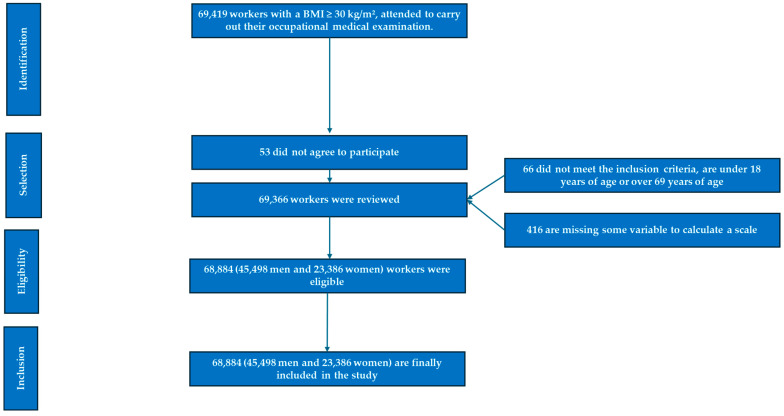
: Obesity constitutes a significant public health concern and is frequently linked to metabolic dysfunctions, particularly insulin resistance (IR). Nevertheless, a subset of obese individuals, referred to as metabolically healthy obese (MHO), do not exhibit overt metabolic abnormalities. The present study aims to assess the risk of developing IR among MHO workers and to explore the determinants contributing to this risk. : This cross-sectional investigation utilized data from a cohort of 68,884 obese workers across multiple occupational sectors in Spain. The classification of participants as MHO was based on the number of metabolic syndrome components, in accordance with the criteria established by the National Cholesterol Education Program Adult Treatment Panel III (NCEP-ATPIII). Anthropometric, clinical, and biochemical parameters-including body mass index (BMI), waist circumference, lipid profile, glycemic levels, and blood pressure-were systematically assessed. The likelihood of developing IR was estimated through various validated risk assessment models. : The analysis indicates that, despite having a relatively favorable metabolic profile, individuals classified as MHO also show signs of metabolic deterioration, such as an increased risk of insulin resistance. Key risk factors such as physical inactivity, low adherence to the Mediterranean diet, and socioeconomic disparities were identified as significant contributors to the transition from the MHO phenotype to a metabolically unhealthy state. Logistic regression analyses corroborated that insufficient physical activity and suboptimal dietary habits were strongly associated with an elevated risk of IR. : The findings underscore the dynamic and potentially transient nature of the MHO phenotype, emphasizing the necessity of proactive monitoring and early preventive strategies. Encouraging physical activity, promoting adherence to a nutritionally balanced diet, and implementing workplace health initiatives emerge as critical measures to attenuate the risk of IR and metabolic deterioration in MHO individuals. Future longitudinal studies are warranted to enhance risk stratification and to formulate tailored preventive interventions.
肥胖是一个重大的公共卫生问题,常常与代谢功能障碍相关,尤其是胰岛素抵抗(IR)。然而,有一部分肥胖个体,被称为代谢健康肥胖者(MHO),并未表现出明显的代谢异常。本研究旨在评估MHO工作者发生IR的风险,并探究导致该风险的决定因素。
这项横断面调查利用了来自西班牙多个职业部门的68884名肥胖工作者队列的数据。根据美国国家胆固醇教育计划成人治疗小组第三次报告(NCEP - ATPIII)制定的标准,依据代谢综合征组分数量将参与者分类为MHO。系统评估了人体测量学、临床和生化参数,包括体重指数(BMI)、腰围、血脂谱、血糖水平和血压。通过各种经过验证的风险评估模型估计发生IR的可能性。
分析表明,尽管被归类为MHO的个体具有相对良好的代谢特征,但他们也表现出代谢恶化的迹象,例如胰岛素抵抗风险增加。身体活动不足、对地中海饮食的低依从性和社会经济差异等关键风险因素被确定为从MHO表型转变为代谢不健康状态的重要促成因素。逻辑回归分析证实,身体活动不足和不良饮食习惯与IR风险升高密切相关。
研究结果强调了MHO表型的动态性和潜在的短暂性,强调了主动监测和早期预防策略的必要性。鼓励身体活动、促进对营养均衡饮食的依从性以及实施职场健康倡议,成为降低MHO个体IR风险和代谢恶化风险的关键措施。未来有必要进行纵向研究,以加强风险分层并制定针对性的预防干预措施。