Rajesh Aashish, Farooq Mohammed
Madras Medical College, No. 3 EVR Periyar Salai, Park Town, Chennai, 600003, Tamil Nadu, India.
Madras Medical College, No. 3 EVR Periyar Salai, Park Town, Chennai, 600003, Tamil Nadu, India.
Int J Surg Case Rep. 2017;37:72-75. doi: 10.1016/j.ijscr.2017.06.016. Epub 2017 Jun 15.
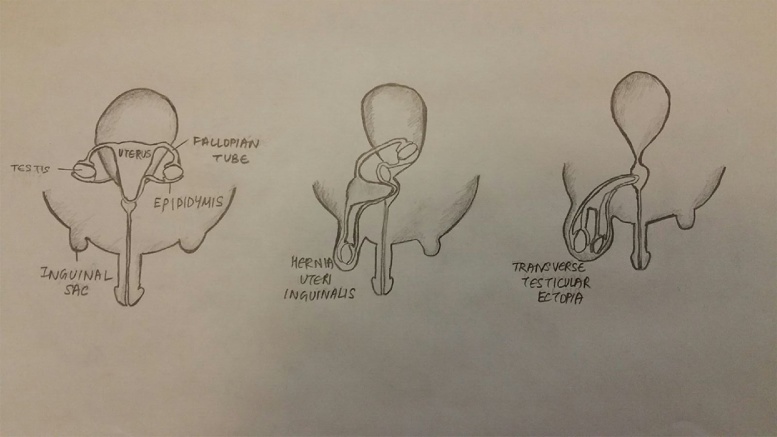
Persistent Mullerian duct syndrome (PMDS) is a rare type of male pseudohermaphroditism. Transverse testicular ectopia (TTE) is characterized by one testis moving to the opposite side and both testes traversing the same inguinal canal.
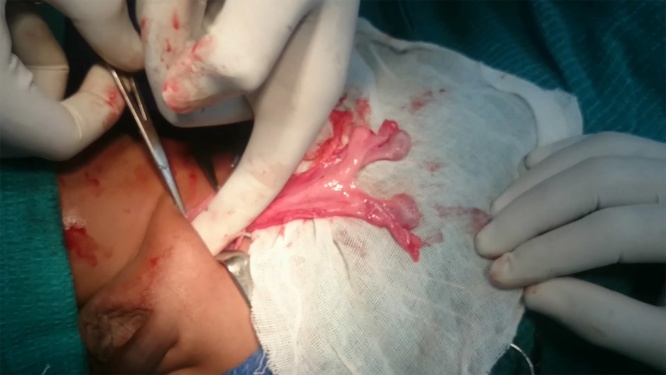
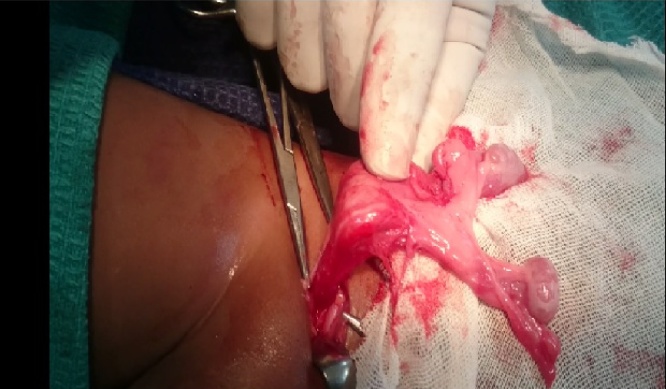
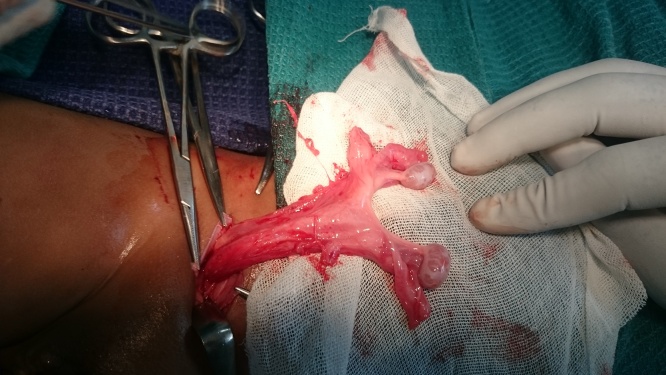
An 11-month-old boy presented with bilateral cryptorchidism. The left testis was not palpable; the right testis was canalicular with a right inguinal hernia. Ultrasound showed both testes located in the right inguinal canal. Right inguinal exploration revealed two testes with intact spermatic cords. A primitive uterus with fallopian tubes was also identified on opening the processus vaginalis. After herniotomy, bilateral orchidopexy was carried out (left orchidopexy through a trans-septal approach). Karyotyping confirmed a male gender (46XY). One year after the operation, ultrasound showed both testes to be in good condition.
PMDS is caused by defects in the gene that encodes Antimullerian hormone(AMH). Treatment aims to correct cryptorchidism and ensure appropriate scrotal placement of the testes. Malignant transformation is as likely as the presence of abdominal testes in an otherwise normal man. Failing early surgical correction, gonadectomy must be offered to prevent malignancy. Division of the persistent mullerian duct structures is indicated only in patients where persistence interferes with orchidopexy.
TTE should be suspected in patients presenting with inguinal hernia on one side and cryptorchidism on the other side. Herniotomy and bilateral orchidopexy is optimal. Removal of mullerian structures may injure the artery to vas deferens and is hence not recommended. Follow-up for fertility assessment in the latter years should be counselled.
持续性苗勒管综合征(PMDS)是一种罕见的男性假两性畸形。横位睾丸异位(TTE)的特征是一侧睾丸移至对侧,且双侧睾丸通过同一腹股沟管。
一名11个月大的男孩出现双侧隐睾。左侧睾丸无法触及;右侧睾丸位于腹股沟管内,伴有右侧腹股沟疝。超声检查显示双侧睾丸均位于右侧腹股沟管内。右侧腹股沟探查发现两个睾丸,精索完整。打开鞘状突后还发现了一个带有输卵管的原始子宫。疝修补术后,进行了双侧睾丸固定术(左侧睾丸固定术采用经中隔入路)。染色体核型分析证实为男性(46XY)。术后一年,超声检查显示双侧睾丸状况良好。
PMDS是由编码抗苗勒管激素(AMH)的基因缺陷引起的。治疗目的是纠正隐睾,并确保睾丸正确置于阴囊内。在其他方面正常的男性中,恶性转化的可能性与存在腹腔内睾丸的情况相同。若早期手术矫正失败,则必须进行性腺切除术以预防恶性肿瘤。仅在持续性苗勒管结构妨碍睾丸固定术的患者中,才考虑切断这些结构。
对于一侧有腹股沟疝而另一侧有隐睾的患者,应怀疑存在TTE。疝修补术和双侧睾丸固定术是最佳选择。切除苗勒管结构可能会损伤输精管动脉,因此不建议这样做。应建议患者在后期进行生育能力评估随访。