Mukhtar Muhammad Umer, Niazi Shehryar Ahmed Khan, Sarwar Muhammad Zeeshan, Naqi Syed Asghar
King Edward Medical University/Mayo Hospital, Lahore, Pakistan.
Department of Surgery, King Edward Medical University/Mayo Hospital, Lahore, Pakistan.
Int J Surg Case Rep. 2020;71:338-340. doi: 10.1016/j.ijscr.2020.04.035. Epub 2020 May 11.
Transverse Testicular Ectopia (TTE) is a rare entity in which both testes descend on the same side, and can be found in ectopic locations. When present with Persistent Mullerian Duct Syndrome (PMDS), a yet rarer entity, the persistence of Mullerian duct derivatives i.e. fallopian tubes, uterus, cervix and upper two-thirds of vagina occurs alongside testicular ectopia. There have only been about a hundred and fifty reported cases of TTE; a fifth of these accompanied by PMDS.
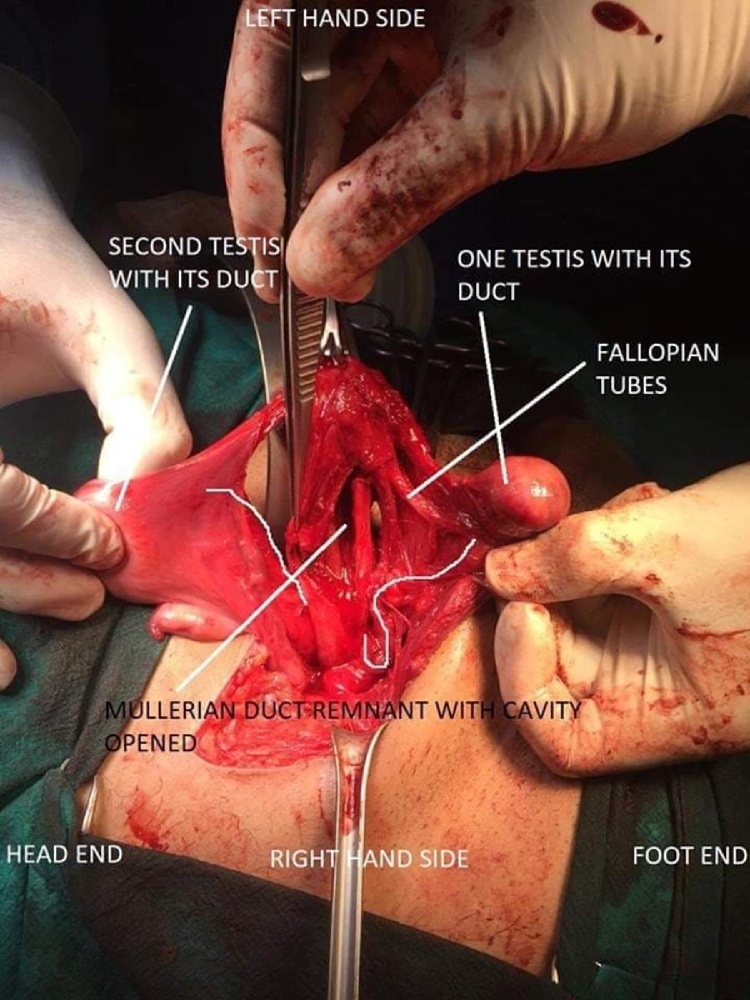
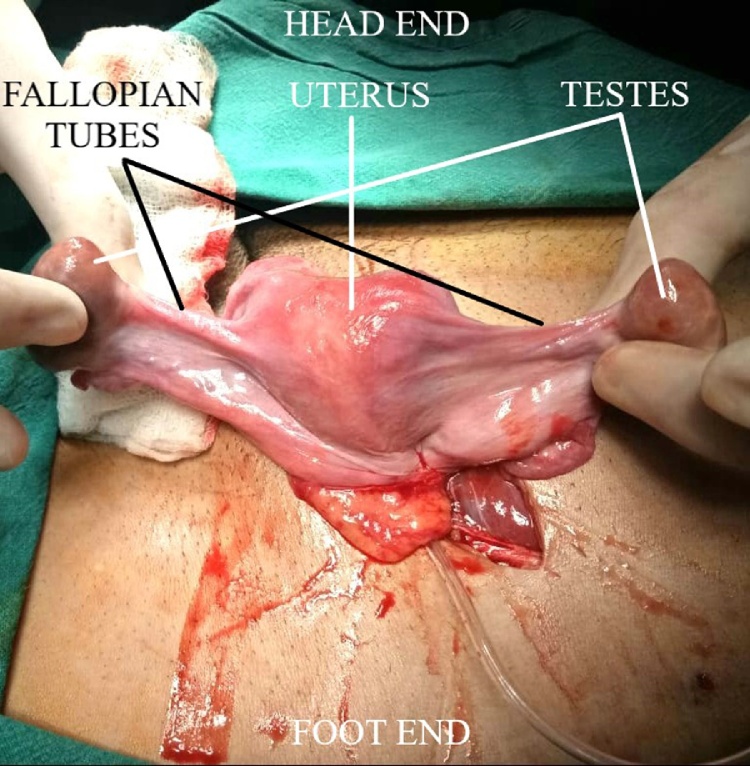
Two middle-aged male patients presented with two separate complaints of inguinoscrotal swellings. In both patients, ultrasonography showed a hernial defect protruding into the scrotum on one side and the testis absent on the contralateral side. During hernia surgery, Mullerian duct remnants were found. Diagnosis of TTE with PMDS was established. Bilateral orchidectomy was done and Mullerian derivatives were excised.
There is controversy over the treatment of TTE with PMDS. Some authors,in addition to hernia repair, advocate the preservation of Mullerian structures because of risk to injury to vas deferens while others advocate resection of these structures due to risk of carcinoma. In pediatric patients, orchidopexy should be done to preserve fertility.However, in the older age group, orchidectomy should be done due to an increased risk of testicular carcinoma.
TTE should be suspected in cases of unilateral inguinal hernia with contralateral undescended testes. Orchidectomy is recommended in patients older than 12 years old, otherwise, orchidopexy should be done. No Mullerian duct remnants should be left in situ.
睾丸横过异位(TTE)是一种罕见的情况,即双侧睾丸均降至同一侧,且可位于异位位置。当合并永存苗勒管综合征(PMDS)时,情况更为罕见,此时苗勒管衍生物即输卵管、子宫、宫颈和阴道上三分之二会与睾丸异位并存。据报道,TTE病例仅有约150例;其中五分之一合并PMDS。
两名中年男性患者分别因腹股沟阴囊肿胀前来就诊。在这两名患者中,超声检查均显示一侧有疝缺损突入阴囊,对侧睾丸缺如。在疝修补手术中,发现了苗勒管残余物。确诊为合并PMDS的TTE。进行了双侧睾丸切除术,并切除了苗勒管衍生物。
对于合并PMDS的TTE的治疗存在争议。一些作者除疝修补外,主张保留苗勒管结构,因为存在损伤输精管的风险;而另一些作者则主张切除这些结构,因为存在癌变风险。对于儿科患者,应进行睾丸固定术以保留生育能力。然而,对于年龄较大的患者,由于睾丸癌风险增加,应进行睾丸切除术。
对于单侧腹股沟疝合并对侧睾丸未降的病例,应怀疑TTE。建议对12岁以上患者进行睾丸切除术,否则应进行睾丸固定术。不应将苗勒管残余物留在原位。