Li Qiji, Ye Liping, Guo Wei, Wang Min, Huang Shuai, Peng Xinsheng
Department of Orthopaedic Surgery, the First Affiliated Hospital of Sun Yat-sen University, 510080, Guangzhou, Guangdong Province, China.
Guangdong Provincial Key Laboratory of Orthopedics and Traumatology, Guangzhou, 510080, China.
J Exp Clin Cancer Res. 2017 Jun 23;36(1):85. doi: 10.1186/s13046-017-0560-y.
PHF21B is newly identified to be involved in the tumor progression; however, its biological role and molecular mechanism in prostate cancer have not been defined. This study is aimed to study the role of PHF21B in the progression of prostate cancer.
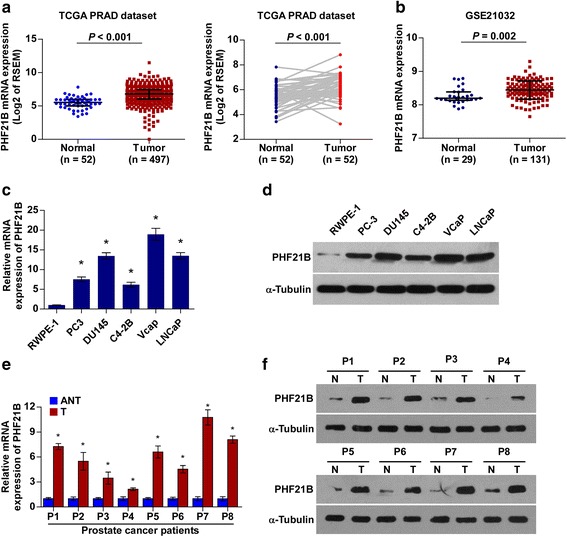
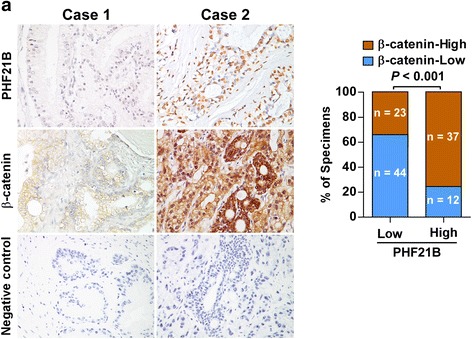
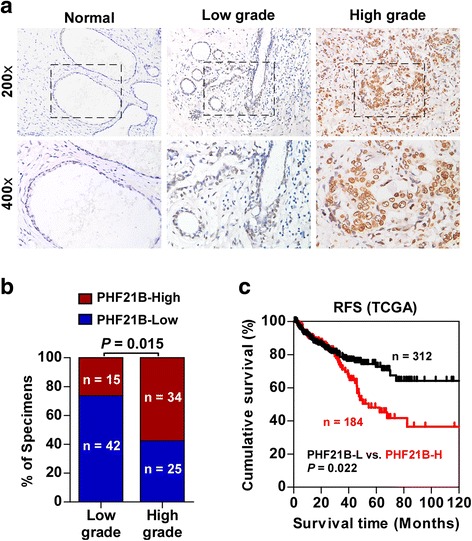
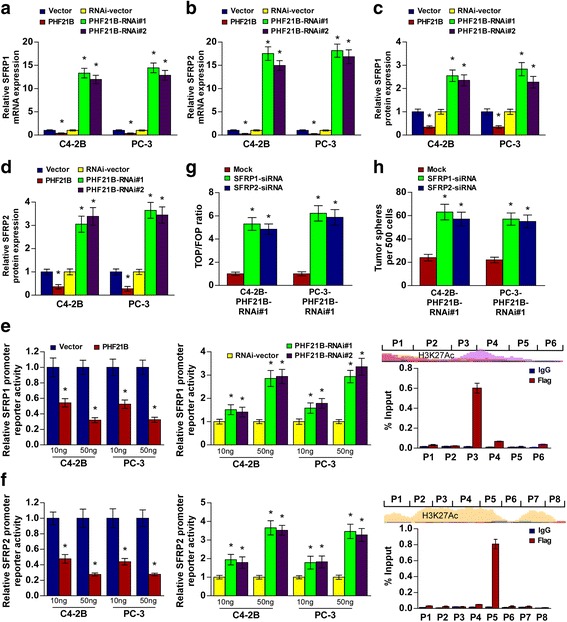
Real-time PCR, immunohistochemistry and western blotting analysis were used to determine PHF21B expression in prostate cancer cell lines and clinical specimens. The role of PHF21B in maintaining prostate cancer stem cell-like phenotype was examined by tumor-sphere formation assay and expression levels of stem cell markers. Luciferase reporter assay, western blot analysis, enzyme-linked immunosorbent assay and ChIP assay were used to determine whether PHF21B activates the Wnt/β-catenin signaling by transcriptionally downregulating SFRP1 and SFRP2.
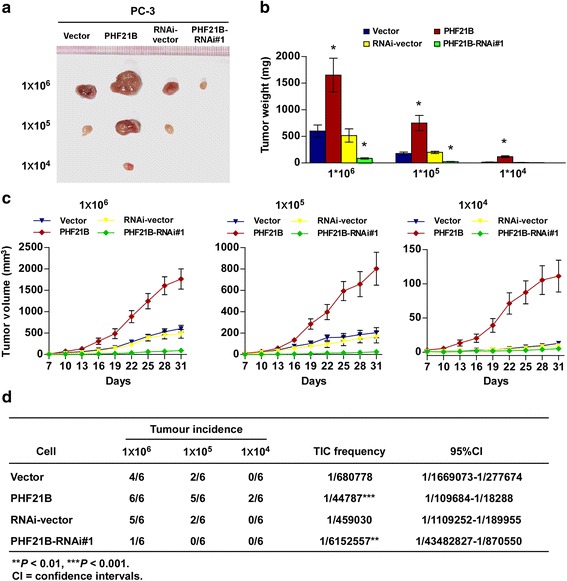
Our results revealed that PHF21B was markedly upregulated in prostate cancer cell lines and tissues. High PHF21B levels predicted poorer recurrence-free survival in prostate cancer patients. Gain-of-function and loss-of-function studies showed that overexpression of PHF21B enhanced, while downregulation suppressed, the cancer stem cell-like phenotype in prostate cancer cells. Xenograft tumor model showed that silencing PHF21B decreased the ability of tumorigenicity in vivo. Notably, Wnt/β-catenin signaling was hyperactivated in prostate cancer cells overexpressing PHF21B, and mediated PHF21B-induced cancer stem cell-like phenotype. Furthermore, PHF21B suppressed repressors of the Wnt/β-catenin signaling cascade, including SFRP1 and SFRP2. These results demonstrated that PHF21B constitutively activated wnt/β-catenin signaling by transcriptionally downregulating SFRP1 and SFRP2, which promotes prostate cancer stem cell-like phenotype.
Our results revealed that PHF21B functions as an oncogene in prostate cancer, and may represent a promising prognostic biomarker and an attractive candidate for target therapy of prostate cancer.
PHF21B最近被发现参与肿瘤进展;然而,其在前列腺癌中的生物学作用和分子机制尚未明确。本研究旨在探讨PHF21B在前列腺癌进展中的作用。
采用实时定量PCR、免疫组织化学和蛋白质免疫印迹分析来测定前列腺癌细胞系和临床标本中PHF21B的表达。通过肿瘤球形成试验和干细胞标志物的表达水平来检测PHF21B在维持前列腺癌干细胞样表型中的作用。采用荧光素酶报告基因检测、蛋白质免疫印迹分析、酶联免疫吸附测定和染色质免疫沉淀试验来确定PHF21B是否通过转录下调SFRP1和SFRP2来激活Wnt/β-连环蛋白信号通路。
我们的结果显示,PHF21B在前列腺癌细胞系和组织中显著上调。高PHF21B水平预示前列腺癌患者无复发生存期较差。功能获得和功能丧失研究表明,PHF21B的过表达增强了前列腺癌细胞中的癌干细胞样表型,而下调则抑制了该表型。异种移植肿瘤模型显示,沉默PHF21B可降低体内致瘤能力。值得注意的是,在过表达PHF21B的前列腺癌细胞中,Wnt/β-连环蛋白信号通路被过度激活,并介导了PHF21B诱导的癌干细胞样表型。此外,PHF21B抑制了Wnt/β-连环蛋白信号级联的抑制因子,包括SFRP1和SFRP2。这些结果表明,PHF21B通过转录下调SFRP1和SFRP2来组成性激活Wnt/β-连环蛋白信号通路,从而促进前列腺癌干细胞样表型。
我们的结果表明,PHF21B在前列腺癌中作为癌基因发挥作用,可能是一个有前景的预后生物标志物和前列腺癌靶向治疗的有吸引力的候选者。