Institute for Learning & Brain Sciences, University of Washington, Seattle, WA, 98195, USA.
Department of Speech and Hearing Sciences, University of Washington, Seattle, WA, 98195, USA.
Sci Rep. 2017 Jun 23;7(1):4185. doi: 10.1038/s41598-017-04471-5.
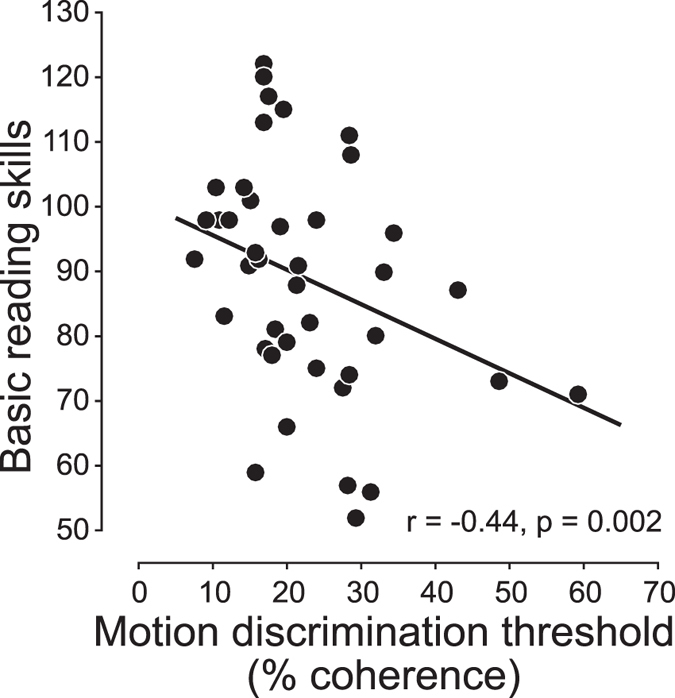
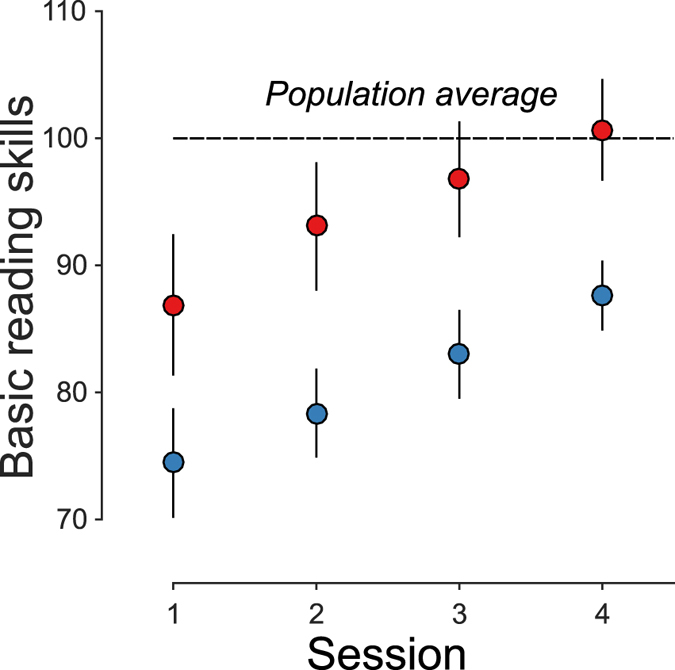
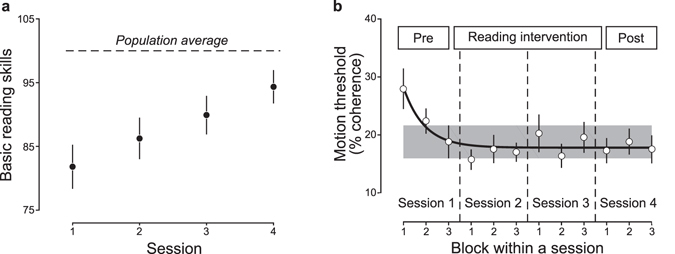
It is well established that visual sensitivity to motion is correlated with reading skills. Yet, the causal relationship between motion sensitivity and reading skills has been debated for more than thirty years. One hypothesis posits that dyslexia is caused by deficits in the motion processing pathway. An alternative hypothesis explains the motion processing deficit observed in dyslexia as the consequence of a lack, or poor quality, of reading experience. Here we used an intensive reading intervention program to test the causal relationship between learning to read and motion processing in children. Our data show that, while the reading intervention enhanced reading abilities, learning to read did not affect motion sensitivity. Motion sensitivity remained stable over the course of the intervention. Furthermore, the motion sensitivity deficit did not negatively impact the learning process. Children with poor motion sensitivity showed the same improvement in reading skills as children with typical motion sensitivity. Our findings call into question the view that motion processing deficits are due to poor reading experience. We propose that the correlation between the two measures arises from other common mechanisms, or that motion processing deficits are among a collection of correlated risk factors for reading difficulties.
众所周知,对运动的视觉敏感性与阅读技能相关。然而,三十多年来,运动敏感性和阅读技能之间的因果关系一直存在争议。一种假设认为,阅读障碍是由运动处理途径的缺陷引起的。另一种假设则将阅读障碍中观察到的运动处理缺陷解释为阅读经验的缺乏或质量差的结果。在这里,我们使用强化阅读干预计划来测试儿童阅读学习和运动处理之间的因果关系。我们的数据表明,虽然阅读干预提高了阅读能力,但阅读学习并没有影响运动敏感性。在干预过程中,运动敏感性保持稳定。此外,运动敏感性缺陷并没有对学习过程产生负面影响。运动敏感性差的孩子在阅读技能方面的提高与运动敏感性正常的孩子相同。我们的研究结果质疑了运动处理缺陷是由于阅读经验不佳的观点。我们提出,这两个指标之间的相关性源于其他共同的机制,或者运动处理缺陷是阅读困难的一系列相关风险因素之一。