Department of Psychology, Gender Development Research Centre, University of Cambridge, Cambridge, CB2 3RQ, UK.
Centre for Child and Adolescent Health, School of Social and Community Medicine, University of Bristol, Bristol, UK.
Arch Sex Behav. 2018 May;47(4):905-914. doi: 10.1007/s10508-017-1005-6. Epub 2017 Jun 23.
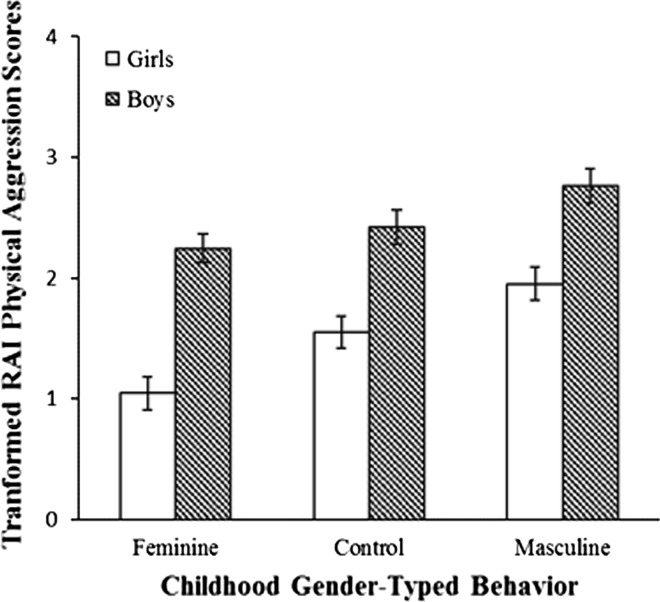
Gender differences in play behavior and physical aggression have been consistently reported. Theoretical perspectives concerning evolutionary, social, and social-cognitive mechanisms suggest that male-typical play behavior during childhood increases subsequent physical aggression. The evidence supporting these connections is limited, however. The present study investigated the association between gender-typed play behavior in early childhood and physical aggression in early adolescence using a sample drawn from a longitudinal, population study, the Avon Longitudinal Study of Parents and Children. Based on gender-typed play behavior as measured by the Pre-School Activities Inventory at age 3.5 years, samples of masculine (64 boys, 60 girls), feminine (80 boys, 66 girls), and randomly selected control children (55 boys, 67 girls) were recruited at age 13 years and administered the Reinisch Aggression Inventory. After controlling for a range of sociodemographic variables, maternal characteristics, and behavioral problems, including hyperactivity and conduct problems at age 3.5, significant group differences in physical aggression at age 13 were found among children classified as masculine, control, and feminine at age 3.5. Masculine children exhibited significantly more physical aggression than control children or feminine children, and control children exhibited significantly more physical aggression than feminine children. The association between gender-typed play behavior and physical aggression was not moderated by sex. These results suggest that the degree of childhood gender-typed play behavior independently predicts the degree of physical aggression at adolescence in boys and in girls.
性别差异在游戏行为和身体攻击方面一直有被报道。理论视角从进化、社会和社会认知机制方面指出,童年时期典型的男性游戏行为会增加随后的身体攻击。然而,支持这些联系的证据是有限的。本研究使用纵向人群研究——雅芳纵向父母与子女研究中的样本,调查了幼儿期性别典型的游戏行为与青少年早期身体攻击之间的关联。基于 3.5 岁时通过学前活动量表测量的性别典型游戏行为,3.5 岁时招募了具有男性化(64 名男孩,60 名女孩)、女性化(80 名男孩,66 名女孩)和随机选择的对照组儿童(55 名男孩,67 名女孩)样本,并在 13 岁时使用 Reinisch 攻击量表进行评估。在控制了一系列社会人口变量、母亲特征和行为问题(包括 3.5 岁时的多动和行为问题)后,在 3.5 岁时被归类为男性化、对照组和女性化的儿童中发现了身体攻击的显著群体差异。男性化儿童的身体攻击显著多于对照组或女性化儿童,而对照组儿童的身体攻击显著多于女性化儿童。性别典型游戏行为与身体攻击之间的关联不受性别的调节。这些结果表明,儿童期性别典型游戏行为的程度独立预测了男孩和女孩青春期身体攻击的程度。