Gender Development Research Centre, University of Cambridge, Free School Lane, Cambridge, CB2 3RQ, UK.
Arch Sex Behav. 2020 Feb;49(2):373-394. doi: 10.1007/s10508-019-01624-7. Epub 2020 Jan 27.
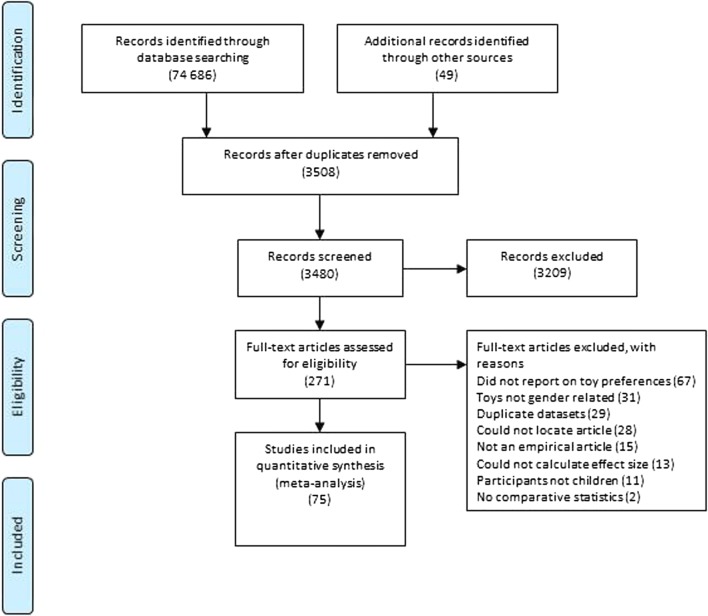
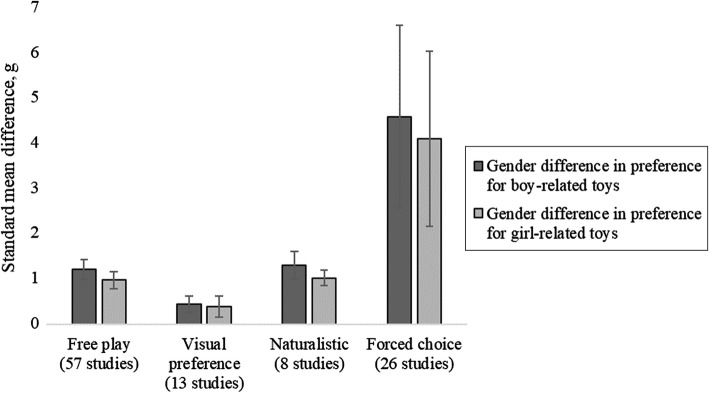
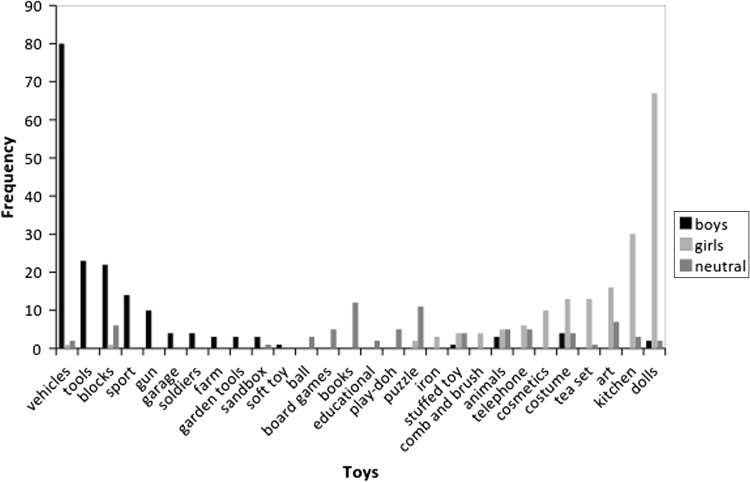
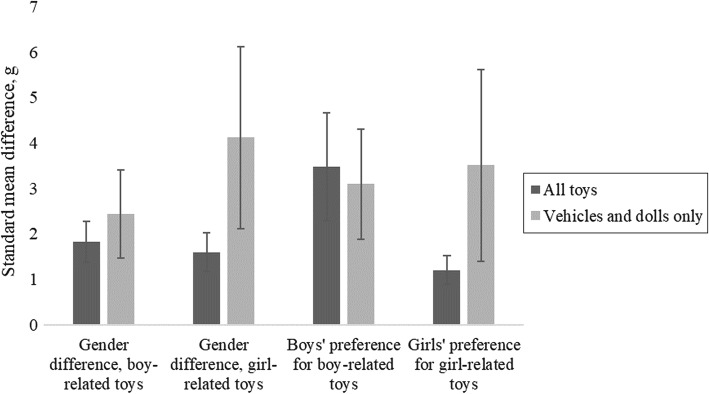
It is generally recognized that there are gender-related differences in children's toy preferences. However, the magnitude of these differences has not been firmly established. Furthermore, not all studies of gender-related toy preferences find significant gender differences. These inconsistent findings could result from using different toys or methods to measure toy preferences or from studying children of different ages. Our systematic review and meta-analysis combined 113 effect sizes from 75 studies to estimate the magnitude of gender-related differences in toy preferences. We also assessed the impact of using different toys or methods to assess these differences, as well as the effect of age on gender-related toy preferences. Boys preferred boy-related toys more than girls did, and girls preferred girl-related toys more than boys did. These differences were large (d ≥ 1.60). Girls also preferred toys that researchers classified as neutral more than boys did (d = 0.29). Preferences for gender-typical over gender-atypical toys were also large and significant (d ≥ 1.20), and girls and boys showed gender-related differences of similar magnitude. When only dolls and vehicles were considered, within-sex differences were even larger and of comparable size for boys and girls. Researchers sometimes misclassified toys, perhaps contributing to an apparent gender difference in preference for neutral toys. Forced choice methods produced larger gender-related differences than other methods, and gender-related differences increased with age.
人们普遍认为,儿童对玩具的偏好存在性别差异。然而,这些差异的程度尚未得到确定。此外,并非所有关于性别相关玩具偏好的研究都发现了显著的性别差异。这些不一致的发现可能是由于使用不同的玩具或方法来测量玩具偏好,或者由于研究不同年龄的儿童。我们的系统评价和荟萃分析结合了 75 项研究中的 113 个效应量,以估计性别相关玩具偏好的差异程度。我们还评估了使用不同的玩具或方法来评估这些差异的影响,以及年龄对性别相关玩具偏好的影响。男孩比女孩更喜欢与男孩相关的玩具,女孩比男孩更喜欢与女孩相关的玩具。这些差异很大(d≥1.60)。女孩也比男孩更喜欢研究人员归类为中性的玩具(d=0.29)。对典型性别玩具的偏好也很大且显著(d≥1.20),且男孩和女孩的性别相关差异程度相似。当只考虑娃娃和车辆时,同性别之间的差异更大,男孩和女孩的差异大小相当。研究人员有时会错误地分类玩具,这可能导致对中性玩具偏好的明显性别差异。强制选择方法产生的性别相关差异大于其他方法,性别相关差异随年龄增长而增加。