Kim Chong H, Simmons Sierra C, Williams Lance A, Staley Elizabeth M, Zheng X Long, Pham Huy P
Department of Clinical Pharmacy, University of Colorado Anschutz Medical Campus, Aurora, Colorado.
Division of Laboratory Medicine, Department of Pathology, University of Alabama at Birmingham, Birmingham, Alabama.
Transfusion. 2017 Nov;57(11):2609-2618. doi: 10.1111/trf.14230. Epub 2017 Jun 23.
The ADAMTS13 test distinguishes thrombotic thrombocytopenic purpura (TTP) from other thrombotic microangiopathies (TMAs). The PLASMIC score helps determine the pretest probability of ADAMTS13 deficiency. Due to inherent limitations of both tests, and potential adverse effects and cost of unnecessary treatments, we performed a cost-effectiveness analysis (CEA) investigating the benefits of incorporating an in-hospital ADAMTS13 test and/or PLASMIC score into our clinical practice.
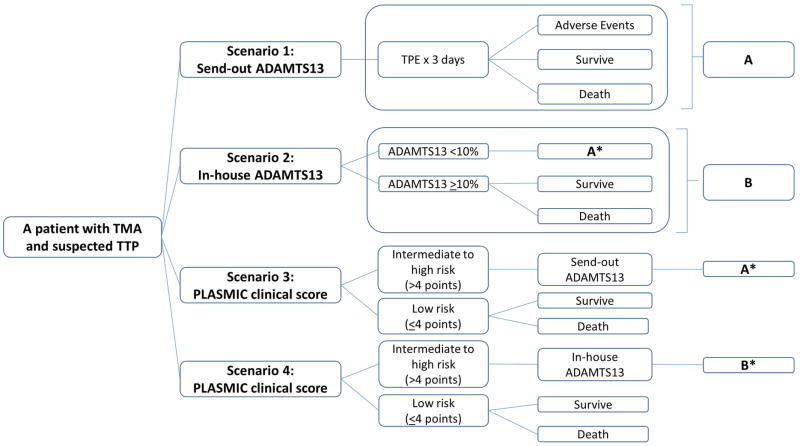
A CEA model was created to compare four scenarios for patients with TMAs, utilizing either an in-house or a send-out ADAMTS13 assay with or without prior risk stratification using PLASMIC scoring. Model variables, including probabilities and costs, were gathered from the medical literature, except for the ADAMTS13 send-out and in-house tests, which were obtained from our institutional data.
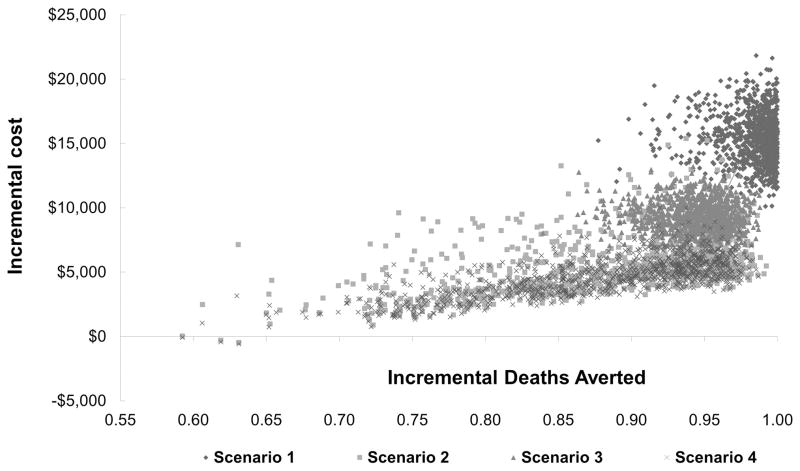
If only the cost is considered, in-house ADAMTS13 test for patients with intermediate- to high-risk PLASMIC score is the least expensive option ($4,732/patient). If effectiveness is assessed as measured by the number of averted deaths, send-out ADAMTS13 test is the most effective. Considering the cost/effectiveness ratio, the in-house ADAMTS13 test in patients with intermediate- to high-risk PLASMIC score is the best option, followed by the in-house ADAMTS13 test without the PLASMIC score.
In patients with clinical presentations of TMAs, having an in-hospital ADAMTS13 test to promptly establish the diagnosis of TTP appears to be cost-effective. Utilizing the PLASMIC score further increases the cost-effectiveness of the in-house ADAMTS13 test. Our findings indicate the benefit of having a rapid and reliable in-house ADAMTS13 test, especially in the tertiary medical center.
ADAMTS13检测可将血栓性血小板减少性紫癜(TTP)与其他血栓性微血管病(TMA)区分开来。PLASMIC评分有助于确定ADAMTS13缺乏的预检概率。由于这两种检测方法都存在固有局限性,以及不必要治疗的潜在不良反应和成本,我们进行了一项成本效益分析(CEA),以研究将院内ADAMTS13检测和/或PLASMIC评分纳入临床实践的益处。
创建了一个CEA模型,用于比较TMA患者的四种情况,即使用内部或外部ADAMTS13检测,以及是否使用PLASMIC评分进行风险分层。除了从我们机构数据中获取的ADAMTS13外部和内部检测外,模型变量(包括概率和成本)均从医学文献中收集。
如果仅考虑成本,对于中高风险PLASMIC评分的患者,内部ADAMTS13检测是最便宜的选择(每位患者4732美元)。如果以避免死亡的数量来评估有效性,外部ADAMTS13检测是最有效的。考虑成本效益比,中高风险PLASMIC评分患者的内部ADAMTS13检测是最佳选择,其次是不使用PLASMIC评分的内部ADAMTS13检测。
对于有TMA临床表现的患者,在院内进行ADAMTS13检测以迅速确诊TTP似乎具有成本效益。使用PLASMIC评分进一步提高了内部ADAMTS13检测的成本效益。我们的研究结果表明,拥有快速可靠的内部ADAMTS13检测是有益的,尤其是在三级医疗中心。