Coldiron Matthew E, Alcoba Gabriel, Ciglenecki Iza, Hitchings Matt, Djibo Ali, Page Anne-Laure, Langendorf Celine, Grais Rebecca F
Epicentre, 8 rue Saint-Sabin, Paris, France.
Médecins Sans Frontières, 78 rue de Lausanne, Geneva, Switzerland.
Trials. 2017 Jun 24;18(1):294. doi: 10.1186/s13063-017-2028-y.
Epidemics of meningococcal meningitis are common in the "African meningitis belt." Current response strategies include reactive vaccination campaigns, which are often organized too late to have maximal impact. A novel strain of Neisseria meningitidis serogroup C has been circulating in recent years, and vaccine supplies are limited. An evaluation of chemoprophylaxis with single-dose ciprofloxacin for household contacts of meningitis cases has therefore been recommended.
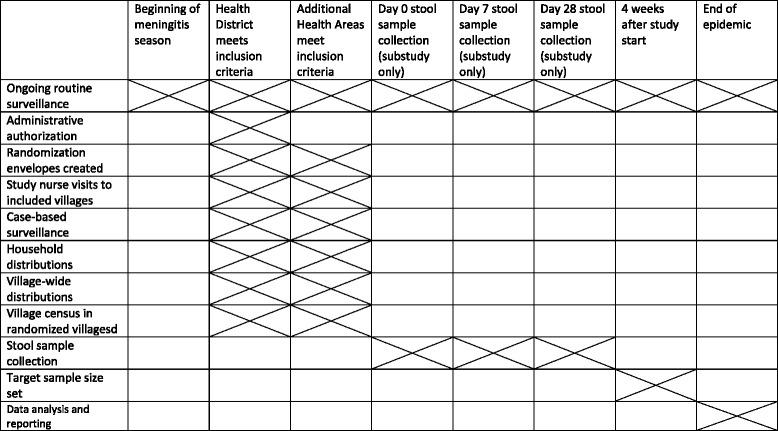
METHODS/DESIGN: A three-arm cluster-randomized trial has been designed for implementation during a meningococcal meningitis epidemic in a health district in Niger in which at least two Health Zones (HZs) have met the weekly epidemic threshold. The primary outcome is the incidence (attack rate) of meningitis during the epidemic. Villages will be randomized in a 1:1:1 ratio to one of three different arms: standard care, household-level prophylaxis, or village-wide prophylaxis. After study launch, when a case of meningococcal meningitis is identified in an HZ, the first reported case from a village will trigger the inclusion and randomization of the village. Household-level prophylaxis with single-dose ciprofloxacin will be offered in the home to all household members within 24 hours of the notification of the case, and village-wide distributions will occur within 72 hours of the notification of the case. The sample size necessary to detect differences between each of the two intervention arms and the standard care arm will be set after 4 weeks of data collection, in order to quantify multiple variables that could be particular to a given area. The primary analysis will compare attack rates at the end of the epidemic in each of the three arms. A nested sub-study will assess the effects of ciprofloxacin prophylaxis on the prevalence of ciprofloxacin-resistant enterobacteriaceae. A total of 200 participants in the standard care arm and 200 in the village-wide prophylaxis arm will provide stool samples at days 0, 7, and 28 following their village's inclusion in the study.
An innovative trial is proposed for implementation during an epidemic that will assess the impact of a novel strategy for meningitis outbreak response. In parallel, we will describe potential negative effects of the intervention.
ClinicalTrials.gov, NCT02724046 . Registered on 15 March 2016. Last updated on 13 June 2017.
脑膜炎球菌性脑膜炎在“非洲脑膜炎带”很常见。当前的应对策略包括反应性疫苗接种运动,但这些运动往往组织得太晚,无法产生最大影响。近年来,一种新型的C群脑膜炎奈瑟菌一直在传播,且疫苗供应有限。因此,有人建议对脑膜炎病例的家庭接触者采用单剂量环丙沙星进行化学预防评估。
方法/设计:一项三臂整群随机试验已设计好,将在尼日尔一个卫生区的脑膜炎球菌性脑膜炎疫情期间实施,该卫生区至少有两个卫生区(HZ)达到每周疫情阈值。主要结局是疫情期间脑膜炎的发病率(罹患率)。村庄将按1:1:1的比例随机分为三个不同的组:标准护理组、家庭层面预防组或全村预防组。研究启动后,当在一个卫生区发现一例脑膜炎球菌性脑膜炎病例时,来自一个村庄的首例报告病例将触发该村庄的纳入和随机分组。在病例通报后24小时内,将在家庭中为所有家庭成员提供单剂量环丙沙星进行家庭层面预防,在病例通报后72小时内进行全村分发。在收集4周数据后,将确定检测两个干预组与标准护理组之间差异所需的样本量,以便量化特定地区可能存在的多个变量。主要分析将比较三个组在疫情结束时的罹患率。一项嵌套子研究将评估环丙沙星预防对耐环丙沙星肠杆菌科细菌流行率的影响。标准护理组的200名参与者和全村预防组的200名参与者将在其村庄纳入研究后的第0天、第7天和第28天提供粪便样本。
提议在疫情期间实施一项创新试验,以评估一种新型脑膜炎疫情应对策略的影响。同时,我们将描述该干预措施可能产生的负面影响。
ClinicalTrials.gov,NCT02724046。于2016年3月15日注册。最后更新于2017年6月13日。