Rude Julius Monday, Kortimai Lavele, Mosoka Fallah, April Baller, Nuha Mouhamoud, Katawera Victoria, Nagbe Thomas, Tamba Alpha, Desmound Williams, Mulbah Richard, Pierre Formenty, Onuche Emmanuel Musa, Chukwudi Joseph Okeibunor, Talisuna Ambrose, Yahaya Ali Ahmed, Rajatonirina Soatiana, Nyenswah Tolbert, Dahn Bernice, Gasasira Alex, Fall Ibrahima Socé
World Health Organization, Monrovia, Liberia.
Ministry of Health, Voinjama, Liberia.
Pan Afr Med J. 2019 May 29;33(Suppl 2):6. doi: 10.11604/pamj.supp.2019.33.2.17095. eCollection 2019.
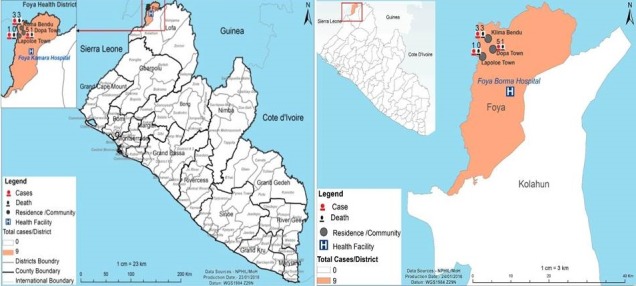
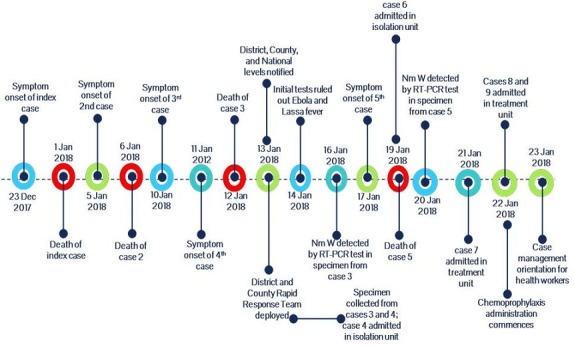
Early detection of disease outbreaks is paramount to averting associated morbidity and mortality. In January 2018, nine cases including four deaths associated with meningococcal disease were reported in three communities of Foya district, Lofa County, Liberia. Due to the porous borders between Lofa County and communities in neighboring Sierra Leone and Guinea, the possibility of epidemic spread of meningococcal disease could not be underestimated.
The county incidence management system (IMS) was activated that coordinated the response activities. Daily meetings were conducted to review response activities progress and challenges. The district rapid response team (DRRT) was the frontline responders. The case based investigation form; case line list and contacts list were used for data collection. A data base was established and analysed daily for action. Tablets Ciprofloxacin were given for chemoprophylaxis.
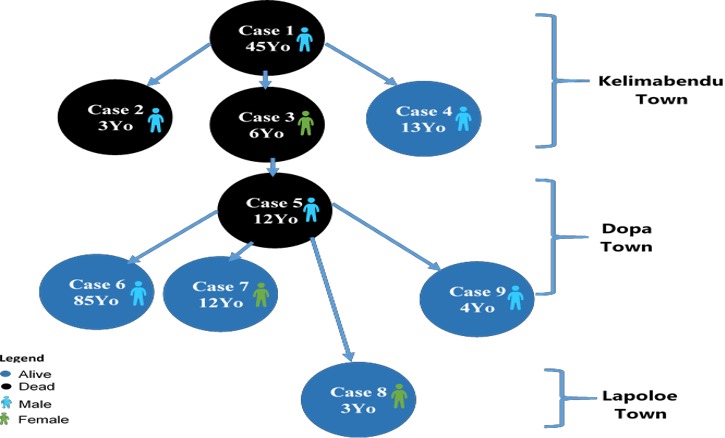
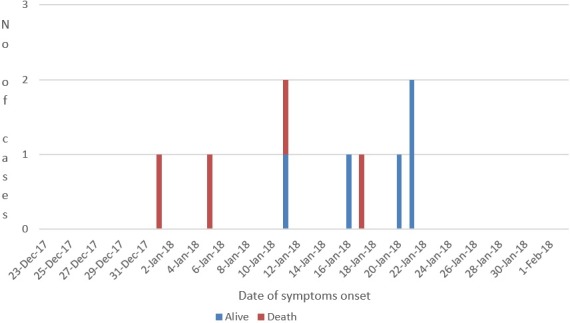
Sixty-seven percent (67%) of the cases were males and also 67% of the affected age range was 3 to 14 years and attending primary school. The attack rate was 7/1,000 population and case fatality rate was 44.4 % with majority of the deaths occurring within 24-48 hours of symptoms onset. Three of the cases tested positive for Neisseria Meningitidis sero-type W while six cases were Epi-linked. None of the cases had recent meningococcal vaccination and no health-worker infections were registered.
This cluster of cases of meningococcal disease during the meningitis season in a country that is not traditionally part of the meningitis belt emphasized the need for strengthening surveillance, preparedness and response capacity to meningitis.
尽早发现疾病爆发对于避免相关的发病率和死亡率至关重要。2018年1月,利比里亚洛法县福亚区的三个社区报告了9例包括4例与脑膜炎球菌病相关死亡的病例。由于洛法县与邻国塞拉利昂和几内亚社区之间边境管控不严,脑膜炎球菌病流行传播的可能性不容小觑。
启动了县发病率管理系统(IMS)来协调应对活动。每天召开会议以审查应对活动的进展和挑战。地区快速反应小组(DRRT)是一线响应者。使用基于病例的调查表、病例一览表和联系人名单进行数据收集。建立了一个数据库并每天进行分析以便采取行动。给予环丙沙星片进行化学预防。
67%的病例为男性,受影响年龄范围的67%为3至14岁且就读于小学。发病率为7/1000人口,病死率为44.4%,大多数死亡发生在症状出现后的24至48小时内。3例病例脑膜炎奈瑟菌血清W型检测呈阳性,6例病例存在流行病学关联。所有病例近期均未接种脑膜炎球菌疫苗,也未记录到卫生工作者感染情况。
在一个传统上不属于脑膜炎带的国家,脑膜炎季节期间出现的这组脑膜炎球菌病病例强调了加强对脑膜炎的监测、防范和应对能力的必要性。