Farrar Diane, Simmonds Mark, Bryant Maria, Sheldon Trevor A, Tuffnell Derek, Golder Su, Lawlor Debbie A
Bradford Institute for Health Research, Bradford Royal Infirmary, Bradford, UK.
Centre for Reviews and Dissemination, University of York, York, UK.
BMJ Open. 2017 Jun 24;7(6):e015557. doi: 10.1136/bmjopen-2016-015557.
To investigate the effectiveness of different treatments for gestational diabetes mellitus (GDM).
Systematic review, meta-analysis and network meta-analysis.
Data sources were searched up to July 2016 and included MEDLINE and Embase. Randomised trials comparing treatments for GDM (packages of care (dietary and lifestyle interventions with pharmacological treatments as required), insulin, metformin, glibenclamide (glyburide)) were selected by two authors and double checked for accuracy. Outcomes included large for gestational age, shoulder dystocia, neonatal hypoglycaemia, caesarean section and pre-eclampsia. We pooled data using random-effects meta-analyses and used Bayesian network meta-analysis to compare pharmacological treatments (ie, including treatments not directly compared within a trial).
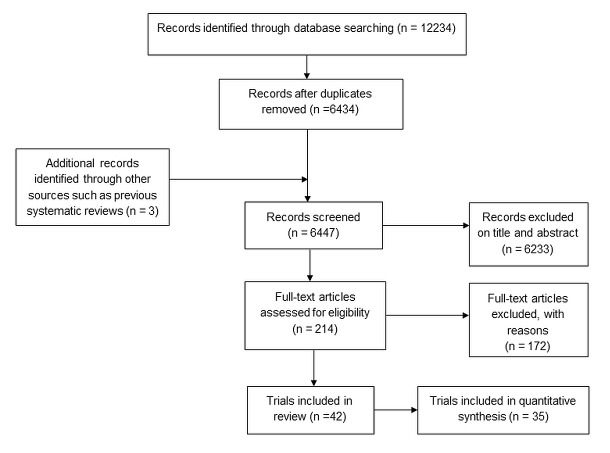
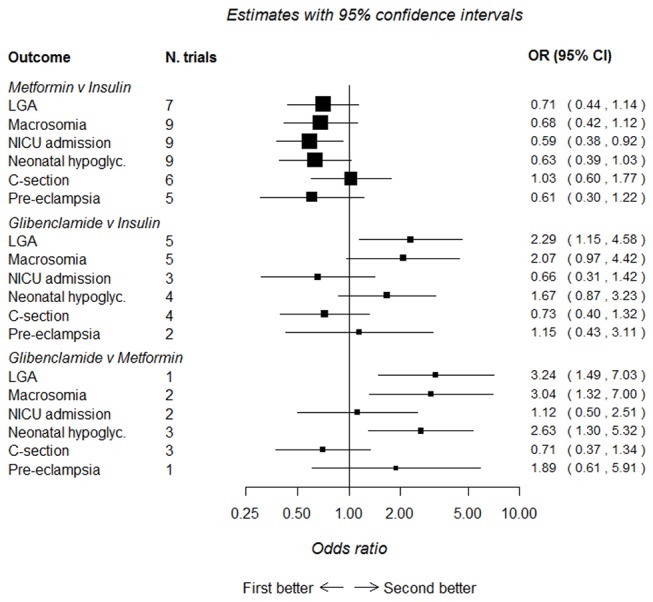
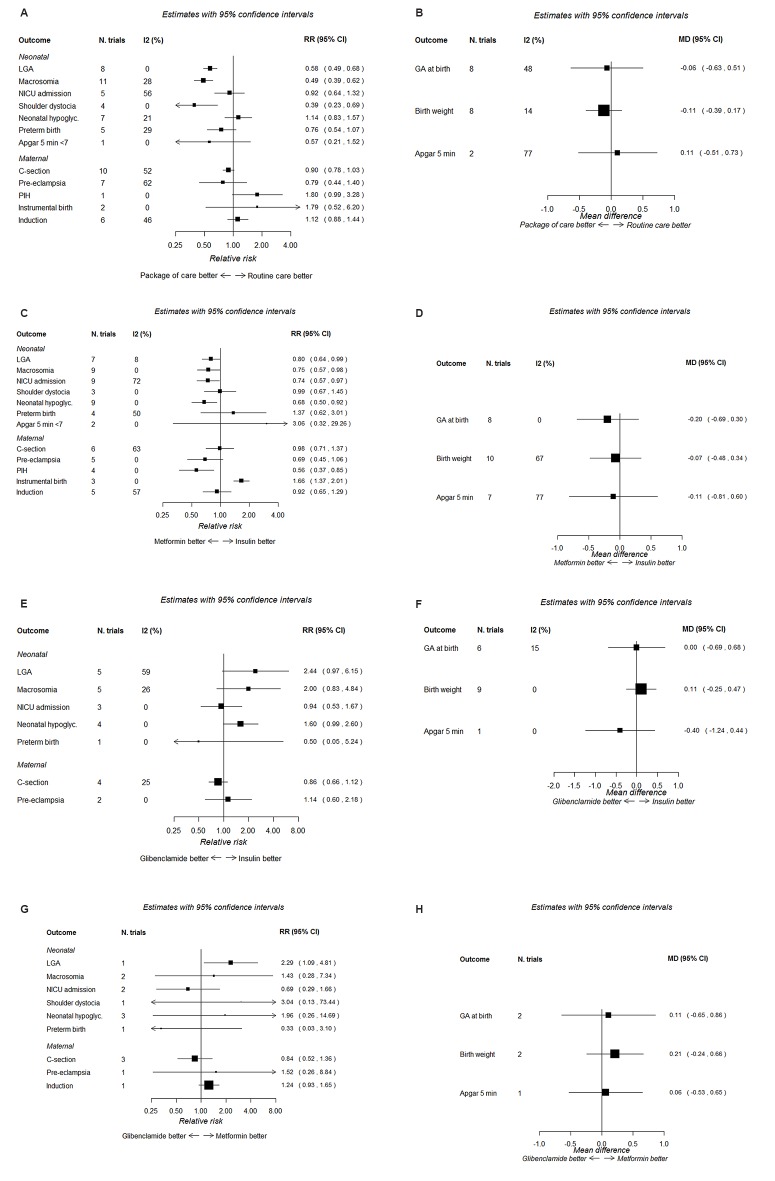
Forty-two trials were included, the reporting of which was generally poor with unclear or high risk of bias. Packages of care varied in their composition and reduced the risk of most adverse perinatal outcomes compared with routine care (eg, large for gestational age: relative risk0.58 (95% CI 0.49 to 0.68; I=0%; trials 8; participants 3462). Network meta-analyses suggest that metformin had the highest probability of being the most effective treatment in reducing the risk of most outcomes compared with insulin or glibenclamide.
Evidence shows that packages of care are effective in reducing the risk of most adverse perinatal outcomes. However, trials often include few women, are poorly reported with unclear or high risk of bias and report few outcomes. The contribution of each treatment within the packages of care remains unclear. Large well-designed and well-conducted trials are urgently needed.
PROSPERO CRD42013004608.
探讨不同治疗方法对妊娠期糖尿病(GDM)的疗效。
系统评价、荟萃分析和网状荟萃分析。
检索截至2016年7月的数据源,包括MEDLINE和Embase。由两位作者选择比较GDM治疗方法(护理套餐(饮食和生活方式干预,必要时采用药物治疗)、胰岛素、二甲双胍、格列本脲(优降糖))的随机试验,并进行准确性的二次核对。结局包括大于胎龄儿、肩难产、新生儿低血糖、剖宫产和子痫前期。我们采用随机效应荟萃分析合并数据,并使用贝叶斯网状荟萃分析比较药物治疗(即包括在一项试验中未直接比较的治疗方法)。
纳入42项试验,其报告质量普遍较差,存在不明确或高偏倚风险。护理套餐的组成各不相同,与常规护理相比,降低了大多数围产期不良结局的风险(例如,大于胎龄儿:相对风险0.58(95%CI 0.49至0.68;I²=0%;试验8项;参与者3462名)。网状荟萃分析表明,与胰岛素或格列本脲相比,二甲双胍在降低大多数结局风险方面最有效的可能性最高。
证据表明,护理套餐在降低大多数围产期不良结局风险方面有效。然而,试验通常纳入的女性较少,报告质量差,存在不明确或高偏倚风险,且报告的结局较少。护理套餐中每种治疗方法的作用仍不明确。迫切需要开展大型、设计良好且实施得当的试验。
PROSPERO CRD42013004608。