Donninelli Gloria, Del Cornò Manuela, Pierdominici Marina, Scazzocchio Beatrice, Varì Rosaria, Varano Barbara, Pacella Ilenia, Piconese Silvia, Barnaba Vincenzo, D'Archivio Massimo, Masella Roberta, Conti Lucia, Gessani Sandra
Center for Gender-Specific Medicine, Istituto Superiore di Sanità, Rome, Italy.
Dipartimento di Medicina Interna e Specialità Mediche, Sapienza Università di Roma, Rome, Italy.
Front Immunol. 2017 Jun 9;8:643. doi: 10.3389/fimmu.2017.00643. eCollection 2017.
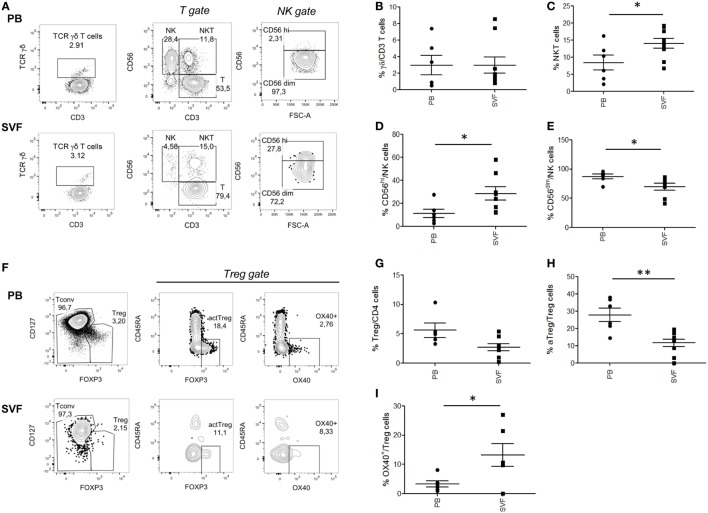
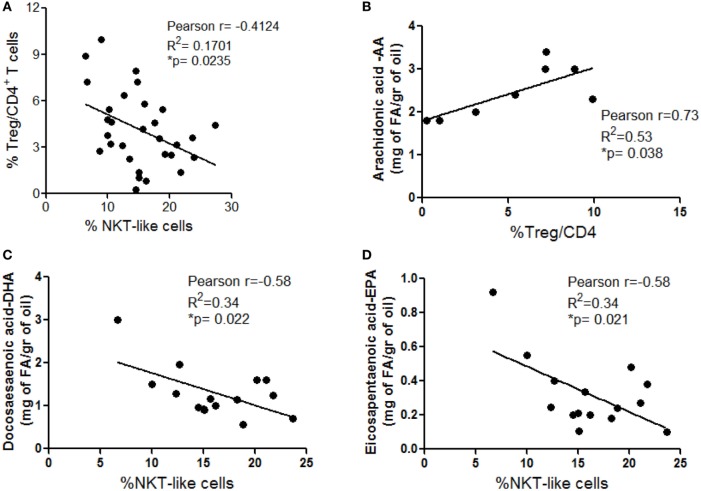
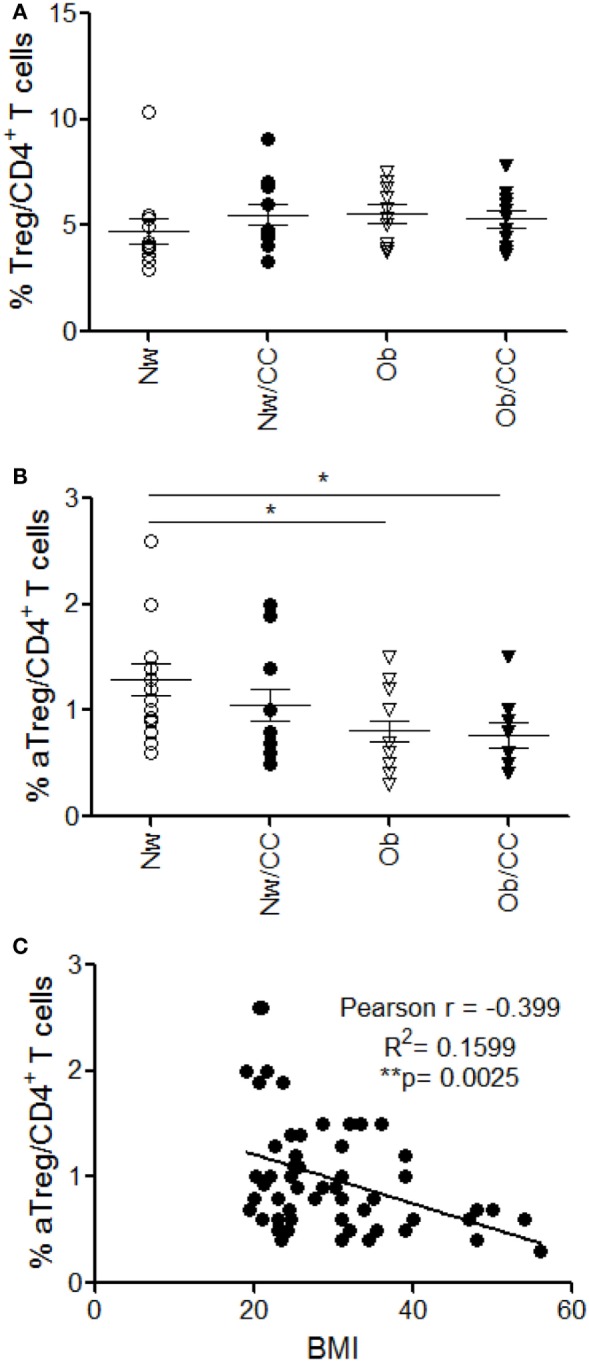
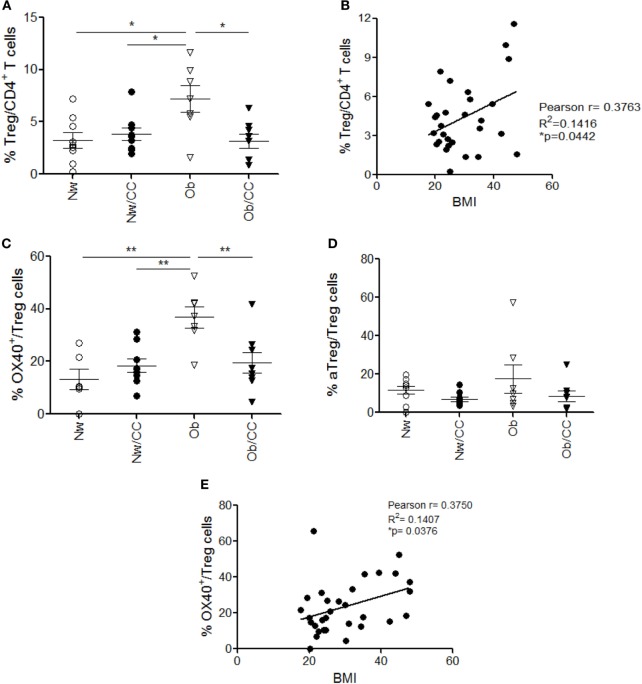
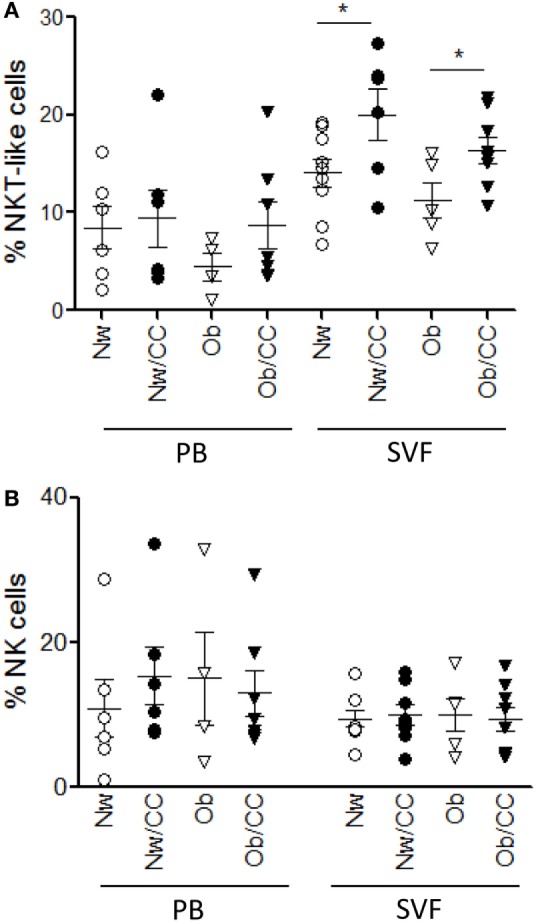
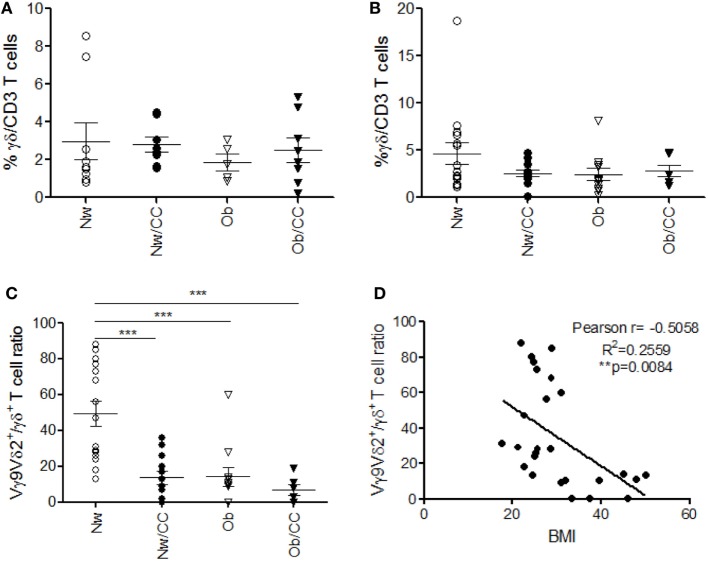
Visceral adipose tissue (VAT) is a main site where metabolic and immunologic processes interplay to regulate, at local and systemic level, the inflammatory status and immune response. Obesity-associated inflammation and immune dysfunctions are inextricably linked to tumor but, in spite of intense efforts, the mechanisms underpinning this association remain elusive. In this report, we characterized the profile of VAT-associated and circulating innate lymphocyte and regulatory T (T) cell subsets underlying inflammatory conditions, such as obesity and colorectal cancer (CRC). Analysis of NK, NKT-like, γδ T, and T cell populations in VAT and blood of healthy lean subjects revealed that CD56 NK and OX40 T cells are more abundant in VAT with respect to blood. Conversely, CD56 NK and total T cells are most present in the circulation, while γδ T lymphocytes are uniformly distributed in the two compartments. Interestingly, a reduced frequency of circulating activated T cells, and a concomitant preferential enrichment of OX40-expressing T cells in VAT, were selectively observed in obese (Ob) subjects, and directly correlated with body mass index. Likewise, CRC patients were characterized by a specific enrichment of VAT-associated NKT-like cells. In addition, Ob and CRC-affected individuals shared a significant reduction of the Vγ9Vδ2/γδ T cell ratio at systemic level. The alterations in the relative proportions of T and NKT-like cells in VAT were found to correlate with the content of pro- and anti-inflammatory polyunsaturated fatty acids (PUFA), respectively. Overall, these results provide evidence for distinct alterations of the immune cell repertoire in the periphery with respect to the VAT microenvironment that uniquely characterize or are shared by different inflammatory conditions, such as obesity and CRC, and suggest that VAT PUFA composition may represent one of the factors that contribute to shape the immune phenotypes.
内脏脂肪组织(VAT)是代谢和免疫过程相互作用以在局部和全身水平调节炎症状态和免疫反应的主要部位。肥胖相关的炎症和免疫功能障碍与肿瘤有着千丝万缕的联系,但尽管付出了巨大努力,这种关联背后的机制仍然难以捉摸。在本报告中,我们描述了肥胖和结直肠癌(CRC)等炎症状态下,VAT相关和循环中的固有淋巴细胞及调节性T细胞亚群的特征。对健康瘦受试者的VAT和血液中的NK、NKT样、γδT和T细胞群体进行分析发现,与血液相比,CD56 NK和OX40 T细胞在VAT中更为丰富。相反,CD56 NK和总T细胞在循环中最为常见,而γδT淋巴细胞在这两个隔室中分布均匀。有趣的是,在肥胖(Ob)受试者中选择性地观察到循环中活化T细胞的频率降低,以及VAT中表达OX40的T细胞同时出现优先富集,且与体重指数直接相关。同样,CRC患者的特征是VAT相关的NKT样细胞特异性富集。此外,Ob患者和CRC患者在全身水平上的Vγ9Vδ2/γδT细胞比例均显著降低。发现VAT中T细胞和NKT样细胞的相对比例变化分别与促炎和抗炎多不饱和脂肪酸(PUFA)的含量相关。总体而言,这些结果为外周免疫细胞库相对于VAT微环境的不同改变提供了证据,这些改变独特地表征或为肥胖和CRC等不同炎症状态所共有,并表明VAT的PUFA组成可能是有助于塑造免疫表型的因素之一。