Krueger-Hadfield Stacy A, Kollars Nicole M, Strand Allan E, Byers James E, Shainker Sarah J, Terada Ryuta, Greig Thomas W, Hammann Mareike, Murray David C, Weinberger Florian, Sotka Erik E
Department of Biology University of Alabama at Birmingham Birmingham AL USA.
Grice Marine Laboratory and the Department of Biology College of Charleston Charleston SC USA.
Ecol Evol. 2017 May 11;7(12):4432-4447. doi: 10.1002/ece3.3001. eCollection 2017 Jun.
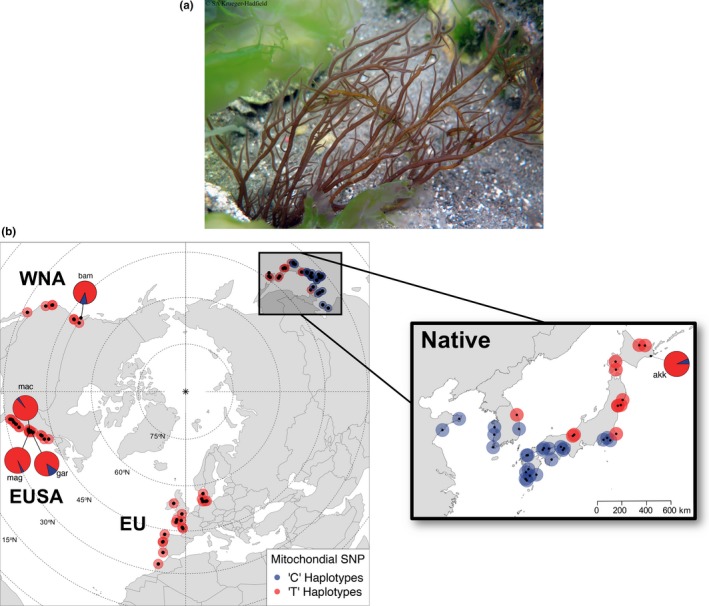
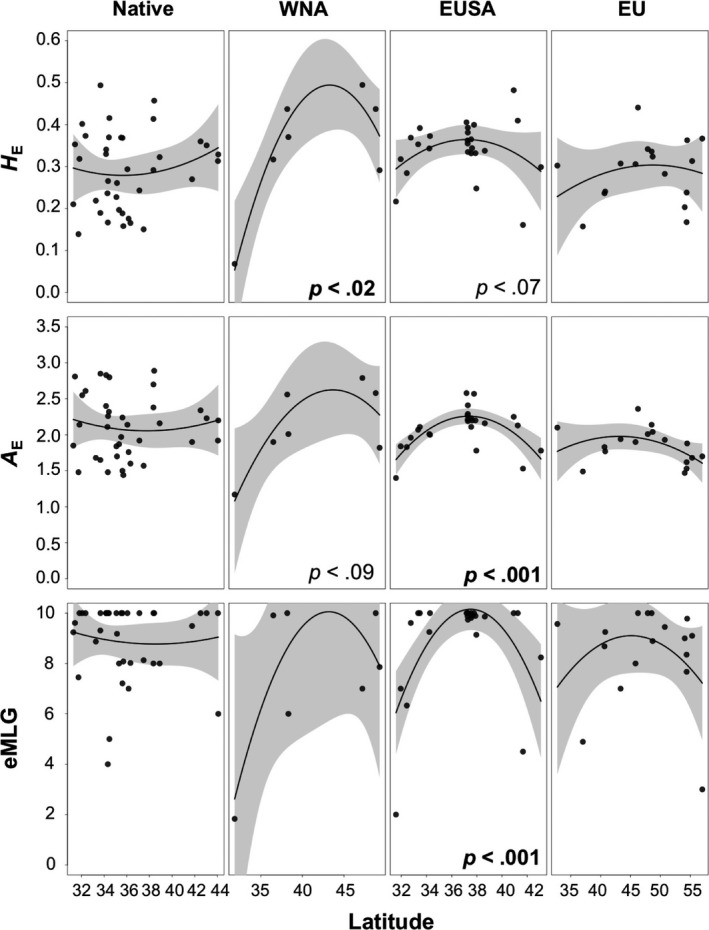
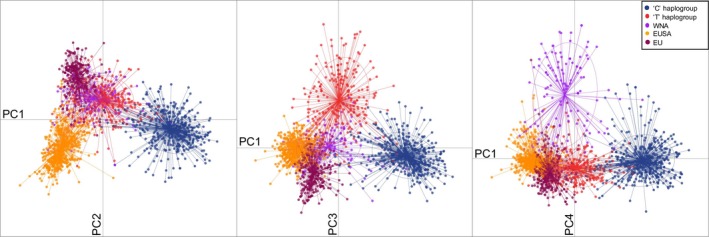
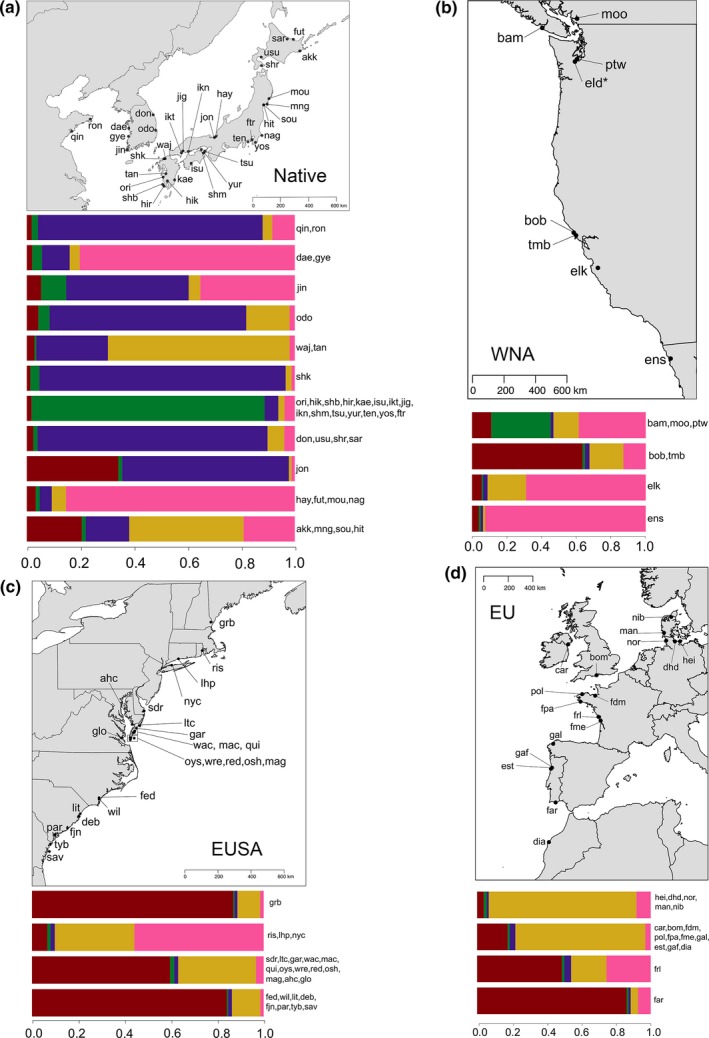
The identification of native sources and vectors of introduced species informs their ecological and evolutionary history and may guide policies that seek to prevent future introductions. Population genetics provides a powerful set of tools to identify origins and vectors. However, these tools can mislead when the native range is poorly sampled or few molecular markers are used. Here, we traced the introduction of the Asian seaweed (Rhodophyta) into estuaries in coastal western North America, the eastern United States, Europe, and northwestern Africa by genotyping more than 2,500 thalli from 37 native and 53 non-native sites at mitochondrial 1 and 10 nuclear microsatellite loci. Overall, greater than 90% of introduced thalli had a genetic signature similar to thalli sampled from the coastline of northeastern Japan, strongly indicating this region served as the principal source of the invasion. Notably, northeastern Japan exported the vast majority of the oyster during the 20th century. The preponderance of evidence suggests may have been inadvertently introduced with shipments and that northeastern Japan is a common source region for estuarine invaders. Each invaded coastline reflected a complex mix of direct introductions from Japan and secondary introductions from other invaded coastlines. The spread of along each coastline was likely facilitated by aquaculture, fishing, and boating activities. Our ability to document a source region was enabled by a robust sampling of locations and loci that previous studies lacked and strong phylogeographic structure along native coastlines.
确定外来物种的原生来源和传播媒介有助于了解它们的生态和进化历史,并可为旨在防止未来物种引入的政策提供指导。群体遗传学提供了一套强大的工具来确定物种的起源和传播媒介。然而,当原生分布区采样不足或使用的分子标记较少时,这些工具可能会产生误导。在这里,我们通过对来自37个原生地和53个非原生地的2500多个藻体在1个线粒体和10个核微卫星位点进行基因分型,追踪了亚洲海藻(红藻门)被引入北美西部沿海、美国东部、欧洲和非洲西北部河口的情况。总体而言,超过90%的引入藻体具有与从日本东北部海岸线采集的藻体相似的遗传特征,这有力地表明该地区是入侵的主要来源地。值得注意的是,日本东北部在20世纪出口了绝大多数牡蛎。大量证据表明, 可能是随牡蛎运输而无意间被引入的,并且日本东北部是河口入侵物种的一个常见来源地。每个入侵的海岸线都反映了来自日本的直接引入和来自其他入侵海岸线的二次引入的复杂混合情况。 沿着每条海岸线的扩散可能是由水产养殖、捕鱼和划船活动促成的。我们能够确定一个来源地,这得益于对地点和位点进行了全面的采样,而这是以往研究中所缺乏的,同时也得益于原生海岸线上强大的系统发育地理结构。