Cao Huayu, Habimana Olivier, Safari Ashkan, Heffernan Rory, Dai Yihong, Casey Eoin
School of Chemical and Bioprocess Engineering, University College Dublin (UCD), Belfield, Dublin 4, Ireland.
School of Biological Sciences, The University of Hong Kong, Hong Kong, PR China.
NPJ Biofilms Microbiomes. 2016 Dec 5;2:5. doi: 10.1038/s41522-016-0005-y. eCollection 2016.
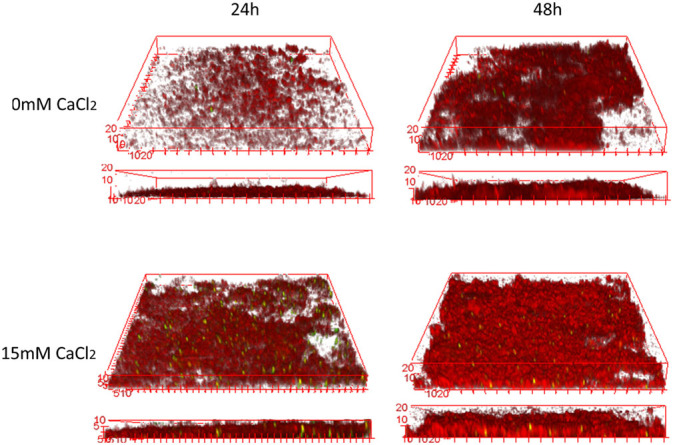
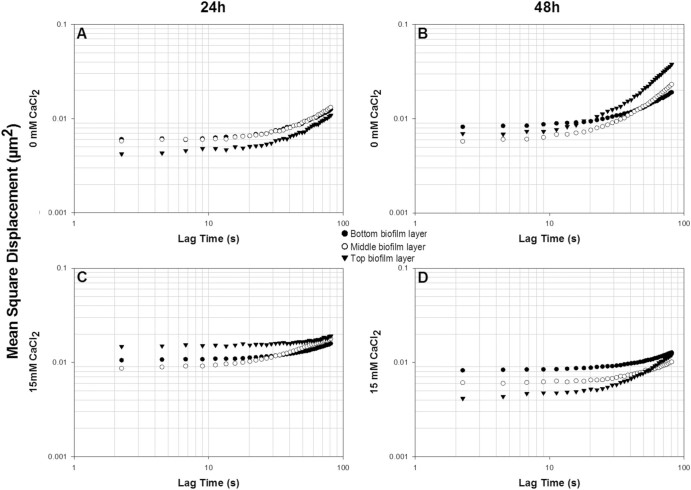
Particle-tracking microrheology is an technique that allows quantification of biofilm material properties. It overcomes the limitations of alternative techniques such as bulk rheology or force spectroscopy by providing data on region specific material properties at any required biofilm location and can be combined with confocal microscopy and associated structural analysis. This article describes single particle tracking microrheology combined with confocal laser scanning microscopy to resolve the biofilm structure in 3 dimensions and calculate the creep compliances locally. Samples were analysed from biofilms that were cultivated over two timescales (24 h and 48 h) and alternate ionic conditions (with and without calcium chloride supplementation). The region-based creep compliance analysis showed that the creep compliance of biofilm void zones is the primary contributor to biofilm mechanical properties, contributing to the overall viscoelastic character.
粒子追踪微观流变学是一种能够对生物膜材料特性进行量化的技术。它克服了诸如整体流变学或力谱学等其他技术的局限性,通过提供任何所需生物膜位置的区域特定材料特性数据,并且可以与共聚焦显微镜及相关结构分析相结合。本文描述了单粒子追踪微观流变学与共聚焦激光扫描显微镜相结合,以三维解析生物膜结构并局部计算蠕变柔量。对在两个时间尺度(24小时和48小时)以及交替离子条件(添加和不添加氯化钙)下培养的生物膜样本进行了分析。基于区域的蠕变柔量分析表明,生物膜空隙区域的蠕变柔量是生物膜力学性能的主要贡献因素,对整体粘弹性特征有贡献。