Sadasivan Shankar, Sharp Bridgett, Schultz-Cherry Stacey, Smeyne Richard Jay
Department of Developmental Neurobiology, St. Jude Children's Research Hospital, 262 Danny Thomas Place,, Memphis, TN 38105 USA.
Department of Infectious Diseases, St. Jude Children's Research Hospital, 262 Danny Thomas Place,, Memphis, TN 38105 USA.
NPJ Parkinsons Dis. 2017 May 23;3:18. doi: 10.1038/s41531-017-0019-z. eCollection 2017.
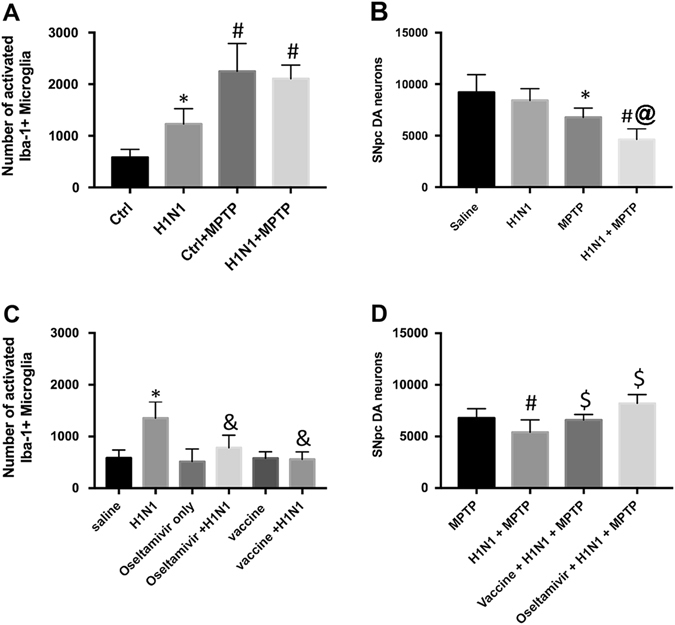
Central Nervous System inflammation has been implicated in neurodegenerative disorders including Parkinson's disease (Ransohoff, Science 353: 777-783, 2016; Kannarkat et al. J. Parkinsons Dis. 3: 493-514, 2013). Here, we examined if the H1N1 influenza virus (Studahl et al. Drugs 73: 131-158, 2013) could synergize with the parkinsonian toxin 1-methyl-4-phenyl-1,2,3,6-tetrahydropyridine (Jackson-Lewis et al. in Mark LeDoux (ed) : 287-306, Elsevier, 2015) to induce a greater microglial activation and loss of substantia nigra pars compacta dopaminergic neurons than either insult alone. H1N1-infected animals administered 1-methyl-4-phenyl-1,2,3,6-tetrahydropyridine exhibit a 20% greater loss of substantia nigra pars compacta dopaminergic neurons than occurs from the additive effects of H1N1 or 1-methyl-4-phenyl-1,2,3,6-tetrahydropyridine alone ( < 0.001). No synergistic effects were found in microglial activation. The synergistic dopaminergic neuron loss is eliminated by influenza vaccination or treatment with oseltamivir carboxylate. This work shows that multiple insults can induce synergistic effects; and even these small changes can be significant as it might allow one to cross a phenotypic disease threshold that would not occur from individual non-interacting exposures. Our observations also have important implications for public health, providing impetus for influenza vaccination or prompt treatment with anti-viral medications upon influenza diagnosis.
中枢神经系统炎症已被认为与包括帕金森病在内的神经退行性疾病有关(兰索霍夫,《科学》353: 777 - 783,2016;坎纳卡特等人,《帕金森病杂志》3: 493 - 514,2013)。在此,我们研究了甲型流感病毒H1N1(斯图达尔等人,《药物》73: 131 - 158,2013)是否能与帕金森病毒素1 - 甲基 - 4 - 苯基 - 1,2,3,6 - 四氢吡啶协同作用(杰克逊 - 刘易斯等人,载于马克·勒杜克斯编著:287 - 306,爱思唯尔出版社,2015),以诱导比单独任何一种损伤更大程度的小胶质细胞活化和黑质致密部多巴胺能神经元损失。接受1 - 甲基 - 4 - 苯基 - 1,2,3,6 - 四氢吡啶的H1N1感染动物,其黑质致密部多巴胺能神经元损失比单独的H1N1或1 - 甲基 - 4 - 苯基 - 1,2,3,6 - 四氢吡啶相加效应所导致的损失多20%(< 0.001)。在小胶质细胞活化方面未发现协同作用。流感疫苗接种或用羧基奥司他韦治疗可消除协同性多巴胺能神经元损失。这项研究表明多种损伤可诱导协同效应;而且即使这些微小变化也可能具有重要意义,因为它们可能使个体跨越一个表型疾病阈值,而这是单个非相互作用暴露所不会出现的。我们的观察结果对公共卫生也具有重要意义,为流感疫苗接种或在诊断出流感后立即用抗病毒药物进行治疗提供了动力。