Bower Jacquelyn J, Vance Leah D, Psioda Matthew, Smith-Roe Stephanie L, Simpson Dennis A, Ibrahim Joseph G, Hoadley Katherine A, Perou Charles M, Kaufmann William K
Department of Pathology and Laboratory Medicine, University of North Carolina at Chapel Hill, Chapel Hill, NC 27599 USA.
Lineberger Comprehensive Cancer Center, University of North Carolina at Chapel Hill, Chapel Hill, NC 27599 USA.
NPJ Breast Cancer. 2017 Mar 31;3:9. doi: 10.1038/s41523-017-0009-7. eCollection 2017.
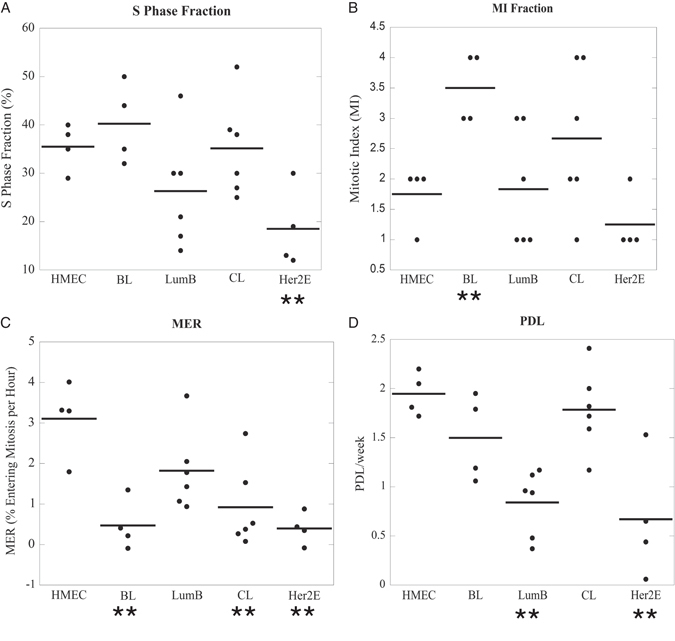
Genomic instability is a hallmark of breast cancer, contributes to tumor heterogeneity, and influences chemotherapy resistance. Although Gap 2 and mitotic checkpoints are thought to prevent genomic instability, the role of these checkpoints in breast cancer is poorly understood. Here, we assess the Gap 2 and mitotic checkpoint functions of 24 breast cancer and immortalized mammary epithelial cell lines representing four of the six intrinsic molecular subtypes of breast cancer. We found that patterns of cell cycle checkpoint deregulation were associated with the intrinsic molecular subtype of breast cancer cell lines. Specifically, the luminal B and basal-like cell lines harbored two molecularly distinct Gap 2/mitosis checkpoint defects (impairment of the decatenation Gap 2 checkpoint and the spindle assembly checkpoint, respectively). All subtypes of breast cancer cell lines examined displayed aberrant DNA synthesis/Gap 2/mitosis progression and the basal-like and claudin-low cell lines exhibited increased percentages of chromatid cohesion defects. Furthermore, a decatenation Gap 2 checkpoint gene expression signature identified in the cell line panel correlated with clinical outcomes in breast cancer patients, suggesting that breast tumors may also harbor defects in decatenation Gap 2 checkpoint function. Taken together, these data imply that pharmacological targeting of signaling pathways driving these phenotypes may lead to the development of novel personalized treatment strategies for the latter two subtypes which currently lack targeted therapeutic options because of their triple negative breast cancer status.
基因组不稳定是乳腺癌的一个标志,它导致肿瘤异质性,并影响化疗耐药性。尽管人们认为G2期和有丝分裂检查点可预防基因组不稳定,但这些检查点在乳腺癌中的作用却知之甚少。在这里,我们评估了24种乳腺癌细胞系和永生化乳腺上皮细胞系的G2期和有丝分裂检查点功能,这些细胞系代表了乳腺癌六种内在分子亚型中的四种。我们发现,细胞周期检查点失调模式与乳腺癌细胞系的内在分子亚型相关。具体而言,管腔B型和基底样细胞系存在两种分子上不同的G2期/有丝分裂检查点缺陷(分别为解连环G2期检查点和纺锤体组装检查点受损)。所检测的所有乳腺癌细胞系亚型均显示出异常的DNA合成/G2期/有丝分裂进程,且基底样和Claudin低表达细胞系的染色单体凝聚缺陷百分比增加。此外,在细胞系组中鉴定出的解连环G2期检查点基因表达特征与乳腺癌患者的临床结果相关,这表明乳腺肿瘤可能在解连环G2期检查点功能方面也存在缺陷。综上所述,这些数据表明,对驱动这些表型的信号通路进行药物靶向治疗,可能会为后两种亚型开发出新的个性化治疗策略,由于它们的三阴性乳腺癌状态,目前缺乏靶向治疗选择。