WEST Chem, School of Chemistry, University of Glasgow, University Avenue, Glasgow, G12 8QQ, UK.
Angew Chem Int Ed Engl. 2017 Aug 28;56(36):10815-10820. doi: 10.1002/anie.201705721. Epub 2017 Aug 3.
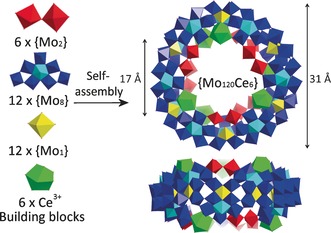
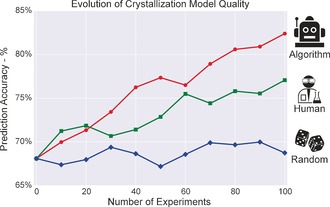
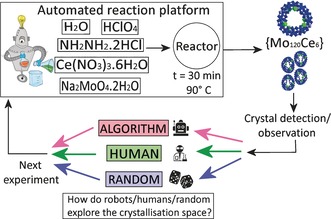
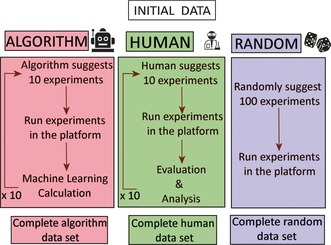
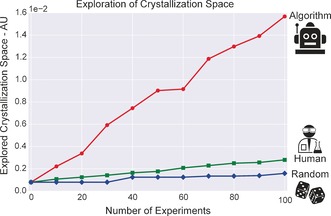
The discovery of new gigantic molecules formed by self-assembly and crystal growth is challenging as it combines two contingent events; first is the formation of a new molecule, and second its crystallization. Herein, we construct a workflow that can be followed manually or by a robot to probe the envelope of both events and employ it for a new polyoxometalate cluster, Na [Mo Ce O H (H O) ]⋅200 H O (1) which has a trigonal-ring type architecture (yield 4.3 % based on Mo). Its synthesis and crystallization was probed using an active machine-learning algorithm developed by us to explore the crystallization space, the algorithm results were compared with those obtained by human experimenters. The algorithm-based search is able to cover ca. 9 times more crystallization space than a random search and ca. 6 times more than humans and increases the crystallization prediction accuracy to 82.4±0.7 % over 77.1±0.9 % from human experimenters.
新的巨大分子通过自组装和晶体生长形成的发现具有挑战性,因为它结合了两个偶然事件;首先是形成新分子,其次是其结晶。在此,我们构建了一个可以手动或通过机器人遵循的工作流程,以探测这两个事件的范围,并将其应用于新的多金属氧酸盐簇 Na[MoCeO(H2O)]·200H2O(1),其具有三角环型结构(基于 Mo 的产率为 4.3%)。使用我们开发的主动机器学习算法来探索结晶空间来探测其合成和结晶,将算法结果与人类实验者的结果进行比较。基于算法的搜索能够覆盖大约 9 倍于随机搜索的结晶空间,大约 6 倍于人类搜索的结晶空间,并将结晶预测的准确性提高到 82.4±0.7%,而人类实验者的准确性为 77.1±0.9%。