Yang Jee Myung, Li Fengxian, Liu Qin, Rüedi Marco, Wei Edward Tak, Lentsman Michael, Lee Hyo Seok, Choi Won, Kim Seong Jin, Yoon Kyung Chul
Graduate School of Medical Science and Engineering, Korea Advanced Institute of Science and Technology, Daejeon, South Korea.
Department of Ophthalmology, Chonnam National University Medical School and Hospital, 42 Jebong-ro, Dong-gu, Gwangju, 61469, South Korea.
BMC Ophthalmol. 2017 Jun 26;17(1):101. doi: 10.1186/s12886-017-0495-2.
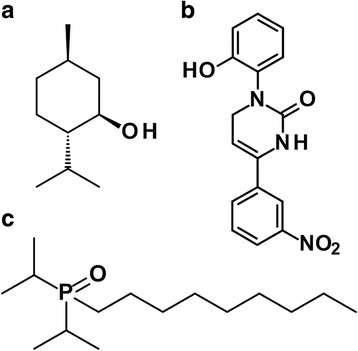
Physical cooling of the eye surface relieves ocular discomfort, but translating this event to drug treatment of dry eye discomfort not been studied. Here, we synthesized a water-soluble TRPM8 receptor agonist called cryosim-3 (C3, 1-diisopropylphosphorylnonane) which selectively activates TRPM8 (linked to cooling) but not TRPV1 or TRPA1 (linked to nociception) and tested C3 in subjects with mild forms of dry eye disease.
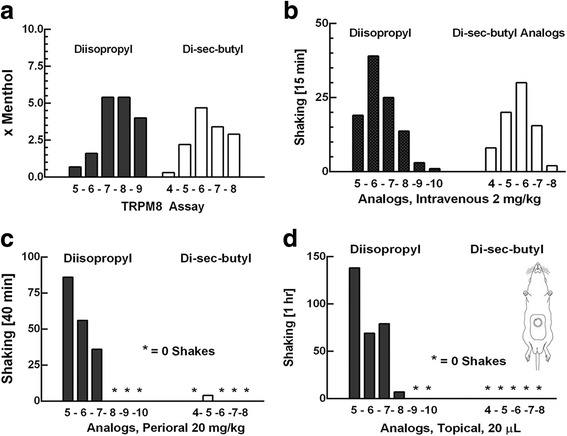
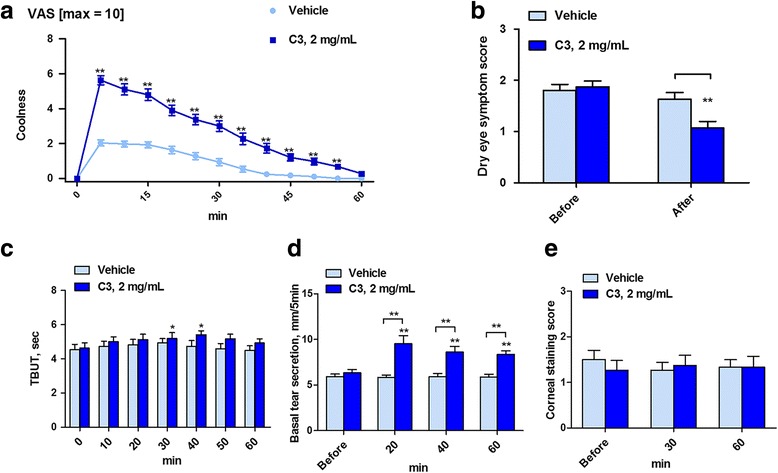
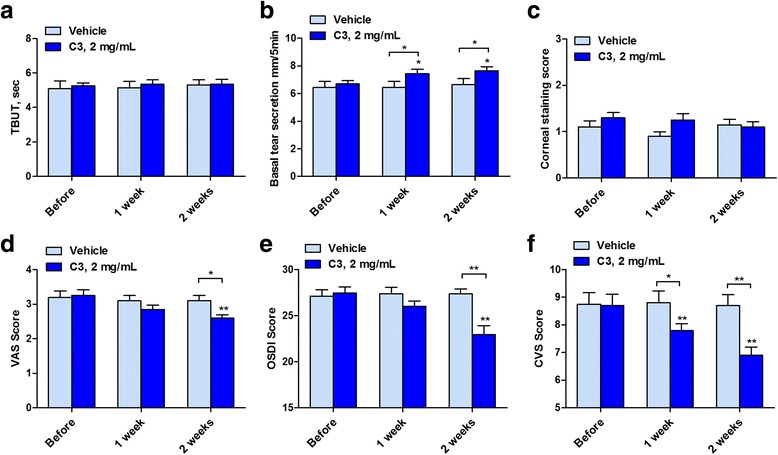
A set of 1-dialkylphosphoryalkanes were tested for activation of TRPM8, TRPV1 and TRPA1 receptors in transfected cells. The bioactivity profiles were compared by perioral, topical, and intravenous delivery to anesthetized rats. The selected lead candidate C3 or vehicle (water) was applied with a cotton gauze pad to upper eyelids of patients with dry eye disease (n = 30). Cooling sensation, tear film break-up time (TBUT), basal tear secretion, and corneal staining were evaluated. C3 was then applied four times daily for 2 weeks to patients using a pre-loaded single unit applicator containing 2 mg/mL of C3 in water (n = 20) or water only. TBUT, basal tear secretion, and corneal staining, and three questionnaires surveys of ocular discomfort (VAS scale, OSDI, and CVS symptoms) were analyzed before and at 1 and 2 weeks thereafter.
C3 was a selective and potent TRPM8 agonist without TRPV1 or TRPA1 activity. In test animals, the absence of shaking behavior after C3 perioral administration made it the first choice for further study. C3 increased tear secretion in an animal model of dry eye disease and did not irritate when wiped on eyes of volunteers. C3 singly applied (2 mg/ml) produced significant cooling in <5 min, an effecting lasting 46 min with an increase in tear secretion for 60 min. C3 applied for 2 weeks also significantly increased basal tear secretion with questionnaire surveys of ocular discomfort indices clearly showing improvement of symptoms at 1 and 2 weeks. No complaints of irritation or pain were reported by any subject.
C3 is a promising candidate for study of TRPM8 function on the eye surface and for relief of dry eye discomfort.
ISRCTN24802609 and ISRCTN13359367 . Registered 23 March 2015 and 2 September 2015.
眼表物理降温可缓解眼部不适,但将此方法转化为药物治疗干眼不适尚未得到研究。在此,我们合成了一种名为cryosim-3(C3,1-二异丙基磷酰基壬烷)的水溶性TRPM8受体激动剂,其可选择性激活TRPM8(与降温相关),但不激活TRPV1或TRPA1(与伤害感受相关),并在轻度干眼疾病患者中对C3进行了测试。
测试了一组1-二烷基磷酰基烷烃对转染细胞中TRPM8、TRPV1和TRPA1受体的激活作用。通过经口、局部和静脉给药至麻醉大鼠来比较生物活性谱。将选定的先导化合物C3或赋形剂(水)用棉纱布垫敷于干眼疾病患者(n = 30)的上眼睑。评估了冷觉、泪膜破裂时间(TBUT)、基础泪液分泌和角膜染色情况。然后,使用预装有2mg/mL C3水溶液(n = 20)或仅用水的单单元给药器,每天对患者给药4次,持续2周。分析给药前、给药后1周和2周时的TBUT、基础泪液分泌、角膜染色情况,以及三项眼部不适问卷调查(视觉模拟评分法、眼表疾病指数和角膜染色视觉模拟评分症状)。
C3是一种选择性强效TRPM8激动剂,无TRPV1或TRPA1活性。在试验动物中,经口给予C3后无颤抖行为,这使其成为进一步研究的首选。C3可增加干眼疾病动物模型的泪液分泌,擦拭志愿者眼睛时无刺激。单次应用C3(2mg/ml)在<5分钟内产生显著降温,效果持续46分钟,泪液分泌增加60分钟。应用C3 2周也显著增加了基础泪液分泌,眼部不适指数问卷调查清楚显示在1周和2周时症状有所改善。无受试者报告有刺激或疼痛主诉。
C3是研究TRPM8在眼表功能及缓解干眼不适方面的一个有前景的候选药物。
ISRCTN24802609和ISRCTN13359367。于2015年3月23日和2015年9月2日注册。