United Graduate School of Agricultural Science, Tokyo University of Agriculture and Technology (TUAT), Fuchu, Tokyo, 183-8509, Japan.
Laboratory of Plant Pathology, Graduate School of Agriculture, Tokyo University of Agriculture and Technology (TUAT), Fuchu, Tokyo, 183-8509, Japan.
Sci Rep. 2017 Jun 26;7(1):4253. doi: 10.1038/s41598-017-04084-y.
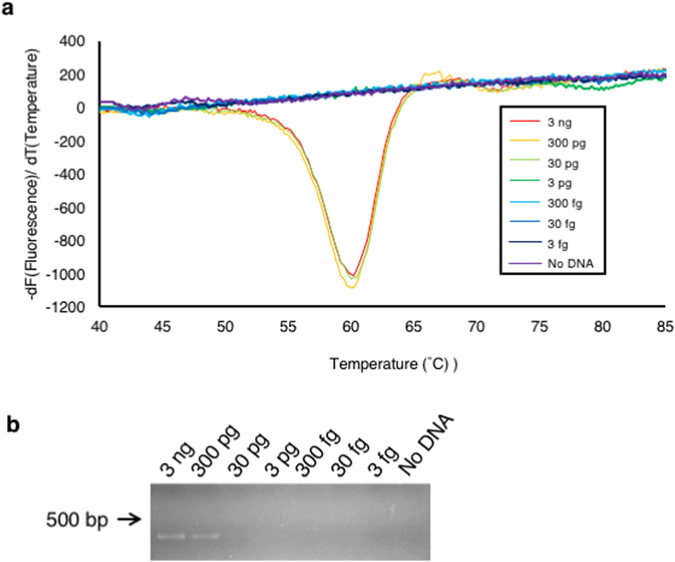
Tomato wilt pathogen Fusarium oxysporum f. sp. lycopersici (Fol) is grouped into three races based on their pathogenicity to different host cultivars. Rapid detection and discrimination of Fol races in field soils is important to prevent tomato wilt disease. Although five types of point mutations in secreted in xylem 3 (SIX3) gene, which are characteristic of race 3, have been reported as a molecular marker for the race, detection of these point mutations is laborious. The aim of this study is to develop a rapid and accurate method for the detection of point mutations in SIX3 of Fol. Loop-mediated isothermal amplification (LAMP) of SIX3 gene with the universal QProbe as well as two joint DNAs followed by annealing curve analysis allowed us to specifically detect Fol and discriminate race 3 among other races in about one hour. Our developed method is applicable for detection of races of other plant pathogenic fungi as well as their pesticide-resistant mutants that arise through point mutations in a particular gene.
番茄枯萎病菌 Fusarium oxysporum f. sp. lycopersici(Fol)根据其对不同寄主品种的致病性分为三个小种。在田间土壤中快速检测和区分 Fol 小种对预防番茄枯萎病非常重要。尽管已经报道了木质部分泌蛋白 3(SIX3)基因中五种特征性的 3 小种点突变作为 3 小种的分子标记,但这些点突变的检测很繁琐。本研究旨在开发一种快速准确的方法来检测 Fol SIX3 基因中的点突变。使用通用 QProbe 的 SIX3 基因环介导等温扩增(LAMP)以及两条联合 DNA 进行退火曲线分析,我们能够在大约一个小时内特异性检测 Fol,并区分其他小种中的 3 小种。我们开发的方法适用于检测其他植物病原真菌的小种以及由于特定基因中的点突变而产生的抗药性突变体。