University of Potsdam, Institute of Biochemistry and Biology, Karl-Liebknecht-Str. 24-25, 14476 Potsdam, Germany.
CONICET and Sección Paleontología de Vertebrados, Museo Argentino de Ciencias Naturales 'Bernardino Rivadavia', Avenida Angel Gallardo 470, Buenos Aires C1405DJR, Argentina.
Nat Commun. 2017 Jun 27;8:15951. doi: 10.1038/ncomms15951.
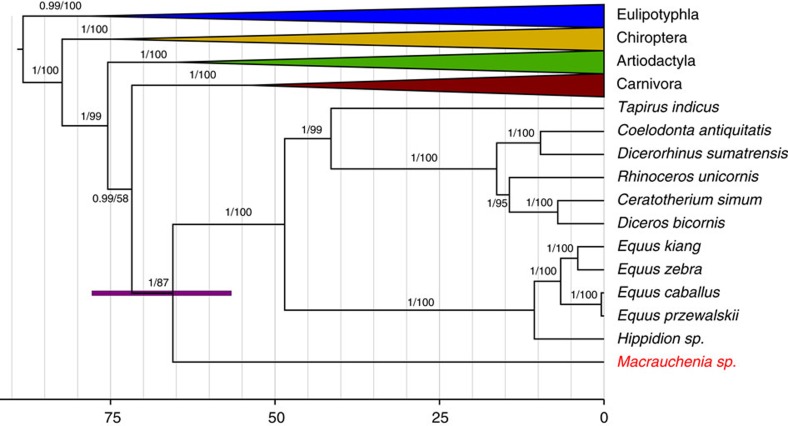
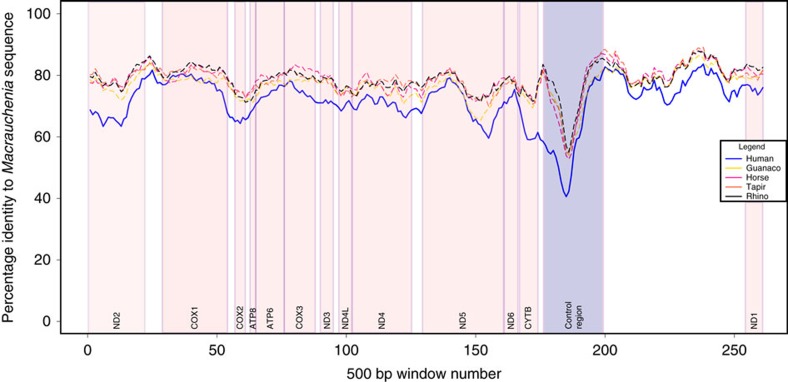
The unusual mix of morphological traits displayed by extinct South American native ungulates (SANUs) confounded both Charles Darwin, who first discovered them, and Richard Owen, who tried to resolve their relationships. Here we report an almost complete mitochondrial genome for the litoptern Macrauchenia. Our dated phylogenetic tree places Macrauchenia as sister to Perissodactyla, but close to the radiation of major lineages within Laurasiatheria. This position is consistent with a divergence estimate of ∼66 Ma (95% credibility interval, 56.64-77.83 Ma) obtained for the split between Macrauchenia and other Panperissodactyla. Combined with their morphological distinctiveness, this evidence supports the positioning of Litopterna (possibly in company with other SANU groups) as a separate order within Laurasiatheria. We also show that, when using strict criteria, extinct taxa marked by deep divergence times and a lack of close living relatives may still be amenable to palaeogenomic analysis through iterative mapping against more distant relatives.
已灭绝的南美本土有蹄类动物(SANUs)所表现出的异常形态特征,不仅令首次发现它们的查尔斯·达尔文感到困惑,也令试图厘清它们之间亲缘关系的理查德·欧文感到困惑。在此,我们报道了一只Litopterna 目 Macrauchenia 的近乎完整的线粒体基因组。我们的系统发育树将 Macrauchenia 置于奇蹄目(Perissodactyla)的姊妹群位置,但与厚皮动物亚目的主要支系辐射关系较近。这一位置与 Macrauchenia 与其他 Panperissodactyla 之间的分歧估计值(66 百万年,95%置信区间为 56.64-77.83 百万年)一致。这一证据与将 Litopterna(可能与其他 SANU 群体一起)作为厚皮动物亚目下一个独立目地位的观点相吻合。我们还表明,当使用严格的标准时,那些具有深远分歧时间和缺乏近缘现存物种的已灭绝分类群,仍可能通过与更远缘的物种进行迭代映射,从而适用于古基因组分析。