Pettibone Lisa, Vohland Katrin, Ziegler David
Public Engagement with Science, Museum für Naturkunde Berlin, Berlin, Germany.
Rachel Carson Center for Environment and Society, Ludwig-Maximilians-Universität Munich, Munich, Germany.
PLoS One. 2017 Jun 27;12(6):e0178778. doi: 10.1371/journal.pone.0178778. eCollection 2017.
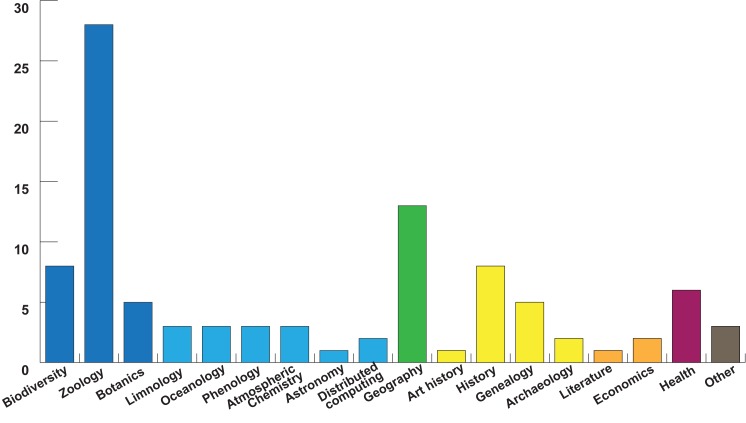
Citizen science has become more popular in recent years, quickly taking on a variety of potentially conflicting characteristics: a way to collect massive data sets at relatively low cost, a way to break science out of the ivory tower and better engage the public, an approach to educate lay people in scientific methods. But the extent of current citizen science practice-the types of actors and scientific disciplines who take part-is still poorly understood. This article builds on recent surveys of citizen science in PLOS One by analyzing citizen science practice in Germany and Austria through the projects on two online platforms. We find evidence supporting previous findings that citizen science is a phenomenon strongest in biodiversity and environmental monitoring research, but at home in a number of scientific fields, such as history and geography. In addition, our survey method yields new insights into citizen science projects initiated by non-scientific actors. We close by discussing additional methodological considerations in attempting to present a cross-disciplinary overview of citizen science.
近年来,公民科学越来越受欢迎,迅速呈现出各种潜在的矛盾特征:一种以相对低成本收集海量数据集的方式,一种将科学带出象牙塔并更好地让公众参与的方式,一种向非专业人士传授科学方法的途径。但目前公民科学实践的范围——参与的行为主体类型和科学学科——仍鲜为人知。本文基于《公共科学图书馆·综合》最近对公民科学的调查,通过两个在线平台上的项目分析德国和奥地利的公民科学实践。我们发现有证据支持之前的研究结果,即公民科学在生物多样性和环境监测研究中最为突出,但在历史和地理等许多科学领域也很常见。此外,我们的调查方法为非科学行为主体发起的公民科学项目提供了新的见解。最后,我们讨论了在试图对公民科学进行跨学科概述时的其他方法学考量。