Department of Psychology, The University of Alabama, Tuscaloosa, AL 35487-0348, USA.
Soc Cogn Affect Neurosci. 2017 Sep 1;12(9):1377-1383. doi: 10.1093/scan/nsx080.
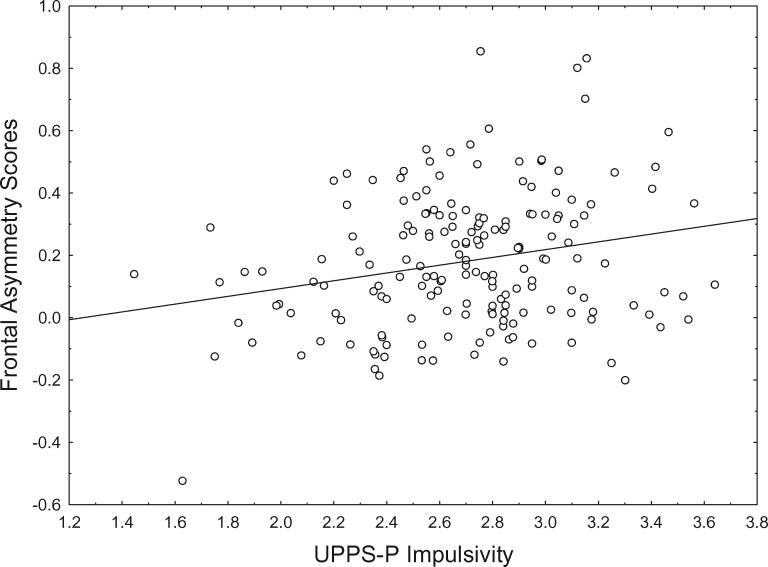
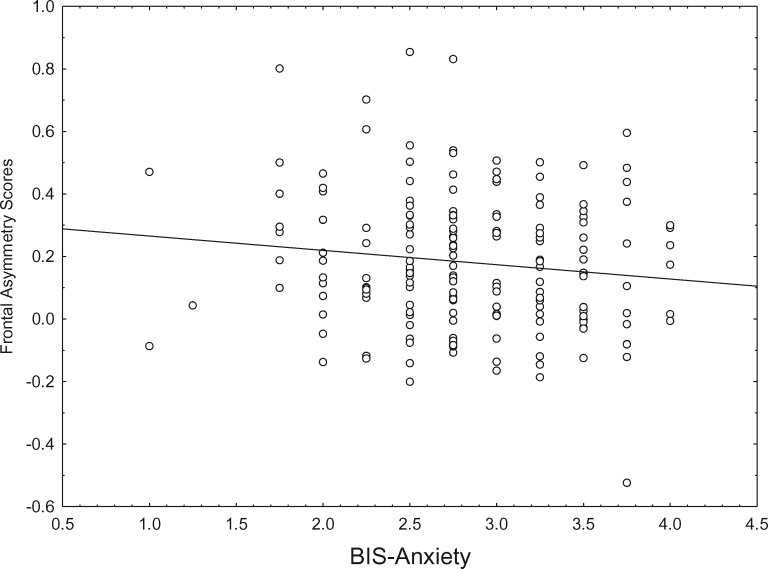
Gray's Reinforcement Sensitivity Theory (RST) asserts three core personality systems: the behavioral approach system (BAS), the fight-flight-freeze system (FFFS) and the revised behavioral inhibition system (r-BIS). Past models of frontal activity link greater relative left frontal activity with Carver and White's (1994) BAS scale and trait impulsivity and greater relative right frontal activity with Carver and White's (1994) BIS scale. However, the original BIS scale assesses both FFFS and r-BIS. Past work linking the BIS scale and right frontal activity does not indicate which system is related to right frontal activity. The current study (n = 182) examined frontal asymmetric activity with personality traits associated with approach (BAS), withdrawal (FFFS-Fear), behavioral inhibition (BIS-Anxiety) and impulsivity (UPPS-P). Resting frontal cortical activity was recorded using electroencephalography (EEG), and the traditional alpha band was examined. Greater BIS-Anxiety related to greater relative right frontal activity. Impulsivity related to less relative right frontal activity. BAS and FFFS-Fear (approach and withdrawal motivation) did not relate to asymmetric frontal activity. Regulatory control processes associated with r-BIS and impulsivity, rather than withdrawal motivation associated with FFFS, may be more closely related to right frontal activity.
格雷的强化敏感性理论(RST)断言有三个核心人格系统:行为趋近系统(BAS)、战斗-逃跑-冻结系统(FFFS)和修订后的行为抑制系统(r-BIS)。过去的额叶活动模型将更大的相对左侧额叶活动与 Carver 和 White(1994)的 BAS 量表和特质冲动联系起来,而更大的相对右侧额叶活动与 Carver 和 White(1994)的 BIS 量表联系起来。然而,原始的 BIS 量表评估了 FFFS 和 r-BIS。过去将 BIS 量表与右侧额叶活动联系起来的工作并没有表明哪个系统与右侧额叶活动有关。本研究(n=182)使用脑电图(EEG)检查了与趋近(BAS)、退缩(FFFS-恐惧)、行为抑制(BIS-焦虑)和冲动(UPPS-P)相关的人格特质的额叶不对称活动。使用脑电图记录静息额叶皮质活动,检查传统的阿尔法波段。更大的 BIS-焦虑与更大的相对右侧额叶活动有关。冲动与相对较少的右侧额叶活动有关。BAS 和 FFFS-恐惧(趋近和退缩动机)与不对称的额叶活动无关。与 r-BIS 和冲动相关的调节控制过程,而不是与 FFFS 相关的退缩动机,可能与右侧额叶活动更为密切相关。