Szczuko Małgorzata, Zapałowska-Chwyć Marta, Maciejewska Dominika, Drozd Arleta, Starczewski Andrzej, Stachowska Ewa
Department of Biochemistry and Human Nutrition, Pomeranian Medical University, Szczecin, Poland.
Clinic of Gynecology and Urogynecology, Pomeranian Medical University, Szczecin, Poland.
Mediators Inflamm. 2017;2017:5489523. doi: 10.1155/2017/5489523. Epub 2017 Jun 5.
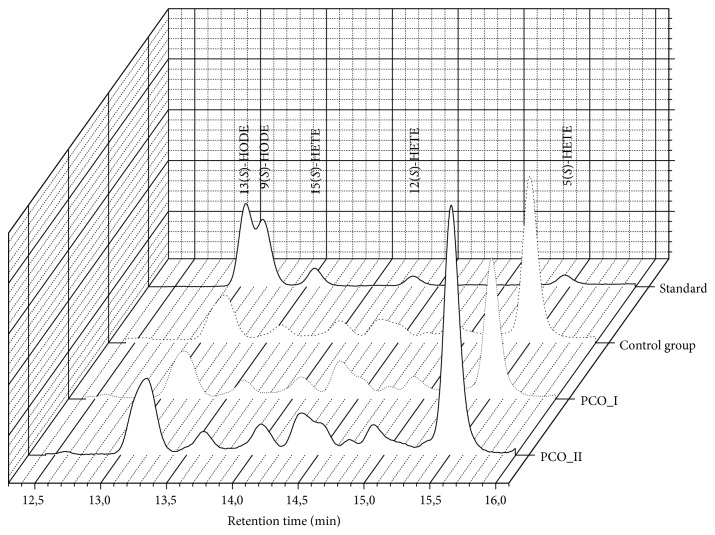
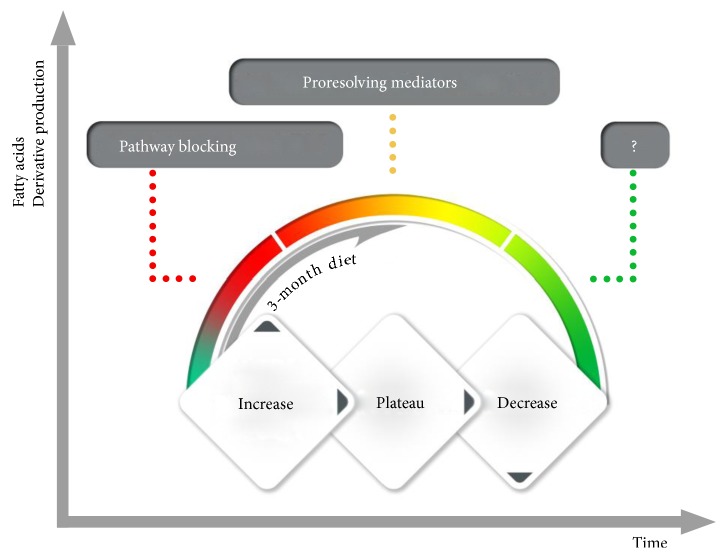
Many researchers suggest an increased risk of atherosclerosis in women with polycystic ovary syndrome. In the available literature, there are no studies on the mediators of inflammation in women with PCOS, especially after dietary intervention. Eicosanoids (HETE and HODE) were compared between the biochemical phenotypes of women with PCOS (normal and high androgens) and after the 3-month reduction diet. Eicosanoid profiles (9()-HODE, 13()-HODE, 5()-HETE, 12()-HETE, 15()-HETE, 5()-oxoETE, 16()-HETE, 16()-HETE and 5(), 6()-lipoxin A, 5(), 6(), 15()-lipoxin A) were extracted from 0.5 ml of plasma using solid-phase extraction RP-18 SPE columns. The HPLC separations were performed on a 1260 liquid chromatograph. No significant differences were found in the concentration of analysed eicosanoids in phenotypes of women with PCOS. These women, however, have significantly lower concentration of inflammatory mediators than potentially healthy women from the control group. Dietary intervention leads to a significant ( < 0.01) increase in the synthesis of proinflammatory mediators, reaching similar levels as in the control group. The development of inflammatory reaction in both phenotypes of women with PCOS is similar. The pathways for synthesis of proinflammatory mediators in women with PCOS are dormant, but can be stimulated through a reduction diet. Three-month period of lifestyle change may be too short to stimulate the pathways inhibiting inflammatory process.
许多研究人员认为多囊卵巢综合征女性患动脉粥样硬化的风险增加。在现有文献中,尚无关于多囊卵巢综合征女性炎症介质的研究,尤其是在饮食干预之后。对多囊卵巢综合征女性(正常雄激素水平和高雄激素水平)的生化表型之间以及在进行3个月的减脂饮食后,对类花生酸(羟二十碳四烯酸和羟基十八碳二烯酸)进行了比较。使用固相萃取RP - 18 SPE柱从0.5毫升血浆中提取类花生酸谱(9(R) - 羟基十八碳二烯酸、13(R) - 羟基十八碳二烯酸、5(S) - 羟二十碳四烯酸、12(S) - 羟二十碳四烯酸、15(S) - 羟二十碳四烯酸、5(S) - 氧代二十碳四烯酸、16(S) - 羟二十碳四烯酸、16(R) - 羟二十碳四烯酸以及5(S),6(R) - 脂氧素A、5(S),6(S),15(R) - 脂氧素A)。在1260型液相色谱仪上进行高效液相色谱分离。在多囊卵巢综合征女性的表型中,所分析的类花生酸浓度未发现显著差异。然而,这些女性炎症介质的浓度明显低于对照组中可能健康的女性。饮食干预导致促炎介质的合成显著(P < 0.01)增加,达到与对照组相似的水平。多囊卵巢综合征两种表型女性的炎症反应发展相似。多囊卵巢综合征女性促炎介质的合成途径处于休眠状态,但可以通过减脂饮食来刺激。三个月的生活方式改变可能太短,不足以刺激抑制炎症过程的途径。