Yuan Yang, Sun Hong, Sun Zilin
Department of Endocrinology, Affiliated Zhongda Hospital of Southeast University, No. 87 DingJiaQiao Road, Nanjing, 210009, People's Republic of China.
Department of Endocrinology and Metabolism, The first Affiliated Hospital of Soochow University, 188 shizi street, suzhou, 215006, jiangsu, China.
Lipids Health Dis. 2017 Jun 28;16(1):126. doi: 10.1186/s12944-017-0522-6.
Advanced glycation end products (AGEs) are pathogenic factors of diabetic nephropathy (DN), causing renal damage in various ways. The aim of this study is to investigate the ectopic lipid accumulation caused by AGEs in human renal tubular epithelial cell line (HK-2) cells and the kidney of type 2 diabetic rats.
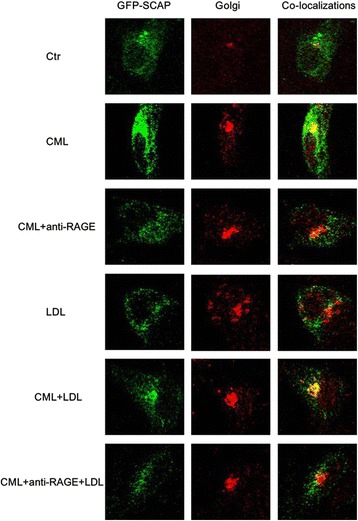
In vivo study, diabetes was induced in male Sprague-Dawley rats through intraperitoneal injection of high-fat/high-sucrose diet and low-dose streptozocin (STZ). Two weeks after STZ injection, the diabetic rats were randomly divided into two groups, namely, untreated diabetic and Aminoguanidine Hydrochloride (AG, an AGEs formation inhibitor)-treated (100 mg/Kg/day, i.g., for 8 weeks) group. In vitro study, according to the different treatments, HK-2 were divided into 6 groups. Intracellular cholesterol content was assessed by Oil Red O staining and cholesterol enzymatic assay. Expression of mRNA and protein of molecules controlling cholesterol homeostasis in the treated cells was examined by real-time quantitative PCR and western blotting, respectively. SREBP cleavage-activating protein (SCAP) translocation was detected by confocal microscopy.
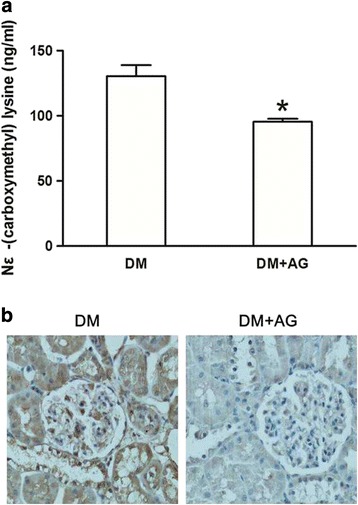
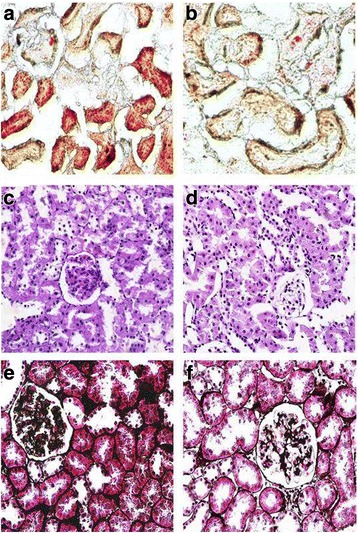
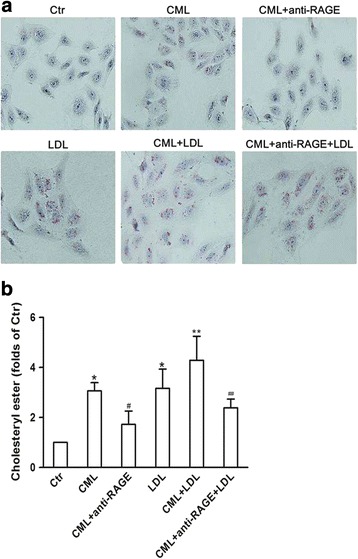
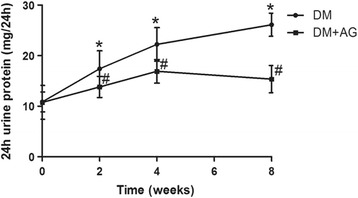
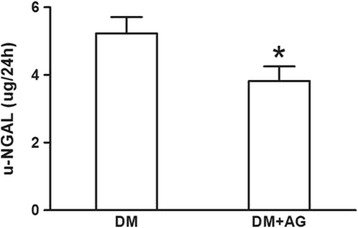
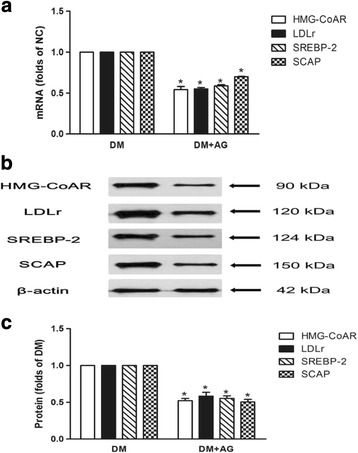
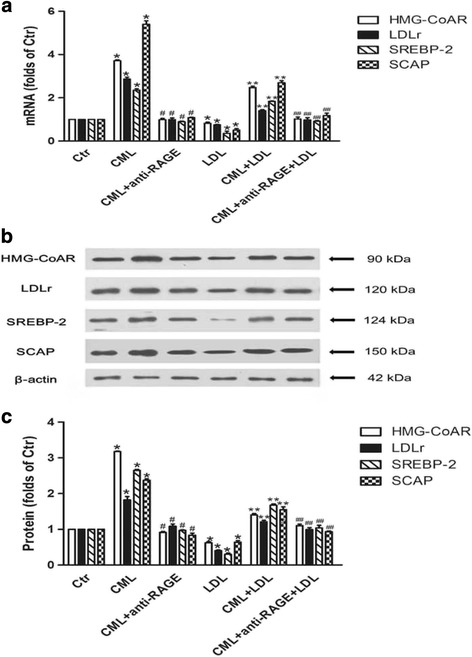
Here we found Nε-(carboxymethyl) lysine (CML, a member of the AGEs family) increased Oil Red O staining and intracellular cholesterol ester (CE) in HK-2 cells; Anti-RAGE (AGEs receptor) reduced lipid droplets and the CE level. A strong staining of Oil Red O was also found in the renal tubules of the diabetic rats, which could be alleviated by AG. CML upregulated both mRNA and protein expression of 3-hydroxy-3-methylglutaryl coenzyme A reductase (HMG-CoAR), LDL receptor (LDLr), sterol regulatory element binding protein-2 (SREBP-2) and SCAP, which were inhibited by anti-RAGE. The upregulation of these molecules in the kidney of the diabetic rats was also ameliorated by AG. Furthermore, AG reduced serum and renal CML deposition, and improved urine protein and u-NGAL in type 2 diabetic rats.
Overall, these results suggest that CML caused DN might be via disturbing the intracellular feedback regulation of cholesterol. Inhibition of CML-induced lipid accumulation might be a potential renoprotective role in the progression of DN.
晚期糖基化终末产物(AGEs)是糖尿病肾病(DN)的致病因素,可通过多种方式导致肾脏损伤。本研究旨在探讨AGEs在人肾小管上皮细胞系(HK-2)细胞及2型糖尿病大鼠肾脏中引起的异位脂质蓄积情况。
在体内研究中,通过腹腔注射高脂/高糖饮食和低剂量链脲佐菌素(STZ)诱导雄性Sprague-Dawley大鼠患糖尿病。注射STZ两周后,将糖尿病大鼠随机分为两组,即未治疗的糖尿病组和盐酸氨基胍(AG,一种AGEs形成抑制剂)治疗组(100mg/Kg/天,灌胃,共8周)。在体外研究中,根据不同处理将HK-2细胞分为6组。通过油红O染色和胆固醇酶法测定细胞内胆固醇含量。分别通过实时定量PCR和蛋白质印迹法检测处理后细胞中控制胆固醇稳态分子的mRNA和蛋白质表达。通过共聚焦显微镜检测固醇调节元件结合蛋白裂解激活蛋白(SCAP)的易位。
我们发现Nε-(羧甲基)赖氨酸(CML,AGEs家族成员之一)增加了HK-2细胞中的油红O染色和细胞内胆固醇酯(CE);抗RAGE(AGEs受体)减少了脂滴和CE水平。在糖尿病大鼠的肾小管中也发现了强烈的油红O染色,AG可使其减轻。CML上调了3-羟基-3-甲基戊二酰辅酶A还原酶(HMG-CoAR)、低密度脂蛋白受体(LDLr)、固醇调节元件结合蛋白-2(SREBP-2)和SCAP的mRNA和蛋白质表达,而抗RAGE可抑制这些表达。糖尿病大鼠肾脏中这些分子的上调也被AG改善。此外,AG减少了2型糖尿病大鼠血清和肾脏中的CML沉积,并改善了尿蛋白和尿中性粒细胞明胶酶相关脂质运载蛋白(u-NGAL)。
总体而言,这些结果表明CML导致DN可能是通过干扰细胞内胆固醇的反馈调节。抑制CML诱导的脂质蓄积可能在DN进展中具有潜在的肾脏保护作用。