Karageorgopoulou Sofia, Kostakis Ioannis D, Gazouli Maria, Markaki Sonia, Papadimitriou Marios, Bournakis Evangelos, Dimopoulos Meletios-Athanassios, Papadimitriou Christos A
Oncology Unit, 2nd Department of Surgery, Aretaieio Hospital, Medical School, National and Kapodistrian University of Athens, V. Sophias 76, 11528, Athens, Greece.
2nd Dept of Propedeutic Surgery, "Laiko" General Hospital, Medical School, National and Kapodistrian University of Athens, Athens, Greece.
BMC Cancer. 2017 Jun 28;17(1):451. doi: 10.1186/s12885-017-3435-x.
Recognizing resistance or susceptibility to the current standard cisplatin and paclitaxel treatment could improve therapeutic outcomes of metastatic or recurrent cervical cancer.
Forty-five tissue samples from patients participating in a phase II trial of cisplatin and ifosfamide, with or without paclitaxel were collected for retrograde analysis. Immunohistochemistry and genotyping was performed to test ERCC1, III β-tubulin, COX-2, CD4, CD8 and ERCC1 (C8092A and N118 N) and MDR1 (C3435T and G2677 T) gene polymorphisms, as possible predictive and prognostic markers. Results were statistically analyzed and correlated with patient characteristics and outcomes.
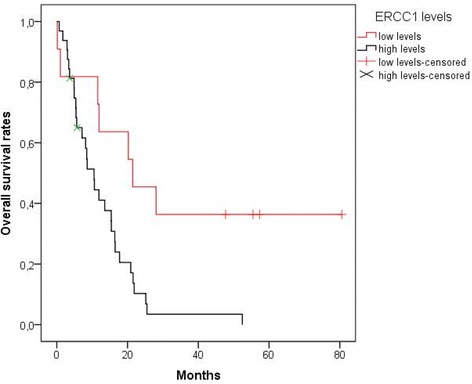
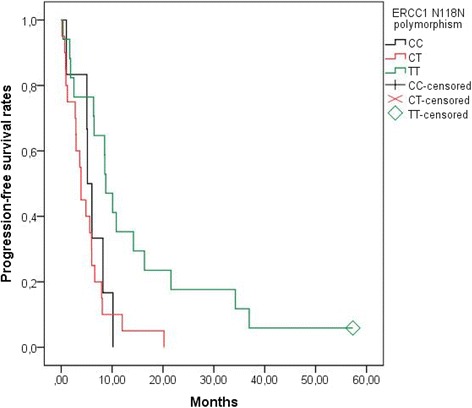
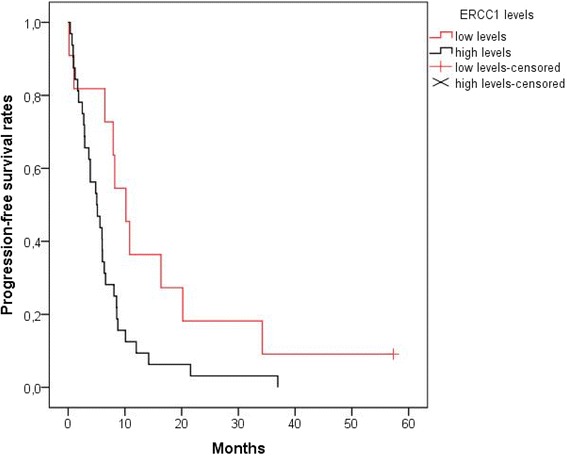
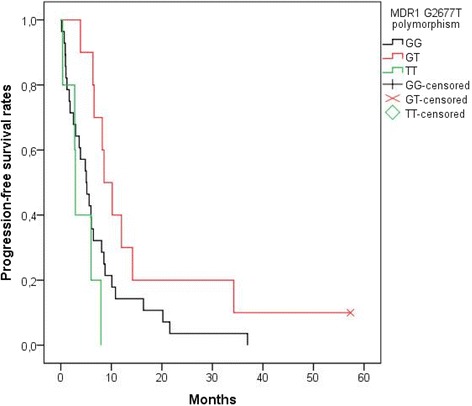
Patients with higher levels of ERCC1 expression had shorter PFS and OS than patients with low ERCC1 expression (mPFS:5.1 vs 10.2 months, p = 0.027; mOS:10.5 vs. 21.4 months, p = 0.006). Patients with TT in the site of ERCC1 N118 N and GT in the site of MDR1 G2677 T polymorphisms had significantly longer PFS (p = 0.006 and p = 0.027 respectively). ERCC1 expression and the ERCC1 N118 N polymorphism remained independent predictors of PFS. Interestingly, high III beta tubulin expression was associated with chemotherapy resistance and fewer responses [5/20 (25%)] compared to lower III β-tubulin expression [15/23 (65.2%)] (p = 0.008). Finally, ΙΙΙ β-tubulin levels and chemotherapy regimen were independent predictors of response to treatment.
ERCC1 expression proved to be a significant prognostic factor for survival in our metastatic or recurrent cervical cancer population treated with cisplatin based chemotherapy. ERCC1 N118 N and MDR1 G2677 T polymorphism also proved of prognostic significance for disease progression, while overexpression of III β-tubulin was positively correlated with chemotherapy resistance.
识别对当前标准顺铂和紫杉醇治疗的耐药性或敏感性,可改善转移性或复发性宫颈癌的治疗效果。
收集参与顺铂和异环磷酰胺(含或不含紫杉醇)II期试验患者的45份组织样本进行回顾性分析。进行免疫组织化学和基因分型,以检测ERCC1、III β-微管蛋白、COX-2、CD4、CD8以及ERCC1(C8092A和N118N)和MDR1(C3435T和G2677T)基因多态性,作为可能的预测和预后标志物。对结果进行统计学分析,并与患者特征和预后相关联。
ERCC1表达水平较高的患者的无进展生存期(PFS)和总生存期(OS)短于ERCC1表达水平低的患者(中位PFS:5.1个月对10.2个月,p = 0.027;中位OS:10.5个月对21.4个月,p = 0.006)。ERCC1 N118N位点为TT以及MDR1 G2677T位点为GT的患者的PFS显著更长(分别为p = 0.006和p = 0.027)。ERCC1表达和ERCC1 N118N多态性仍然是PFS的独立预测因素。有趣的是,与III β-微管蛋白表达较低[15/23(65.2%)]相比,III β-微管蛋白高表达与化疗耐药和较少的反应相关[5/20(25%)](p = 0.008)。最后,III β-微管蛋白水平和化疗方案是治疗反应的独立预测因素。
在我们接受基于顺铂化疗的转移性或复发性宫颈癌人群中,ERCC1表达被证明是生存的重要预后因素。ERCC1 N118N和MDR1 G2677T多态性也被证明对疾病进展具有预后意义,而III β-微管蛋白的过表达与化疗耐药呈正相关。