Eskandari Davoud, Zou Ding, Grote Ludger, Schneider Hartmut, Penzel Thomas, Hedner Jan
Center for Sleep and Vigilance Disorders, Department of Internal Medicine and Clinical Nutrition, Sahlgrenska Academy, University of Gothenburg, Medicinaregatan 8B, Box 421, SE-40530, Gothenburg, Sweden.
Johns Hopkins Sleep Disorders Center, Division of Pulmonary and Critical Care Medicine, Johns Hopkins University, Baltimore, Maryland, USA.
Respir Res. 2017 Jun 28;18(1):130. doi: 10.1186/s12931-017-0607-9.
Obstructive sleep apnea is characterized by intermittent hypoxia and hypercapnia. CO production, transport and elimination are influenced by the carbonic anhydrase enzyme. We hypothesized that elevated standard bicarbonate, a proxy for increased carbonic anhydrase activity, is associated with apnea severity and higher blood pressure in patients with obstructive sleep apnea.
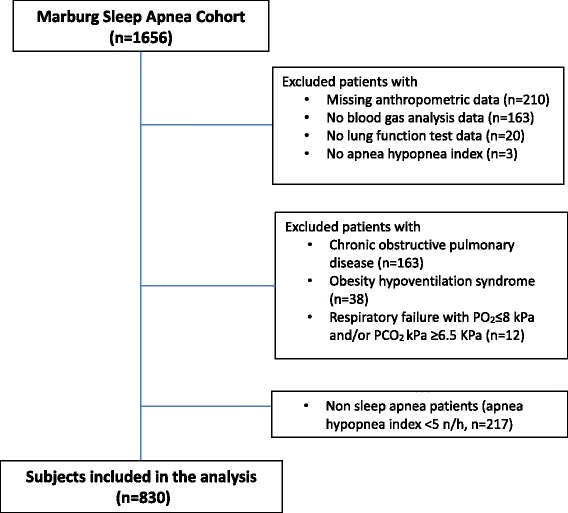
A retrospective analysis of a sleep apnea cohort (n = 830) studied by ambulatory polygraphy. Office systolic/diastolic blood pressure, lung function, and arterial blood gases were assessed during daytime.
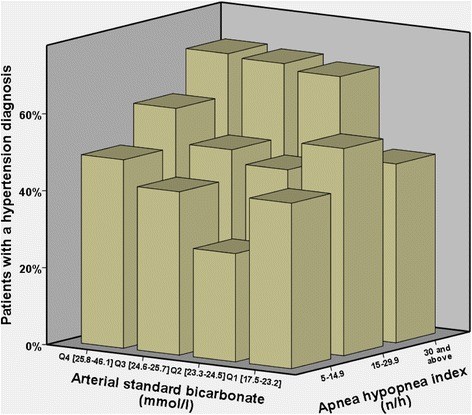
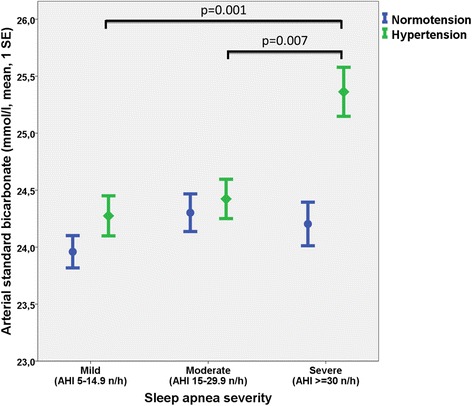
Arterial standard bicarbonate was increased with apnea severity (mild/moderate/severe 24.1 ± 1.8, 24.4 ± 1.7 and 24.9 ± 2.9 mmol/l, respectively, Kruskal-Wallis test p < 0.001). Standard bicarbonate was independently associated with apnea hypopnea index after adjustment for sex, age, body mass index, smoking, alcohol, hypertension, pO and pCO (standard bicarbonate quartile 1 vs. quartile 4, β = 10.6, p < 0.001). Log-transformed standard bicarbonate was associated with a diagnosis of hypertension or diastolic blood pressure but not systolic blood pressure adjusting for cofounders (p = 0.007, 0.048 and 0.45, respectively).
There was an independent association between sleep apnea severity and arterial standard bicarbonate. The link between high standard bicarbonate and daytime hypertension suggests that carbonic anhydrase activity may constitute a novel mechanism for blood pressure regulation in sleep apnea.
阻塞性睡眠呼吸暂停的特征是间歇性缺氧和高碳酸血症。一氧化碳的产生、运输和清除受碳酸酐酶影响。我们推测,作为碳酸酐酶活性增加指标的标准碳酸氢盐升高,与阻塞性睡眠呼吸暂停患者的呼吸暂停严重程度和更高血压相关。
对通过动态多导睡眠监测仪研究的睡眠呼吸暂停队列(n = 830)进行回顾性分析。在白天评估诊室收缩压/舒张压、肺功能和动脉血气。
动脉标准碳酸氢盐随呼吸暂停严重程度增加而升高(轻度/中度/重度分别为24.1±1.8、24.4±1.7和24.9±2.9 mmol/l,Kruskal-Wallis检验p<0.001)。在调整性别、年龄、体重指数、吸烟、饮酒、高血压、pO和pCO后,标准碳酸氢盐与呼吸暂停低通气指数独立相关(标准碳酸氢盐四分位数1与四分位数4相比,β = 10.6,p<0.001)。经混杂因素调整后,对数转换后的标准碳酸氢盐与高血压诊断或舒张压相关,但与收缩压无关(p分别为0.007、0.048和0.45)。
睡眠呼吸暂停严重程度与动脉标准碳酸氢盐之间存在独立关联。高标准碳酸氢盐与白天高血压之间的联系表明,碳酸酐酶活性可能构成睡眠呼吸暂停中血压调节的新机制。