Weller Romy, Hueging Kathrin, Brown Richard J P, Todt Daniel, Joecks Sebastian, Vondran Florian W R, Pietschmann Thomas
Institute of Experimental Virology, Twincore, Centre for Experimental and Clinical Infection Research, Hanover, Germany.
Department of General, Visceral and Transplant Surgery, Hanover Medical School, Hanover, Germany.
J Virol. 2017 Aug 24;91(18). doi: 10.1128/JVI.00422-17. Print 2017 Sep 15.
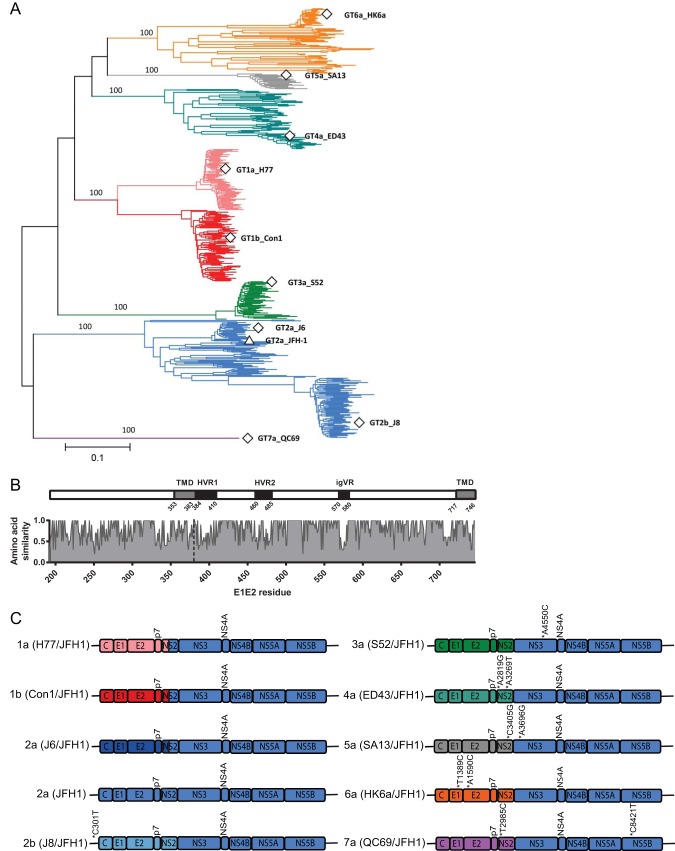
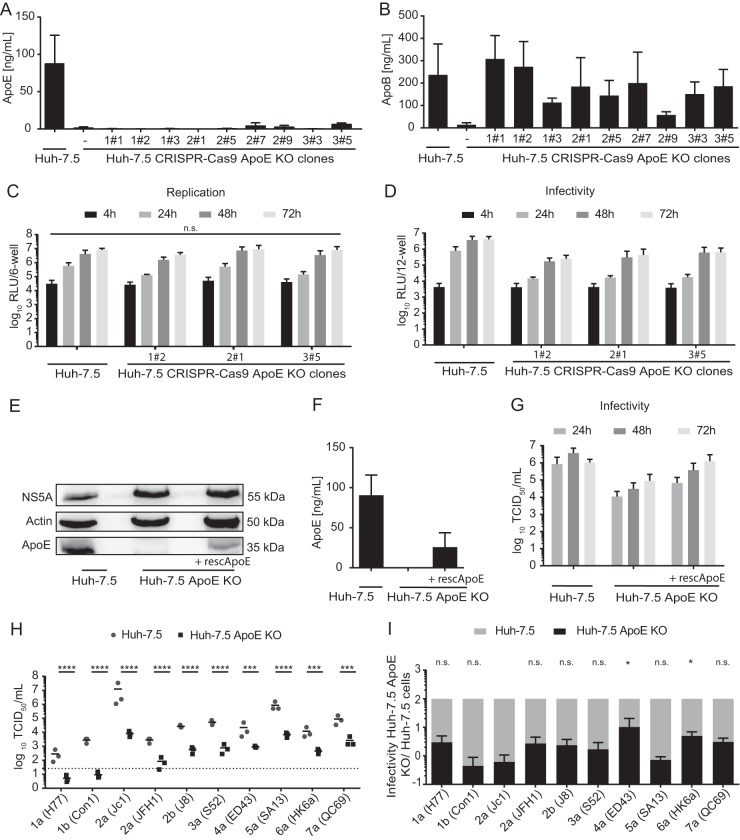
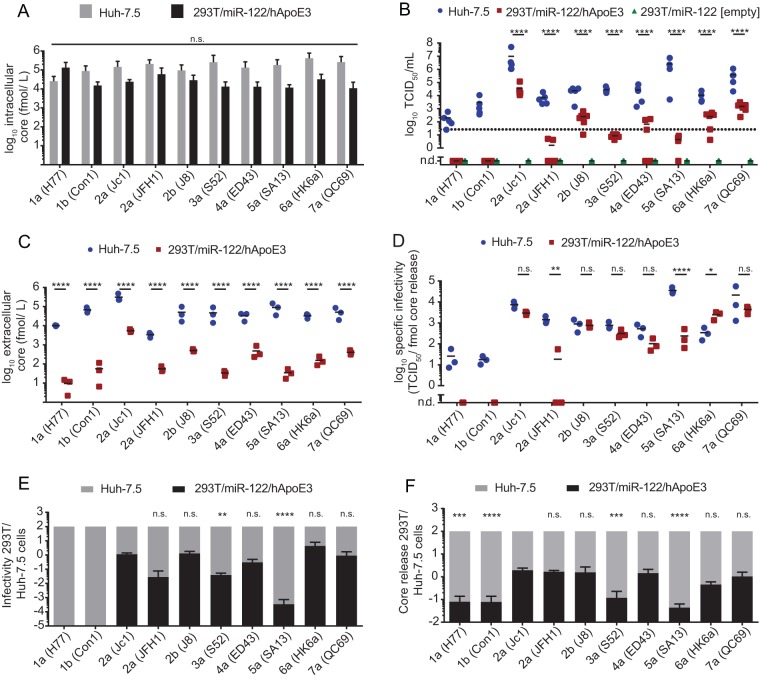
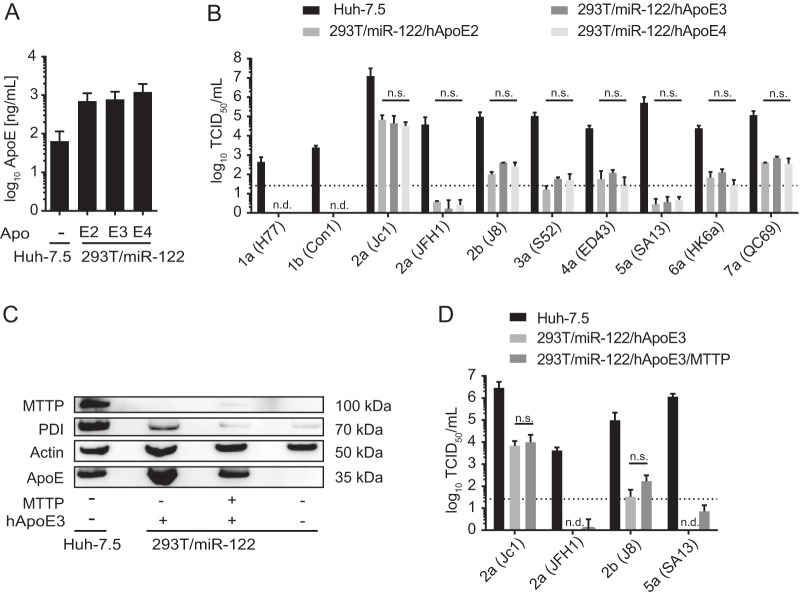
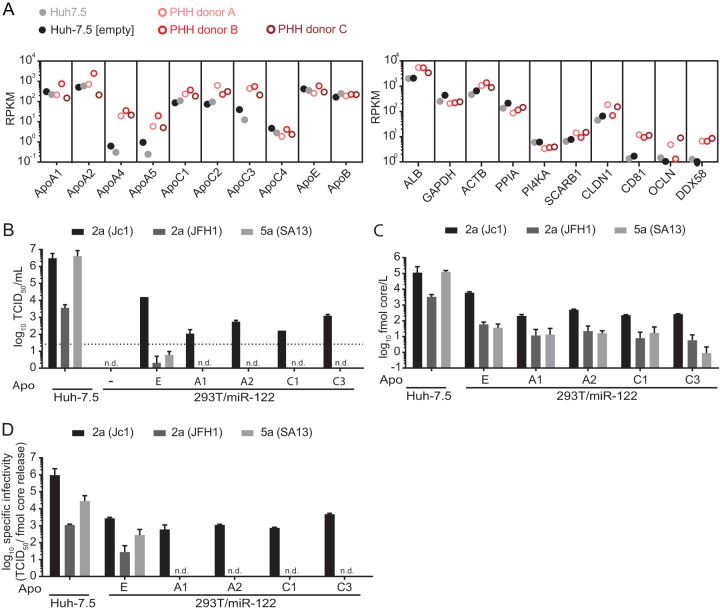
Hepatitis C virus (HCV) is extraordinarily diverse and uses entry factors in a strain-specific manner. Virus particles associate with lipoproteins, and apolipoprotein E (ApoE) is critical for HCV assembly and infectivity. However, whether ApoE dependency is common to all HCV genotypes remains unknown. Therefore, we compared the roles of ApoE utilizing 10 virus strains from genotypes 1 through 7. ApoA and ApoC also support HCV assembly, so they may contribute to virus production in a strain-dependent fashion. Transcriptome sequencing (RNA-seq) revealed abundant coexpression of ApoE, ApoB, ApoA1, ApoA2, ApoC1, ApoC2, and ApoC3 in primary hepatocytes and in Huh-7.5 cells. Virus production was examined in Huh-7.5 cells with and without ApoE expression and in 293T cells where individual apolipoproteins (ApoE1, -E2, -E3, -A1, -A2, -C1, and -C3) were provided in All strains were strictly ApoE dependent. However, ApoE involvement in virus production was strain and cell type specific, because some HCV strains poorly produced infectious virus in ApoE-expressing 293T cells and because ApoE knockout differentially affected virus production of HCV strains in Huh-7.5 cells. ApoE allelic isoforms (ApoE2, -E3, and -E4) complemented virus production of HCV strains to comparable degrees. All tested strains assembled infectious progeny with ApoE in preference to other exchangeable apolipoproteins (ApoA1, -A2, -C1, and -C3). The specific infectivity of HCV particles was similar for 293T- and Huh-7.5-derived particles for most strains; however, it differed by more than 100-fold in some viruses. Collectively, this study reveals strain-dependent and host cell-dependent use of ApoE during HCV assembly. These differences relate to the efficacy of virus production and also to the properties of released virus particles and therefore govern viral fitness at the level of assembly and cell entry. Chronic HCV infections are a major cause of liver disease. HCV is highly variable, and strain-specific determinants modulate the response to antiviral therapy, the natural course of infection, and cell entry factor usage. Here we explored whether host factor dependency of HCV in particle assembly is modulated by strain-dependent viral properties. We showed that all examined HCV strains, which represent all seven known genotypes, rely on ApoE expression for assembly of infectious progeny. However, the degree of ApoE dependence is modulated in a strain-specific and cell type-dependent manner. This indicates that HCV strains differ in their assembly properties and host factor usage during assembly of infectious progeny. Importantly, these differences relate not only to the efficiency of virus production and release but also to the infectiousness of virus particles. Thus, strain-dependent features of HCV modulate ApoE usage, with implications for virus fitness at the level of assembly and cell entry.
丙型肝炎病毒(HCV)具有高度多样性,并且以毒株特异性方式利用进入因子。病毒颗粒与脂蛋白相关联,载脂蛋白E(ApoE)对HCV组装和感染性至关重要。然而,ApoE依赖性是否为所有HCV基因型所共有仍不清楚。因此,我们利用来自1至7型的10种病毒毒株比较了ApoE的作用。载脂蛋白A(ApoA)和载脂蛋白C(ApoC)也支持HCV组装,因此它们可能以毒株依赖性方式促进病毒产生。转录组测序(RNA-seq)显示,在原代肝细胞和Huh-7.5细胞中,ApoE、载脂蛋白B(ApoB)、载脂蛋白A1(ApoA1)、载脂蛋白A2(ApoA2)、载脂蛋白C1(ApoC1)、载脂蛋白C2(ApoC二)和载脂蛋白C3(ApoC3)大量共表达。在有和没有ApoE表达的Huh-7.5细胞以及在提供了单个载脂蛋白(ApoE1、-E2、-E3、-A1、-A2、-C1和-C3)的293T细胞中检测病毒产生情况。所有毒株都严格依赖ApoE。然而,ApoE参与病毒产生具有毒株和细胞类型特异性,因为一些HCV毒株在表达ApoE的293T细胞中产生传染性病毒的能力较差,并且因为ApoE基因敲除对Huh-7.5细胞中HCV毒株的病毒产生有不同影响。ApoE等位基因亚型(ApoE2、-E3和-E4)对HCV毒株的病毒产生具有相当程度的互补作用。所有测试毒株优先与ApoE组装感染性子代,而非其他可交换载脂蛋白(ApoA1、-A2、-C1和-C3)。对于大多数毒株而言,293T细胞和Huh-7.5细胞衍生的HCV颗粒的比感染性相似;然而,在某些病毒中,其差异超过100倍。总体而言,本研究揭示了HCV组装过程中ApoE的毒株依赖性和宿主细胞依赖性利用情况。这些差异与病毒产生的效率有关,也与释放的病毒颗粒的特性有关,因此在组装和细胞进入水平上决定了病毒适应性。慢性HCV感染是肝病的主要原因。HCV高度可变,毒株特异性决定因素调节对抗病毒治疗的反应、感染的自然病程以及细胞进入因子的使用。在这里,我们探讨了HCV在颗粒组装中对宿主因子的依赖性是否受毒株依赖性病毒特性的调节。我们表明,所有检测的HCV毒株,代表了所有七种已知基因型,在组装感染性子代时都依赖ApoE表达。然而,ApoE依赖性程度以毒株特异性和细胞类型依赖性方式受到调节。这表明HCV毒株在感染性子代组装过程中的组装特性和宿主因子使用存在差异。重要的是,这些差异不仅与病毒产生和释放的效率有关,还与病毒颗粒的感染性有关。因此,HCV的毒株依赖性特征调节ApoE的使用,对组装和细胞进入水平的病毒适应性有影响。