Mikhaylenko Dmitry S, Efremov Gennady D, Strelnikov Vladimir V, Zaletaev Dmitry V, Alekseev Boris Y
Pathology Department, Molecular Genetics Group, N. Lopatkin Research Institute of Urology and Interventional Radiology - Branch of the National Medical Research Radiological Center, Moscow, Russia.
Laboratory of Human Molecular Genetics, Institute of Molecular Medicine of the Sechenov First Moscow State Medical University, Moscow, Russia.
Curr Genomics. 2017 Jun;18(3):236-243. doi: 10.2174/1389202917666161102095900.
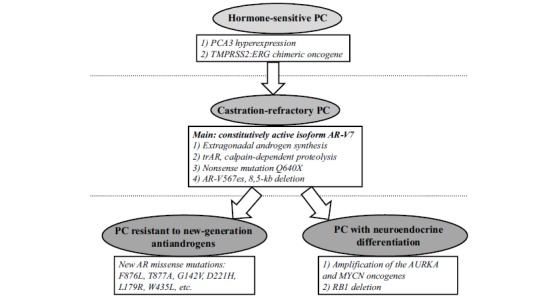
Prostate cancer (PC) is the most common uro-oncological disease in the global population and still requires a more efficient laboratory diagnosis. Point mutations of oncogenes and tumor sup-pressor genes are the most frequent molecular genetic events in carcinogenesis. The mutations are re-sponsible, to a great extent, for the clonal evolution of cancer and can be considered as primary candi-date molecular markers of PC. Using next-generation sequencing to analyze the mutations in PC, the main molecular PC subtypes were identified, which depended on the presence of fusion genes and FOXA1, CHD1, and SPOP point mutations; other driver mutations responsible for the progression of PC subclones were also characterized. This review summarizes the data on early PC genetic markers (an mtDNA deletion, and TMPRSS2:ERG expression), as well as these somatic mutations at later stages of PC. Emphasis is placed on a switch in AR synthesis to a constitutively active variant and the point muta-tions that facilitate PC transition to a castration-refractory state that is resistant to new AR inhibitors. Based on the current whole-exome sequencing data, the frequencies and localizations of the somatic mu-tations that may provide new genetic diagnostic markers and drug targets are described.
前列腺癌(PC)是全球人群中最常见的泌尿肿瘤疾病,仍需要更有效的实验室诊断。癌基因和肿瘤抑制基因的点突变是致癌过程中最常见的分子遗传事件。这些突变在很大程度上导致了癌症的克隆进化,可被视为前列腺癌的主要候选分子标志物。通过下一代测序分析前列腺癌中的突变,确定了主要的前列腺癌分子亚型,其取决于融合基因以及FOXA1、CHD1和SPOP点突变的存在;还对导致前列腺癌亚克隆进展的其他驱动突变进行了表征。本综述总结了早期前列腺癌遗传标志物(线粒体DNA缺失和TMPRSS2:ERG表达)以及前列腺癌后期这些体细胞突变的数据。重点在于雄激素受体(AR)合成向组成型活性变体的转变以及促进前列腺癌转变为对新的AR抑制剂耐药的去势抵抗状态的点突变。基于当前的全外显子测序数据,描述了可能提供新的遗传诊断标志物和药物靶点的体细胞突变的频率和定位。