Schepetilnikov Mikhail, Ryabova Lyubov A
Institut de Biologie Moléculaire des Plantes, Centre National de la Recherche Scientifique, UPR 2357, Université de StrasbourgStrasbourg, France.
Front Plant Sci. 2017 Jun 14;8:1014. doi: 10.3389/fpls.2017.01014. eCollection 2017.
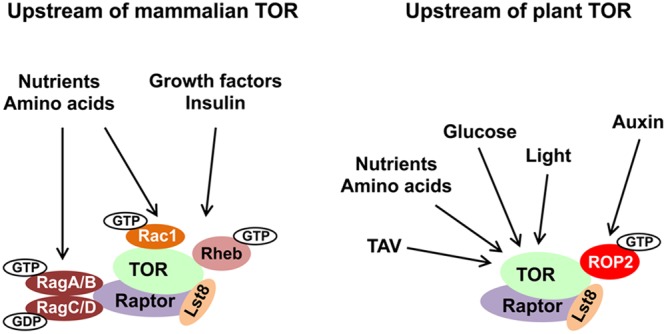
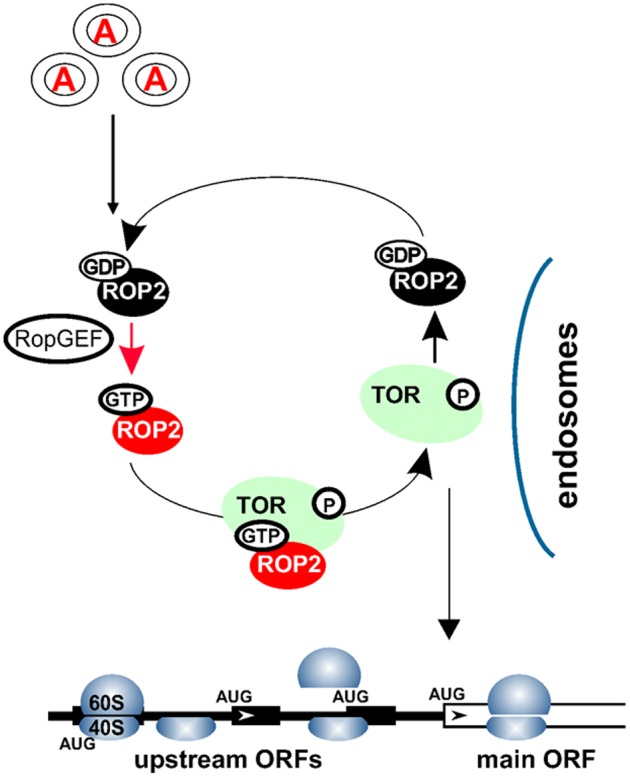
The mRNA translation machinery directs protein production, and thus cell growth, according to prevailing cellular and environmental conditions. The target of rapamycin (TOR) signaling pathway-a major growth-related pathway-plays a pivotal role in optimizing protein synthesis in mammals, while its deregulation triggers uncontrolled cell proliferation and the development of severe diseases. In plants, several signaling pathways sensitive to environmental changes, hormones, and pathogens have been implicated in post-transcriptional control, and thus far phytohormones have attracted most attention as TOR upstream regulators in plants. Recent data have suggested that the coordinated actions of the phytohormone auxin, Rho-like small GTPases (ROPs) from plants, and TOR signaling contribute to translation regulation of mRNAs that harbor upstream open reading frames (uORFs) within their 5'-untranslated regions (5'-UTRs). This review will summarize recent advances in translational regulation of a specific set of uORF-containing mRNAs that encode regulatory proteins-transcription factors, protein kinases and other cellular controllers-and how their control can impact plant growth and development.
信使核糖核酸(mRNA)翻译机制根据当前的细胞和环境条件指导蛋白质合成,进而调控细胞生长。雷帕霉素靶蛋白(TOR)信号通路是一条主要的与生长相关的信号通路,在优化哺乳动物蛋白质合成过程中发挥着关键作用,而其失调会引发细胞的失控增殖以及严重疾病的发展。在植物中,一些对环境变化、激素及病原体敏感的信号通路参与转录后调控,到目前为止,植物激素作为植物中TOR的上游调节因子受到了最多关注。最近的数据表明,植物激素生长素、植物中的Rho样小GTP酶(ROP)以及TOR信号的协同作用有助于对5'-非翻译区(5'-UTR)内含有上游开放阅读框(uORF)的mRNA进行翻译调控。本综述将总结近期在一组特定的含uORF的mRNA翻译调控方面取得的进展,这些mRNA编码调控蛋白——转录因子、蛋白激酶和其他细胞调控因子,以及它们的调控如何影响植物的生长和发育。