• 文献检索
  • 文档翻译
  • 深度研究
  • 学术资讯
  • Suppr Zotero 插件Zotero 插件
  • 邀请有礼
  • 套餐&价格
  • 历史记录
应用&插件
Suppr Zotero 插件Zotero 插件浏览器插件Mac 客户端Windows 客户端微信小程序
定价
高级版会员购买积分包购买API积分包
服务
文献检索文档翻译深度研究API 文档MCP 服务
关于我们
关于 Suppr公司介绍联系我们用户协议隐私条款
关注我们

Suppr 超能文献

核心技术专利:CN118964589B侵权必究
粤ICP备2023148730 号-1Suppr @ 2026

文献检索

告别复杂PubMed语法,用中文像聊天一样搜索,搜遍4000万医学文献。AI智能推荐,让科研检索更轻松。

立即免费搜索

文件翻译

保留排版,准确专业,支持PDF/Word/PPT等文件格式,支持 12+语言互译。

免费翻译文档

深度研究

AI帮你快速写综述,25分钟生成高质量综述,智能提取关键信息,辅助科研写作。

立即免费体验

金属对金属髋关节表面置换失败病例中血清金属离子水平与年龄相关性黄斑变性病理变化的相关性

Correlation of serum metal ion levels with pathological changes of ARMD in failed metal-on-metal-hip-resurfacing arthroplasties.

作者信息

Grammatopoulos George, Munemoto Mitsuru, Pollalis Athanasios, Athanasou Nicholas A

机构信息

Nuffield Orthopaedic Centre, Windmill Road, Headington, Oxford, OX3 7LD, UK.

Nuffield Department Orthopaedics Rheumatology and Musculoskeletal Sciences (NDORMS), University of Oxford, Windmill Road, Oxford, UK.

出版信息

Arch Orthop Trauma Surg. 2017 Aug;137(8):1129-1137. doi: 10.1007/s00402-017-2723-x. Epub 2017 Jun 28.

DOI:10.1007/s00402-017-2723-x
PMID:28660477
原文链接:https://pmc.ncbi.nlm.nih.gov/articles/PMC5511305/
Abstract

BACKGROUND

Metal-on-metal-hip-resurfacing arthroplasties (MoMHRAs) have been associated with an increased failure rates due to an adverse-response-to-metal-debris (ARMD) associated with a spectrum of pathological features. Serum levels of cobalt (Co) and chromium (Cr) are used to assess MoMHRAs, with regard to ARMD, but it is not certain whether ion levels correlate with pathological changes in periprosthetic tissues.

METHODS

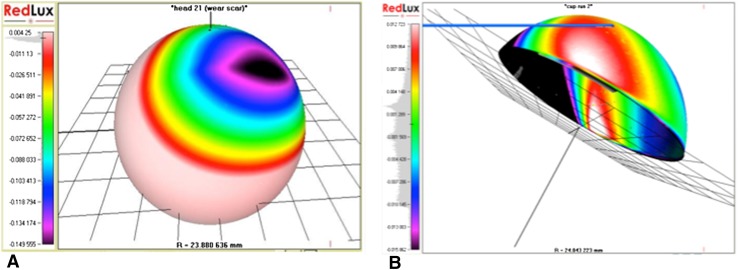
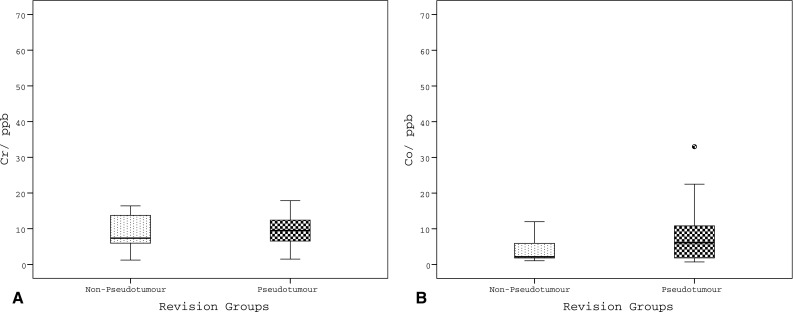
Serum Co and Cr levels were correlated with histological findings in 38 revised MoMHRAs (29 pseudotumour cases and 9 non-pseudotumour cases revised for pain). The extent of necrosis and macrophage infiltrate as well as the aseptic lymphocyte-dominated vasculitis-associated lesion (ALVAL) response was assessed semi-quantitatively; the prosthesis linear wear rate (PLWR) was also determined in ten cases.

RESULTS

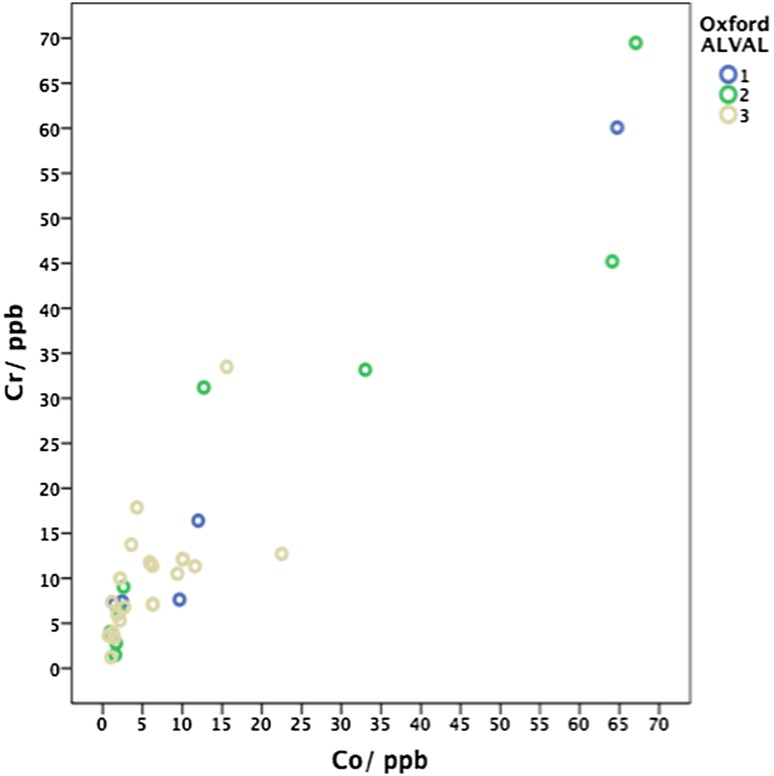
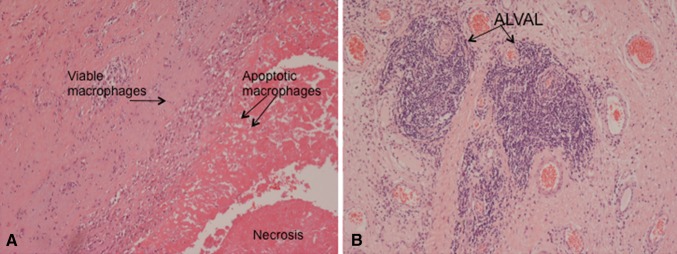
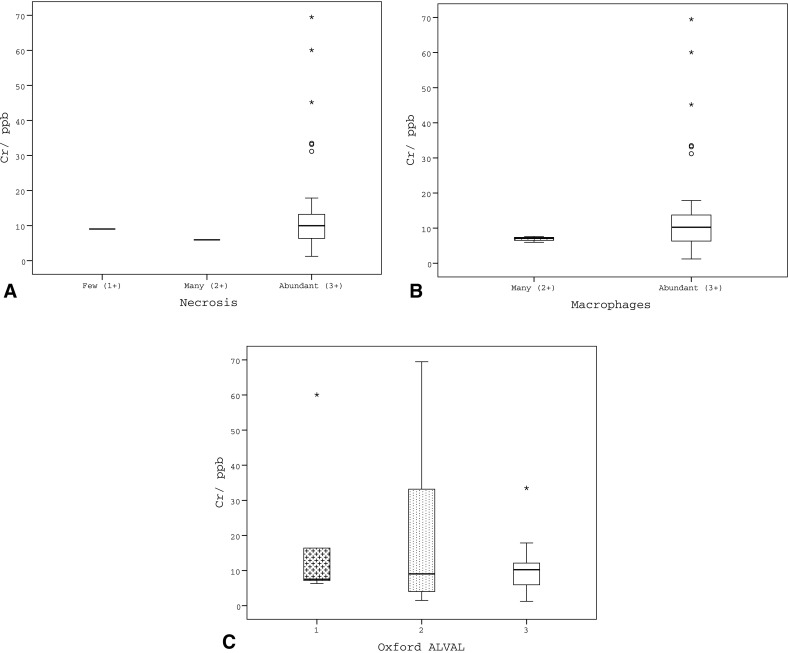
Cr levels were elevated in 82% and Co levels elevated in 53% of cases; the PLWR correlated with Cr level (rho = 0.8, p = 0.006). Tissue necrosis and macrophage infiltration were noted in all, most of which also exhibited significant ALVAL. Although a discrete correlation was not seen between Co and/or Cr ion levels and the extent of necrosis, degree of macrophage infiltration, or ALVAL score, it was noted that cases with acceptable metal ions levels had high ALVAL score.

CONCLUSION

Histological features of both innate and adaptive immune response to metal wear are seen in periprosthetic tissues in cases with both elevated and non-elevated metal ion levels. MoMHRA failures with acceptable ion levels exhibited a pronounced ALVAL response. Although metal ion levels are elevated in most cases of MoMHRA failure due to ARMD, the finding of a normal metal ion level does not exclude this diagnosis.

摘要

背景

金属对金属髋关节表面置换术(MoMHRAs)因与一系列病理特征相关的金属碎片不良反应(ARMD)而导致失败率增加。血清钴(Co)和铬(Cr)水平用于评估MoMHRAs的ARMD情况,但尚不确定离子水平是否与假体周围组织的病理变化相关。

方法

对38例翻修的MoMHRAs(29例假肿瘤病例和9例因疼痛翻修的非假肿瘤病例)的血清Co和Cr水平与组织学结果进行相关性分析。对坏死程度、巨噬细胞浸润以及无菌性淋巴细胞为主的血管炎相关病变(ALVAL)反应进行半定量评估;还对10例病例测定了假体线性磨损率(PLWR)。

结果

82%的病例Cr水平升高,53%的病例Co水平升高;PLWR与Cr水平相关(rho = 0.8,p = 0.006)。所有病例均出现组织坏死和巨噬细胞浸润,其中大多数也表现出明显的ALVAL。虽然未发现Co和/或Cr离子水平与坏死程度、巨噬细胞浸润程度或ALVAL评分之间存在明确的相关性,但注意到金属离子水平可接受的病例ALVAL评分较高。

结论

在金属离子水平升高和未升高的病例中,假体周围组织均可见对金属磨损的先天性和适应性免疫反应的组织学特征。离子水平可接受的MoMHRA失败病例表现出明显的ALVAL反应。虽然由于ARMD导致的大多数MoMHRA失败病例中金属离子水平升高,但金属离子水平正常并不能排除该诊断。
https://cdn.ncbi.nlm.nih.gov/pmc/blobs/f87d/5511305/e91bf0938dfc/402_2017_2723_Fig5_HTML.jpg
https://cdn.ncbi.nlm.nih.gov/pmc/blobs/f87d/5511305/e0c2ad721e45/402_2017_2723_Fig1_HTML.jpg
https://cdn.ncbi.nlm.nih.gov/pmc/blobs/f87d/5511305/0fd28fb1ca87/402_2017_2723_Fig2_HTML.jpg
https://cdn.ncbi.nlm.nih.gov/pmc/blobs/f87d/5511305/204686e7f66b/402_2017_2723_Fig3_HTML.jpg
https://cdn.ncbi.nlm.nih.gov/pmc/blobs/f87d/5511305/fa65ac84747e/402_2017_2723_Fig4_HTML.jpg
https://cdn.ncbi.nlm.nih.gov/pmc/blobs/f87d/5511305/e91bf0938dfc/402_2017_2723_Fig5_HTML.jpg
https://cdn.ncbi.nlm.nih.gov/pmc/blobs/f87d/5511305/e0c2ad721e45/402_2017_2723_Fig1_HTML.jpg
https://cdn.ncbi.nlm.nih.gov/pmc/blobs/f87d/5511305/0fd28fb1ca87/402_2017_2723_Fig2_HTML.jpg
https://cdn.ncbi.nlm.nih.gov/pmc/blobs/f87d/5511305/204686e7f66b/402_2017_2723_Fig3_HTML.jpg
https://cdn.ncbi.nlm.nih.gov/pmc/blobs/f87d/5511305/fa65ac84747e/402_2017_2723_Fig4_HTML.jpg
https://cdn.ncbi.nlm.nih.gov/pmc/blobs/f87d/5511305/e91bf0938dfc/402_2017_2723_Fig5_HTML.jpg

相似文献

1
Correlation of serum metal ion levels with pathological changes of ARMD in failed metal-on-metal-hip-resurfacing arthroplasties.金属对金属髋关节表面置换失败病例中血清金属离子水平与年龄相关性黄斑变性病理变化的相关性
Arch Orthop Trauma Surg. 2017 Aug;137(8):1129-1137. doi: 10.1007/s00402-017-2723-x. Epub 2017 Jun 28.
2
Implant failure in bilateral metal-on-metal hip resurfacing arthroplasties: a clinical and pathological study.双侧金属对金属髋关节表面置换术后的假体失败:一项临床和病理学研究。
J Mater Sci Mater Med. 2018 Mar 7;29(3):28. doi: 10.1007/s10856-018-6037-5.
3
Analysis of bearing wear, whole blood and synovial fluid metal ion concentrations and histopathological findings in patients with failed ASR hip resurfacings.对ASR髋关节表面置换失败患者的轴承磨损、全血和滑液金属离子浓度及组织病理学结果的分析。
BMC Musculoskelet Disord. 2017 Dec 11;18(1):523. doi: 10.1186/s12891-017-1894-5.
4
The correlation of wear with histological features after failed hip resurfacing arthroplasty.髋关节表面置换翻修术后磨损与组织学特征的相关性。
J Bone Joint Surg Am. 2013 Jun 19;95(12):e81. doi: 10.2106/JBJS.L.00775.
5
Metal Ion Levels Are Not Correlated With Histopathology of Adverse Local Tissue Reactions in Taper Corrosion of Total Hip Arthroplasty.金属离子水平与全髋关节置换术锥形腐蚀中局部组织不良反应的组织病理学无关。
J Arthroplasty. 2016 Aug;31(8):1797-802. doi: 10.1016/j.arth.2016.01.041. Epub 2016 Feb 4.
6
The Diagnostic Utility of Serum Metal Ion Markers for High-Grade Aseptic Lymphocyte-Dominated Vasculitis-Associated Lesions (ALVALs) in Revision Hip and Knee Arthroplasty: An International Multicenter Study.血清金属离子标志物对髋关节和膝关节翻修术时高级别无菌性淋巴细胞为主型血管炎相关病变(ALVAL)的诊断效用:一项国际多中心研究。
J Arthroplasty. 2024 Jan;39(1):206-210. doi: 10.1016/j.arth.2023.06.024. Epub 2023 Jun 16.
7
Blood Metal Ion Thresholds to Identify Patients with Metal-on-Metal Hip Implants at Risk of Adverse Reactions to Metal Debris: An External Multicenter Validation Study of Birmingham Hip Resurfacing and Corail-Pinnacle Implants.识别金属对金属髋关节植入物有金属碎屑不良反应风险患者的血液金属离子阈值:对伯明翰髋关节表面置换术和Corail-Pinnacle植入物的外部多中心验证研究
J Bone Joint Surg Am. 2017 Sep 20;99(18):1532-1539. doi: 10.2106/JBJS.16.01568.
8
Can blood metal ion levels be used to identify patients with bilateral Birmingham Hip Resurfacings who are at risk of adverse reactions to metal debris?血液金属离子水平能否用于识别接受双侧伯明翰髋关节表面置换术且有金属碎屑不良反应风险的患者?
Bone Joint J. 2016 Nov;98-B(11):1455-1462. doi: 10.1302/0301-620X.98B11.38042.
9
MRI Findings in Patients After Small-Head Metal-on-Metal Total Hip Arthroplasty with a Minimum Follow-up of 10 Years.小尺寸金属对金属全髋关节置换术后 10 年以上患者的 MRI 检查结果。
J Bone Joint Surg Am. 2017 Sep 20;99(18):1540-1546. doi: 10.2106/JBJS.16.01021.
10
Blood Metal Ion Levels Have Limited Utility in the Surveillance of Asymptomatic Large-Head Metal-on-Metal Total Hip Arthroplasties.血金属离子水平在无症状大头金属对金属全髋关节置换术后的监测中应用价值有限。
J Arthroplasty. 2017 Dec;32(12):3685-3688. doi: 10.1016/j.arth.2017.07.015. Epub 2017 Jul 20.

引用本文的文献

1
Comparison of blood metal ion levels in scoliosis patients following instrumented spinal fusion with cobalt-chromium and titanium alloy rods.脊柱侧弯患者使用钴铬合金棒和钛合金棒进行器械脊柱融合术后血液中金属离子水平的比较。
Sci Rep. 2025 May 13;15(1):16549. doi: 10.1038/s41598-025-99065-x.
2
Metal ion levels after metal-on-metal hip resurfacing: A single-center longitudinal study of Chinese patients.金属对金属髋关节表面置换术后金属离子水平:中国患者的单中心纵向研究。
Acta Orthop Traumatol Turc. 2024 Jul 31;58(4):196-202. doi: 10.5152/j.aott.2024.23096.
3
Aluminum Nanoparticles Affect Human Platelet Function In Vitro.

本文引用的文献

1
The pathobiology and pathology of aseptic implant failure.无菌性植入物失败的病理生物学与病理学
Bone Joint Res. 2016 May;5(5):162-8. doi: 10.1302/2046-3758.55.BJR-2016-0086.
2
No association between pseudotumors, high serum metal-ion levels and metal hypersensitivity in large-head metal-on-metal total hip arthroplasty at 5-7-year follow-up.在5至7年随访期的大头金属对金属全髋关节置换术中,假肿瘤、高血清金属离子水平与金属超敏反应之间无关联。
Skeletal Radiol. 2016 Jan;45(1):115-25. doi: 10.1007/s00256-015-2264-8. Epub 2015 Oct 10.
3
Predicting high blood metal ion concentrations following hip resurfacing.
铝纳米颗粒对体外人血小板功能的影响。
Int J Mol Sci. 2023 Jan 29;24(3):2547. doi: 10.3390/ijms24032547.
4
Periarticular metal hypersensitivity complications of hip bearings containing cobalt-chromium.含钴铬的髋关节轴承的关节周围金属超敏反应并发症
EFORT Open Rev. 2022 Dec 7;7(11):758-771. doi: 10.1530/EOR-22-0036.
5
Careful patient selection together with optimal implant positioning may reduce but does not eliminate the risk of elevated serum cobalt and chrome levels following metal-on-metal hip resurfacing.仔细选择患者并优化植入物定位可以降低,但不能消除金属对金属髋关节表面置换术后血清钴和铬水平升高的风险。
Hip Int. 2023 Sep;33(5):872-879. doi: 10.1177/11207000221124302. Epub 2022 Oct 30.
6
Correlation between Metal Ions and Cytokines in the Saliva of Patients with Oral Lichenoid Lesions.口腔苔藓样病变患者唾液中金属离子与细胞因子的相关性。
Yonsei Med J. 2021 Aug;62(8):767-775. doi: 10.3349/ymj.2021.62.8.767.
7
Semi-quantitative histology confirms that the macrophage is the predominant cell type in metal-on-metal hip tissues.半定量组织学证实,巨噬细胞是金属对金属髋关节组织中的主要细胞类型。
J Orthop Res. 2022 Feb;40(2):387-395. doi: 10.1002/jor.25040. Epub 2021 Apr 6.
8
[Surface modifications of implants. Part 2 : Clinical application].[植入物的表面改性。第2部分:临床应用]
Orthopade. 2018 May;47(5):445-458. doi: 10.1007/s00132-018-3560-5.
9
Implant failure in bilateral metal-on-metal hip resurfacing arthroplasties: a clinical and pathological study.双侧金属对金属髋关节表面置换术后的假体失败:一项临床和病理学研究。
J Mater Sci Mater Med. 2018 Mar 7;29(3):28. doi: 10.1007/s10856-018-6037-5.
预测髋关节表面置换术后血液中金属离子的高浓度。
Hip Int. 2015 Nov-Dec;25(6):510-9. doi: 10.5301/hipint.5000258. Epub 2015 Jun 6.
4
Do retrieval analysis and blood metal measurements contribute to our understanding of adverse local tissue reactions?检索分析和血液金属测量对我们理解局部组织不良反应有帮助吗?
Clin Orthop Relat Res. 2014 Dec;472(12):3718-27. doi: 10.1007/s11999-014-3893-2.
5
Surveillance of Patients with Metal-on-Metal Hip Resurfacing and Total Hip Prostheses: A Prospective Cohort Study to Investigate the Relationship Between Blood Metal Ion Levels and Implant Failure.金属对金属髋关节表面置换术和全髋关节假体患者的监测:一项前瞻性队列研究,旨在调查血液金属离子水平与植入物失败之间的关系。
J Bone Joint Surg Am. 2014 Jul 2;96(13):1091-1099. doi: 10.2106/JBJS.M.00957.
6
Repeated metal ion measurements in patients with high risk metal-on-metal hip replacement.对高风险金属对金属髋关节置换患者进行重复金属离子测量。
Int Orthop. 2014 Jul;38(7):1353-61. doi: 10.1007/s00264-014-2300-7. Epub 2014 Mar 18.
7
Histologic, serologic, and tribologic findings in failed metal-on-metal total hip arthroplasty: AAOS exhibit selection.金属对金属全髋关节置换失败的组织学、血清学和摩擦学研究:AAOS 精选研究
J Bone Joint Surg Am. 2013 Nov 6;95(21):e163. doi: 10.2106/JBJS.L.01446.
8
Metal-on-metal hip prostheses: correlation between debris in the synovial fluid and levels of cobalt and chromium ions in the bloodstream.金属对金属髋关节假体:滑液中的碎屑与血液中钴离子和铬离子水平之间的相关性。
Int Orthop. 2014 Mar;38(3):469-75. doi: 10.1007/s00264-013-2137-5.
9
High metal ion levels after use of the ASR™ device correlate with development of pseudotumors and T cell activation.使用 ASR™ 装置后金属离子水平升高与假性肿瘤的发生和 T 细胞激活相关。
Clin Orthop Relat Res. 2014 Mar;472(3):953-61. doi: 10.1007/s11999-013-3307-x. Epub 2013 Oct 1.
10
Metal ion levels from well-functioning Birmingham Hip Resurfacings decline significantly at ten years.在十年时,功能良好的 Birmingham Hip Resurfacings 的金属离子水平显著下降。
Bone Joint J. 2013 Oct;95-B(10):1332-8. doi: 10.1302/0301-620X.95B10.32022.