Royal National Hospital for Rheumatic Diseases, Royal United Hospitals Bath NHS Foundation Trust, Upper Borough Walls, Bath, BA1 1RL, UK; Department of Pharmacy and Pharmacology, University of Bath, Claverton Down, Bath, BA2 7AY, UK.
Inflammation and Rheumatology Section, UCL Institute of Child Health and Arthritis Research UK Centre for Adolescent Rheumatology at UCL, UCLH and GOSH, London, UK.
J Autoimmun. 2017 Nov;84:55-64. doi: 10.1016/j.jaut.2017.06.007. Epub 2017 Jun 26.
Juvenile myositis is a rare and heterogeneous disease. Diagnosis is often difficult but early treatment is important in reducing the risk of associated morbidity and poor outcomes. Myositis specific autoantibodies have been described in both juvenile and adult patients with myositis and can be helpful in dividing patients into clinically homogenous groups. We aimed to explore the utility of myositis specific autoantibodies as diagnostic and prognostic biomarkers in patients with juvenile-onset disease.
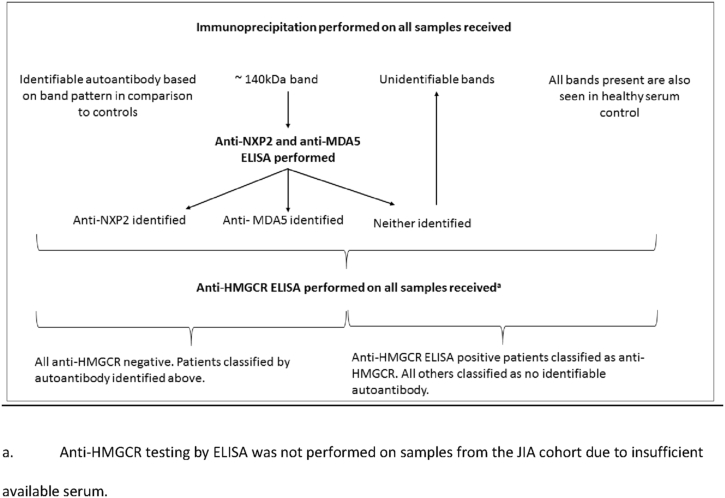
Using radio-labelled immunoprecipitation and previously validated ELISAs we examined the presence of myositis specific autoantibodies in 380 patients with juvenile-onset myositis in addition to, 318 patients with juvenile idiopathic arthritis, 21 patients with juvenile-onset SLE, 27 patients with muscular dystrophies, and 48 healthy children.
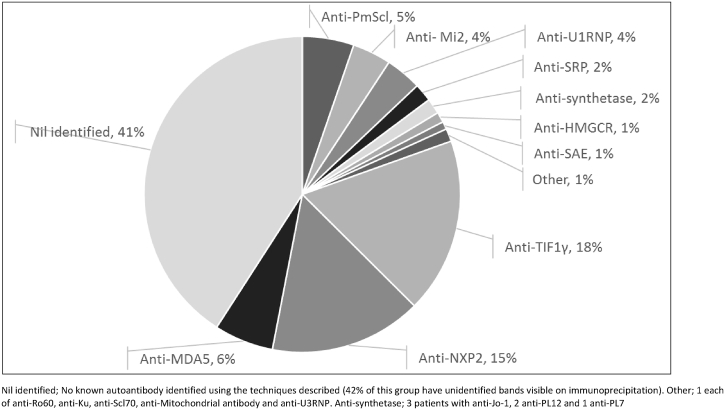
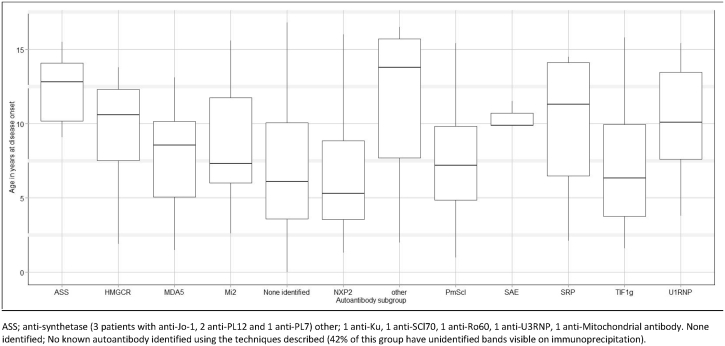
An autoantibody was identified in 60% of juvenile-onset myositis patients. Myositis specific autoantibodies (49% patients) were exclusively found in patients with myositis and with the exception of one case were mutually exclusive and not found in conjunction with another autoantibody. Autoantibody subtypes were associated with age at disease onset, key clinical disease features and treatment received.
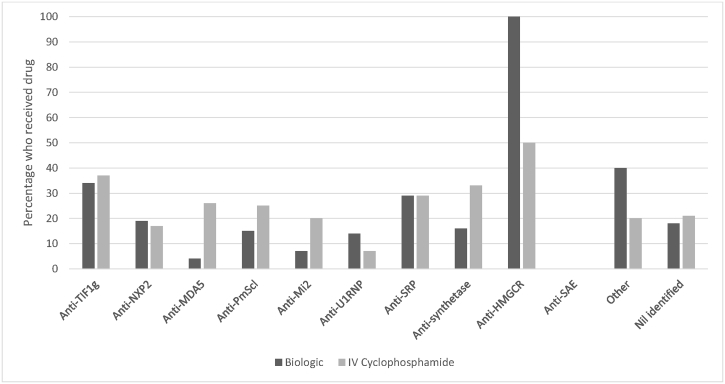
In juvenile patients the identification of a myositis specific autoantibody is highly suggestive of myositis. Autoantibodies can be identified in the majority of affected children and provide useful prognostic information. There is evidence of a differential treatment approach and patients with anti-TIF1γ autoantibodies are significantly more likely to receive aggressive treatment with IV cyclophosphamide and/or biologic drugs, clear trends are also visible in other autoantibody subgroups.
青少年皮肌炎是一种罕见且异质性的疾病。早期诊断困难,但早期治疗对于降低相关发病率和不良结局的风险非常重要。肌炎特异性自身抗体已在青少年和成人皮肌炎患者中被描述,并且可以帮助将患者分为临床同质性组。我们旨在探讨肌炎特异性自身抗体作为青少年发病疾病的诊断和预后生物标志物的效用。
我们使用放射性免疫沉淀和以前验证的 ELISA,在 380 名患有青少年发病皮肌炎的患者中,以及 318 名患有青少年特发性关节炎、21 名患有青少年发病系统性红斑狼疮、27 名患有肌肉萎缩症和 48 名健康儿童中,检测了肌炎特异性自身抗体的存在。
在 60%的青少年发病皮肌炎患者中发现了自身抗体。肌炎特异性自身抗体(49%的患者)仅在肌炎患者中发现,除了一个病例外,它们是相互排斥的,并且与另一种自身抗体不一起发现。自身抗体亚型与疾病发病年龄、关键临床疾病特征和接受的治疗有关。
在青少年患者中,肌炎特异性自身抗体的鉴定高度提示为皮肌炎。自身抗体可在大多数受影响的儿童中识别,并提供有用的预后信息。有证据表明存在不同的治疗方法,并且抗-TIF1γ 自身抗体的患者更有可能接受静脉注射环磷酰胺和/或生物药物的强化治疗,在其他自身抗体亚组中也可以看到明显的趋势。