Banuelos Erika, Ramsey Keri, Belnap Newell, Krishnan Malavika, Balak Chris, Szelinger Szabolcs, Siniard Ashley L, Russell Megan, Richholt Ryan, De Both Matt, Piras Ignazio, Naymik Marcus, Claasen Ana M, Rangasamy Sampathkumar, Huentelman Matthew J, Craig David W, Campeau Philippe M, Narayanan Vinodh, Schrauwen Isabelle
Center for Rare Childhood Disorders, Translational Genomics Research Institute, Phoenix, AZ, 85004, USA.
Neurogenomics Division, Translational Genomics Research Institute, Phoenix, AZ, 85004, USA.
F1000Res. 2017 Apr 24;6:553. doi: 10.12688/f1000research.10588.1. eCollection 2017.
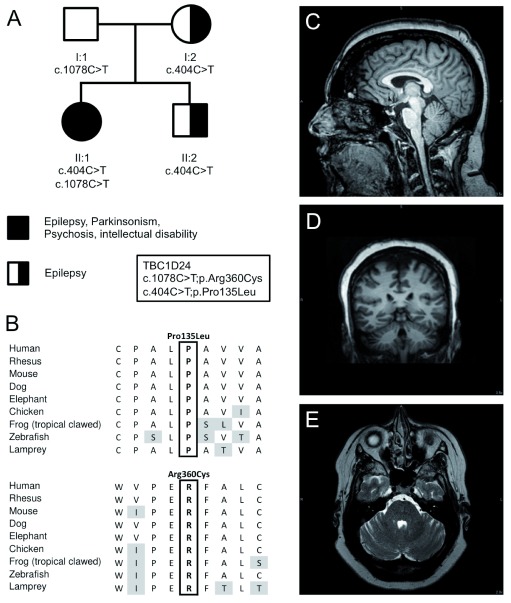
Mutations disrupting presynaptic protein TBC1D24 are associated with a variable neurological phenotype, including DOORS syndrome, myoclonic epilepsy, early-infantile epileptic encephalopathy, and non-syndromic hearing loss. In this report, we describe a family segregating autosomal dominant epilepsy, and a 37-year-old Caucasian female with a severe neurological phenotype including epilepsy, Parkinsonism, psychosis, visual and auditory hallucinations, gait ataxia and intellectual disability. Whole exome sequencing revealed two missense mutations in the gene segregating within this family (c.1078C>T; p.Arg360Cys and c.404C>T; p.Pro135Leu). The female proband who presents with a severe neurological phenotype carries both of these mutations in a compound heterozygous state. The p.Pro135Leu variant, however, is present in the proband's mother and sibling as well, and is consistent with an autosomal dominant pattern linked to tonic-clonic and myoclonic epilepsy. In conclusion, we describe a single family in which mutations cause expanded dominant and recessive phenotypes. In addition, we discuss and highlight that some variants in might cause a dominant susceptibility to epilepsy.
破坏突触前蛋白TBC1D24的突变与多种神经学表型相关,包括DOORS综合征、肌阵挛性癫痫、早发性婴儿癫痫性脑病和非综合征性听力损失。在本报告中,我们描述了一个分离常染色体显性癫痫的家族,以及一名37岁的白种女性,她具有严重的神经学表型,包括癫痫、帕金森症、精神病、视觉和听觉幻觉、步态共济失调和智力残疾。全外显子组测序揭示了该家族中分离出的该基因的两个错义突变(c.1078C>T;p.Arg360Cys和c.404C>T;p.Pro135Leu)。表现出严重神经学表型的女性先证者以复合杂合状态携带这两种突变。然而,p.Pro135Leu变体也存在于先证者的母亲和兄弟姐妹中,并且与与强直阵挛性和肌阵挛性癫痫相关的常染色体显性模式一致。总之,我们描述了一个单一的家族,其中突变导致显性和隐性表型扩展。此外,我们讨论并强调,该基因中的一些变体可能导致对癫痫的显性易感性。