Murali Malliga Raman, Naveen Sangeetha Vasudevaraj, Son Chang Gue, Raghavendran Hanumantha Rao Balaji
Tissue Engineering Group, National Orthopaedic Centre of Excellence for Research and Learning (NOCERAL), Department of Orthopaedic surgery, Faculty of Medicine, University of Malaya, Kuala Lumpur, Malaysia.
Liver and Immunology Research Center, Oriental Medical College of Daejeon University, Daejeon, South Korea.
Integr Med Res. 2014 Sep;3(3):111-118. doi: 10.1016/j.imr.2014.04.001. Epub 2014 Apr 24.
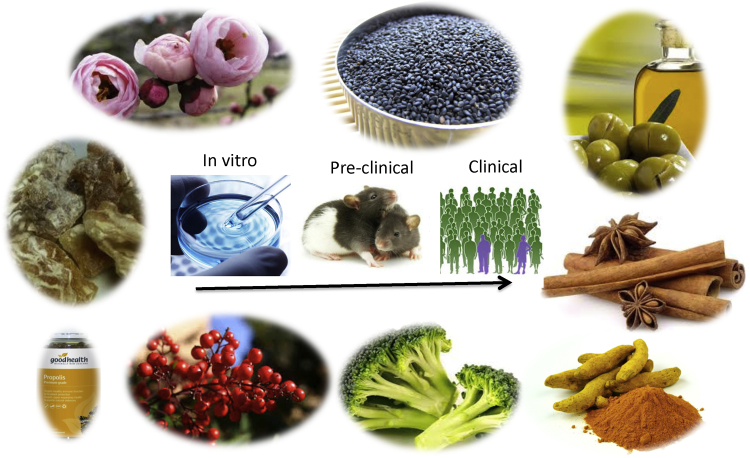
, a spiral-shaped Gram-negative bacterium, has been classified as a class I carcinogen by the World Health Organization and recognized as the causative agent for peptic ulcers, duodenal ulcer, gastritis, mucosa-associated lymphoid tissue lymphomas, and gastric cancer. Owing to their alarming rate of drug resistance, eradication of remains a global challenge. Triple therapy consisting of a proton pump inhibitor, clarithromycin, and either amoxicillin or metronidazole, is generally the recommended standard for the treatment of infection. Complementary and alternative medicines have a long history in the treatment of gastrointestinal ailments and various compounds has been tested for anti- activity both and ; however, their successful use in human clinical trials is sporadic. Hence, the aim of this review is to analyze the role of some well-known natural products that have been tested in clinical trials in preventing, altering, or treating infections. Whereas some and studies in the literature have demonstrated the successful use of a few potential natural products for the treatment of -related infections, others indicate a need to consider natural products, with or without triple therapy, as a useful alternative in treating -related infections. Thus, the reported mechanisms include killing of urease inhibition, induction of bacterial cell damage, and immunomodulatory effect on the host immune system. Furthermore, both and studies have demonstrated the successful use of some potential natural products for the treatment of -related infections. Nevertheless, the routine prescription of potential complementary and alternative medicines continues to be restrained, and evidence on the safety and efficacy of the active compounds remains a subject of ongoing debate.
幽门螺杆菌是一种螺旋形革兰氏阴性菌,已被世界卫生组织列为I类致癌物,并被公认为消化性溃疡、十二指肠溃疡、胃炎、黏膜相关淋巴组织淋巴瘤和胃癌的病原体。由于其惊人的耐药率,根除幽门螺杆菌仍然是一项全球性挑战。由质子泵抑制剂、克拉霉素以及阿莫西林或甲硝唑组成的三联疗法通常是治疗幽门螺杆菌感染的推荐标准疗法。补充和替代药物在治疗胃肠道疾病方面有着悠久的历史,并且已经对各种化合物进行了体内和体外的抗幽门螺杆菌活性测试;然而,它们在人体临床试验中的成功应用并不常见。因此,本综述的目的是分析一些在临床试验中已测试过的知名天然产物在预防、改变或治疗幽门螺杆菌感染中的作用。虽然文献中的一些体内和体外研究已经证明了一些潜在天然产物成功用于治疗幽门螺杆菌相关感染,但其他研究表明,需要考虑将天然产物(无论是否联合三联疗法)作为治疗幽门螺杆菌相关感染的一种有用替代方法。因此,报道的作用机制包括杀死幽门螺杆菌、抑制脲酶、诱导细菌细胞损伤以及对宿主免疫系统的免疫调节作用。此外,体内和体外研究均已证明一些潜在天然产物成功用于治疗幽门螺杆菌相关感染。然而,潜在补充和替代药物的常规处方仍然受到限制,活性化合物的安全性和有效性证据仍然是一个持续争论的话题。