Suppr超能文献

高度灵活的机器人针实现肝脏组织的分布式消融。

Highly Articulated Robotic Needle Achieves Distributed Ablation of Liver Tissue.

作者信息

Gerboni Giada, Greer Joseph D, Laeseke Paul F, Hwang Gloria L, Okamura Allison M

机构信息

Mechanical Engineering Department, Stanford University, Stanford, CA 94035 USA.

Radiology Department, University of Wisconsin, Madison, WI 53715 USA.

出版信息

IEEE Robot Autom Lett. 2017 Jul;2(3):1367-1374. doi: 10.1109/LRA.2017.2668467. Epub 2017 Feb 14.

Abstract

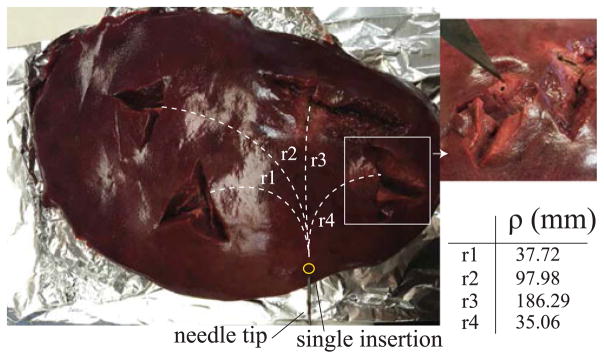
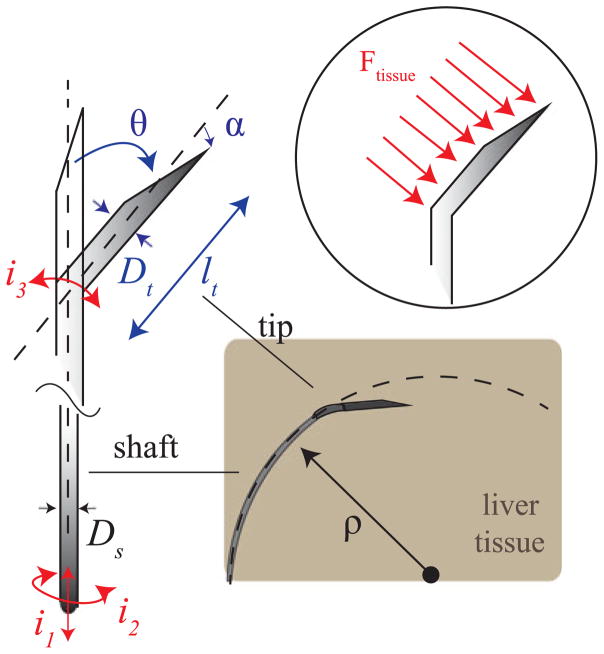
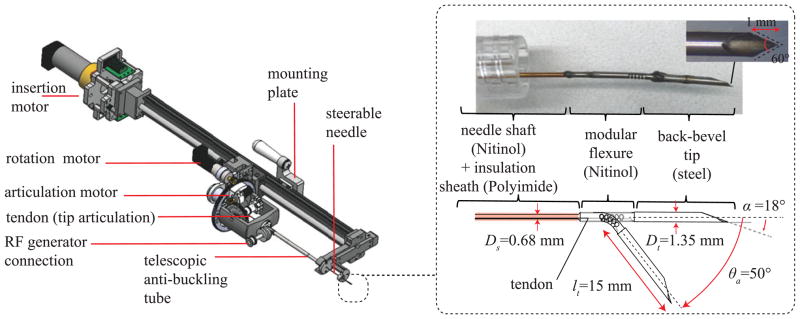
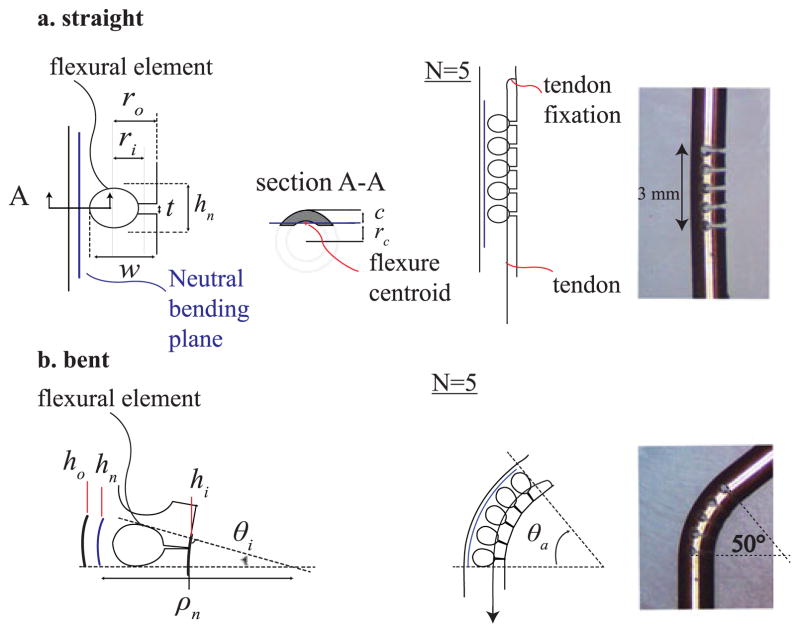
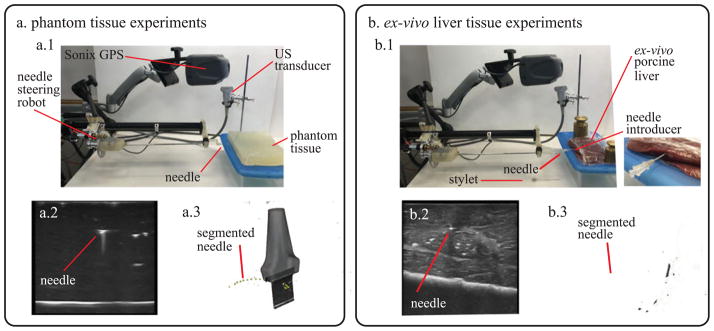
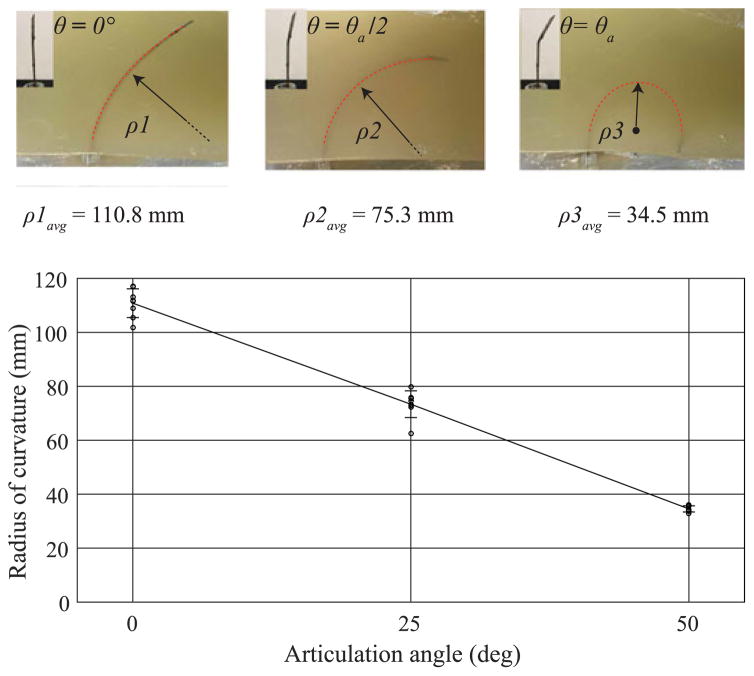
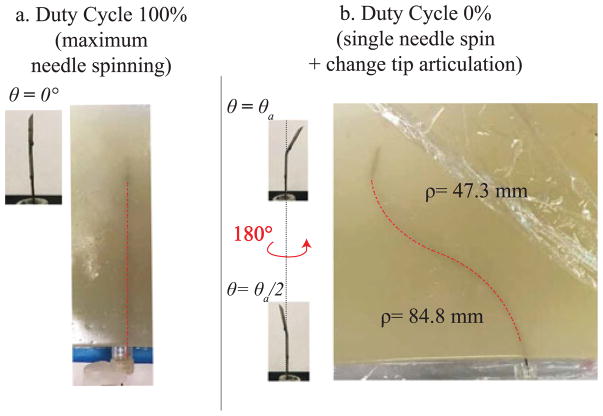
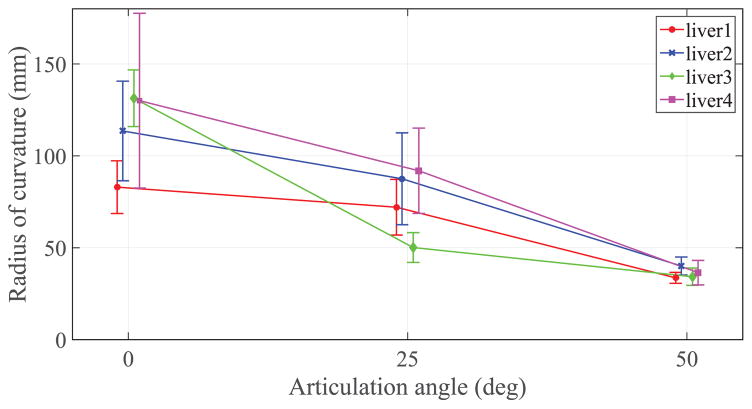
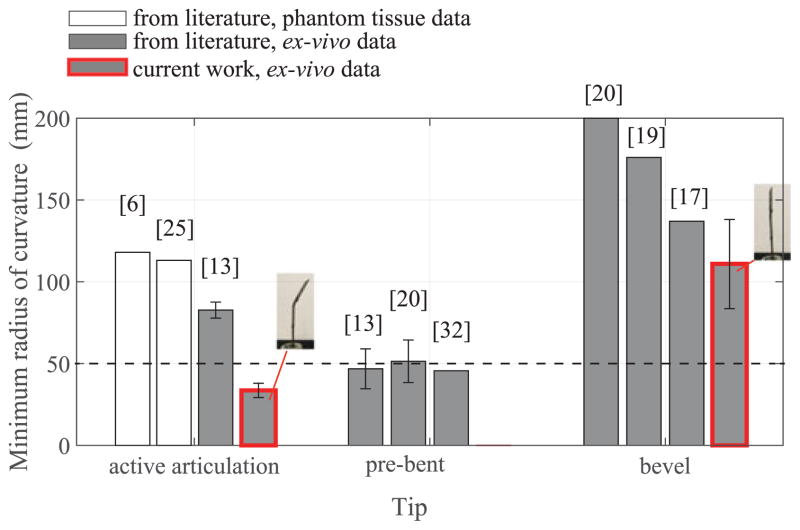
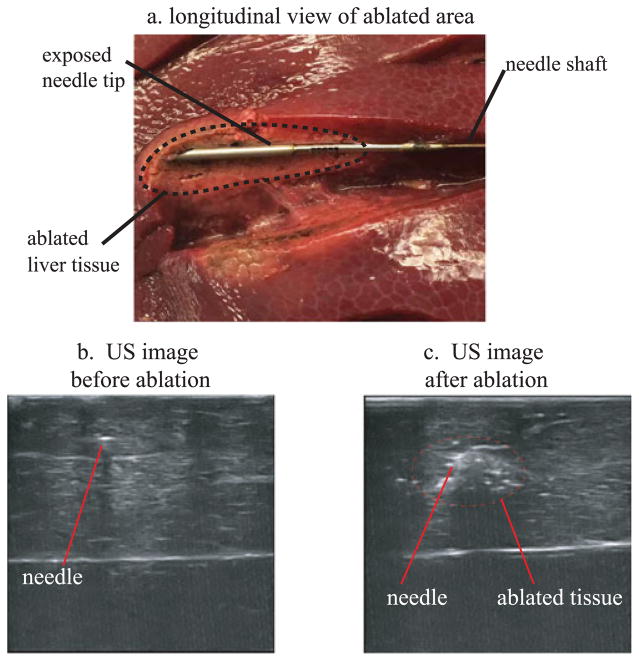
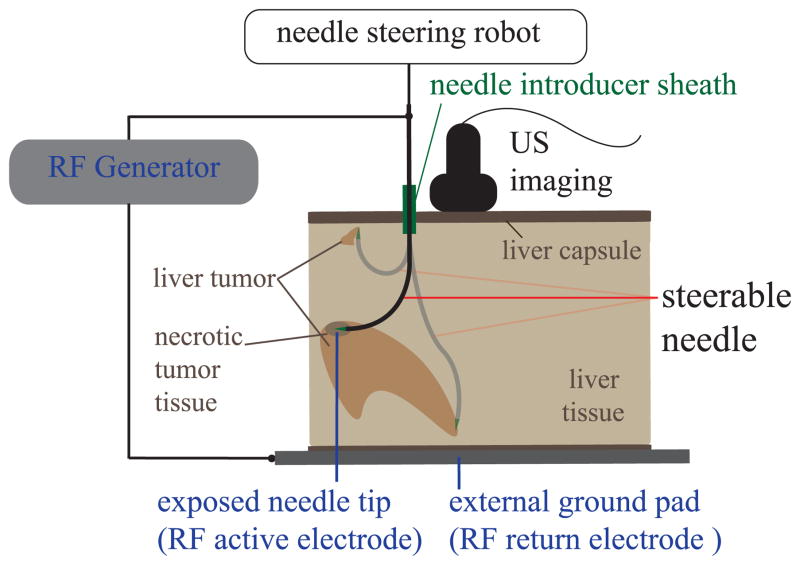
Robotic needle steering will improve percutaneous radio-frequency ablation (RFA) in the liver by performing distributed ablations without requiring multiple punctures of the liver capsule, thus enabling the treatment of large or multifocal tumors. However, state-of-the-art asymmetric-tip robotic needle steering systems do not yet achieve clinically relevant curvature. This work presents the design and development of a highly articulated needle that enables distributed RFA in liver tissue under ultrasound (US) image guidance. Our new needle design attains the target curvature required for liver procedures while meeting important clinical requirements, such as the use of fixed diameter needle introducers, presence of a free needle working channel, robustness for repeated insertions, and conductivity for the delivery of RF current for tissue ablation. The new needle tip includes two important design features: A tendon-actuated Nitinol asymmetric flexure joint, which allows for an active amplification of the needle steering force, and a steel back-bevel tip profile, which decreases the risk of needle jamming. The needle's resulting curvature was evaluated in both phantom and liver tissues using segmented US images. The average radius of minimum curvature in liver tissue was found to be 33.6 mm, the smallest reported to date. Furthermore, RFA in porcine liver tissue tests were performed to demonstrate that distributedablation with a single puncture of the liver capsule is possible via robotic needle steering.

摘要

机器人针转向技术将通过进行分布式消融来改进肝脏的经皮射频消融(RFA),而无需多次穿刺肝包膜,从而能够治疗大型或多灶性肿瘤。然而,最先进的不对称尖端机器人针转向系统尚未实现与临床相关的弯曲度。这项工作展示了一种高度灵活的针的设计与开发,该针能够在超声(US)图像引导下在肝组织中进行分布式RFA。我们的新针设计在满足重要临床要求的同时,达到了肝脏手术所需的目标弯曲度,这些要求包括使用固定直径的针引导器、存在自由的针工作通道、重复插入的稳健性以及用于组织消融的射频电流传输的导电性。新的针尖包括两个重要的设计特征:一个由肌腱驱动的镍钛诺不对称挠曲关节,它允许主动放大针转向力;以及一个钢质后斜角针尖轮廓,它降低了针堵塞的风险。使用分段的超声图像在模拟组织和肝组织中评估了针产生的弯曲度。在肝组织中测得的最小曲率平均半径为33.6毫米,这是迄今为止报道的最小值。此外,在猪肝组织测试中进行了RFA,以证明通过机器人针转向,单次穿刺肝包膜进行分布式消融是可行的。
相似文献

2
Methods for Improving the Curvature of Steerable Needles in Biological Tissue.改善生物组织中可控针曲率的方法。
IEEE Trans Biomed Eng. 2016 Jun;63(6):1167-77. doi: 10.1109/TBME.2015.2484262. Epub 2015 Oct 1.
3
A novel curvature-controllable steerable needle for percutaneous intervention.一种用于经皮介入的新型曲率可控可转向针。
Proc Inst Mech Eng H. 2016 Aug;230(8):727-38. doi: 10.1177/0954411916648988. Epub 2016 May 19.
4
Behavior of tip-steerable needles in ex vivo and in vivo tissue.可转向针尖在离体和活体组织中的行为。
IEEE Trans Biomed Eng. 2012 Oct;59(10):2705-15. doi: 10.1109/TBME.2012.2204749. Epub 2012 Jun 13.
5
Evaluation of Robotic Needle Steering in ex vivo Tissue.体外组织中机器人针转向的评估
IEEE Int Conf Robot Autom. 2010 May 3;2010:2068-2073. doi: 10.1109/ROBOT.2010.5509873.
8
3-D ultrasound-guided robotic needle steering in biological tissue.生物组织中三维超声引导的机器人针转向
IEEE Trans Biomed Eng. 2014 Dec;61(12):2899-910. doi: 10.1109/TBME.2014.2334309. Epub 2014 Jul 1.
10
Endpoint Accuracy in Manual Control of a Steerable Needle.可操纵针手动控制中的端点精度
J Vasc Interv Radiol. 2017 Feb;28(2):276-283.e2. doi: 10.1016/j.jvir.2016.07.018. Epub 2016 Oct 6.

引用本文的文献

1
A Survey of Needle Steering Approaches in Minimally Invasive Surgery.微创外科中的针道规划方法研究综述。
Ann Biomed Eng. 2024 Jun;52(6):1492-1517. doi: 10.1007/s10439-024-03494-0. Epub 2024 Mar 26.
4
8
[Robots in the operating room-(co)operation during surgery].[手术室中的机器人——手术期间的(协同)合作]
Gastroenterologe. 2021;16(1):25-34. doi: 10.1007/s11377-020-00496-x. Epub 2020 Dec 22.

本文引用的文献

3
Methods for Improving the Curvature of Steerable Needles in Biological Tissue.改善生物组织中可控针曲率的方法。
IEEE Trans Biomed Eng. 2016 Jun;63(6):1167-77. doi: 10.1109/TBME.2015.2484262. Epub 2015 Oct 1.
4
Needle Steering in 3-D Via Rapid Replanning.通过快速重新规划实现三维针引导
IEEE Trans Robot. 2014 Aug;30(4):853-864. doi: 10.1109/TRO.2014.2307633.
5
Sliding Mode Control of Steerable Needles.可控针的滑模控制
IEEE Trans Robot. 2013 Oct;29(5):1289-1299. doi: 10.1109/TRO.2013.2271098.
6
3-D ultrasound-guided robotic needle steering in biological tissue.生物组织中三维超声引导的机器人针转向
IEEE Trans Biomed Eng. 2014 Dec;61(12):2899-910. doi: 10.1109/TBME.2014.2334309. Epub 2014 Jul 1.
7
A flexure-based steerable needle: high curvature with reduced tissue damage.基于弯曲的可控式针:高曲率,减少组织损伤。
IEEE Trans Biomed Eng. 2013 Apr;60(4):906-9. doi: 10.1109/TBME.2012.2230001. Epub 2012 Nov 27.
8
Behavior of tip-steerable needles in ex vivo and in vivo tissue.可转向针尖在离体和活体组织中的行为。
IEEE Trans Biomed Eng. 2012 Oct;59(10):2705-15. doi: 10.1109/TBME.2012.2204749. Epub 2012 Jun 13.
9
Evaluation of Robotic Needle Steering in ex vivo Tissue.体外组织中机器人针转向的评估
IEEE Int Conf Robot Autom. 2010 May 3;2010:2068-2073. doi: 10.1109/ROBOT.2010.5509873.

文献AI研究员

20分钟写一篇综述,助力文献阅读效率提升50倍。

立即体验

用中文搜PubMed

大模型驱动的PubMed中文搜索引擎

马上搜索

文档翻译

学术文献翻译模型,支持多种主流文档格式。

立即体验