Ko Wan-Kyu, Lee Soo-Hong, Kim Sung Jun, Jo Min-Jae, Kumar Hemant, Han In-Bo, Sohn Seil
Department of Neurosurgery, CHA University, CHA Bundang Medical Center, Seongnam-si, Gyeonggi-do, Republic of Korea.
Department of Biomedical Science, CHA University, Seongnam-si, Gyeonggi-do, Republic of Korea.
PLoS One. 2017 Jun 30;12(6):e0180673. doi: 10.1371/journal.pone.0180673. eCollection 2017.
The aim of this study was to investigate the anti-inflammatory effects of Ursodeoxycholic acid (UDCA) in lipopolysaccharide (LPS)-stimulated RAW 264.7 macrophages.
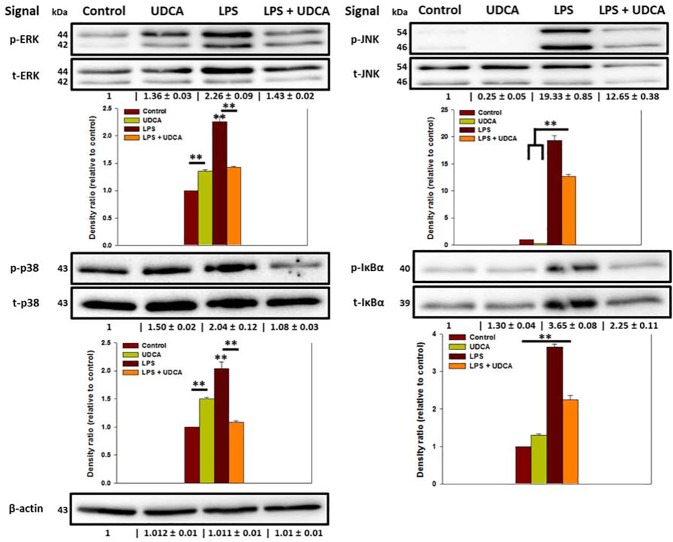
We induced an inflammatory process in RAW 264.7 macrophages using LPS. The anti-inflammatory effects of UDCA on LPS-stimulated RAW 264.7 macrophages were analyzed using nitric oxide (NO). Pro-inflammatory and anti-inflammatory cytokines were analyzed by quantitative real time polymerase chain reaction (qRT-PCR) and enzyme-linked immunosorbent assay (ELISA). The phosphorylations of extracellular signal-regulated kinase (ERK), c-Jun N-terminal kinase (JNK), and p38 in mitogen-activated protein kinase (MAPK) signaling pathways and nuclear factor kappa-light polypeptide gene enhancer in B-cells inhibitor, alpha (IκBα) signaling pathways were evaluated by western blot assays.
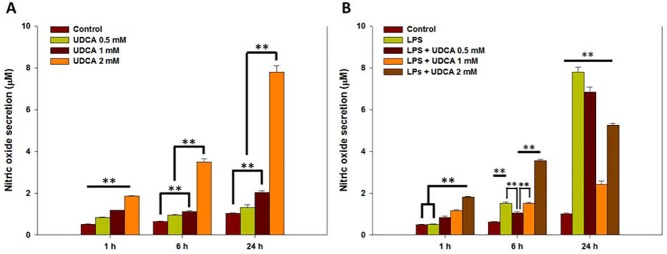
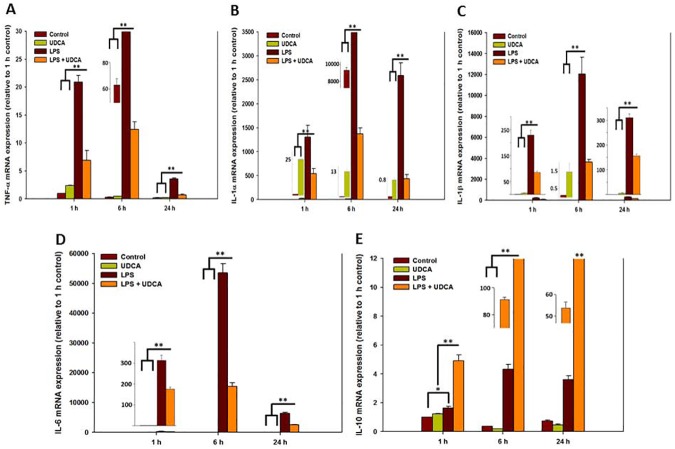
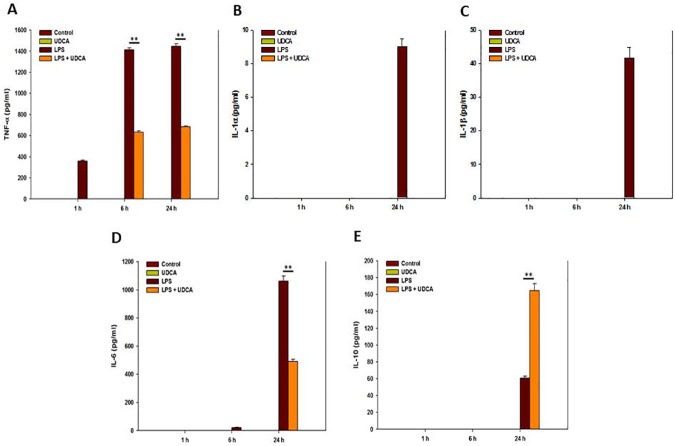
UDCA decreased the LPS-stimulated release of the inflammatory mediator NO. UDCA also decreased the pro-inflammatory cytokines tumor necrosis factor-α (TNF-α), interleukin 1-α (IL-1α), interleukin 1-β (IL-1β), and interleukin 6 (IL-6) in mRNA and protein levels. In addition, UDCA increased an anti-inflammatory cytokine interleukin 10 (IL-10) in the LPS-stimulated RAW 264.7 macrophages. UDCA inhibited the expression of inflammatory transcription factor nuclear factor kappa B (NF-κB) in LPS-stimulated RAW 264.7 macrophages. Furthermore, UDCA suppressed the phosphorylation of ERK, JNK, and p38 signals related to inflammatory pathways. In addition, the phosphorylation of IκBα, the inhibitor of NF-κB, also inhibited by UDCA.
UDCA inhibits the pro-inflammatory responses by LPS in RAW 264.7 macrophages. UDCA also suppresses the phosphorylation by LPS on ERK, JNK, and p38 in MAPKs and NF-κB pathway. These results suggest that UDCA can serve as a useful anti-inflammatory drug.
本研究旨在探讨熊去氧胆酸(UDCA)对脂多糖(LPS)刺激的RAW 264.7巨噬细胞的抗炎作用。
我们使用LPS在RAW 264.7巨噬细胞中诱导炎症过程。通过一氧化氮(NO)分析UDCA对LPS刺激的RAW 264.7巨噬细胞的抗炎作用。通过定量实时聚合酶链反应(qRT-PCR)和酶联免疫吸附测定(ELISA)分析促炎和抗炎细胞因子。通过蛋白质印迹分析评估丝裂原活化蛋白激酶(MAPK)信号通路中的细胞外信号调节激酶(ERK)、c-Jun氨基末端激酶(JNK)和p38以及B细胞抑制剂α(IκBα)信号通路中核因子κB轻链多肽基因增强子的磷酸化。
UDCA降低了LPS刺激的炎症介质NO的释放。UDCA还在mRNA和蛋白质水平上降低了促炎细胞因子肿瘤坏死因子-α(TNF-α)、白细胞介素1-α(IL-1α)、白细胞介素1-β(IL-1β)和白细胞介素6(IL-6)。此外,UDCA增加了LPS刺激的RAW 264.7巨噬细胞中的抗炎细胞因子白细胞介素10(IL-10)。UDCA抑制了LPS刺激的RAW 264.7巨噬细胞中炎症转录因子核因子κB(NF-κB)的表达。此外,UDCA抑制了与炎症途径相关的ERK、JNK和p38信号的磷酸化。此外,NF-κB抑制剂IκBα的磷酸化也受到UDCA的抑制。
UDCA抑制LPS在RAW 264.7巨噬细胞中的促炎反应。UDCA还抑制LPS对MAPKs和NF-κB途径中ERK、JNK和p38的磷酸化。这些结果表明UDCA可作为一种有用的抗炎药物。