
西格玛-1受体调控内质网应激诱导的心肌细胞中C/EBP同源蛋白的表达。
Sigmar1 regulates endoplasmic reticulum stress-induced C/EBP-homologous protein expression in cardiomyocytes.
作者信息
Alam Shafiul, Abdullah Chowdhury S, Aishwarya Richa, Orr A Wayne, Traylor James, Miriyala Sumitra, Panchatcharam Manikandan, Pattillo Christopher B, Bhuiyan Md Shenuarin
机构信息
Department of Pathology and Translational Pathobiology, Louisiana State University Health Sciences Center, Shreveport, LA 71103, U.S.A.
Department of Molecular and Cellular Physiology, Louisiana State University Health Sciences Center, Shreveport, LA 71103, U.S.A.
出版信息
Biosci Rep. 2017 Jul 16;37(4). doi: 10.1042/BSR20170898. Print 2017 Aug 31.
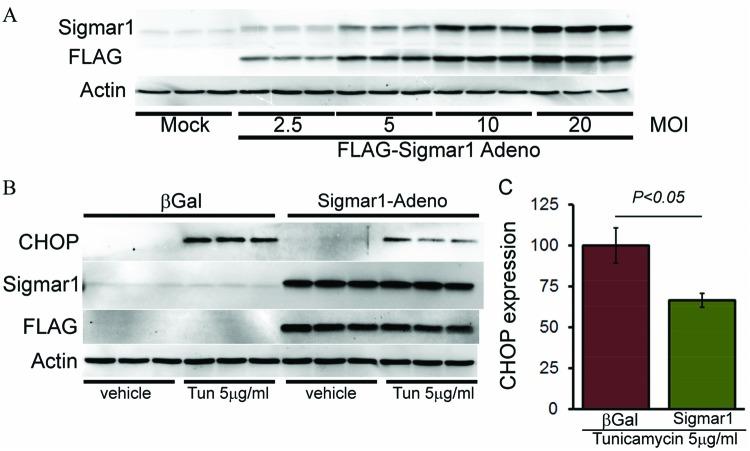
C/EBP-homologous protein (CHOP) is a ubiquitously expressed stress-inducible transcription factor robustly induced by maladaptive endoplasmic reticulum (ER) stresses in a wide variety of cells. Here, we examined a novel function of Sigma 1 receptor (Sigmar1) in regulating CHOP expression under ER stress in cardiomyocytes. We also defined Sigmar1-dependent activation of the adaptive ER-stress pathway in regulating CHOP expression. We used adenovirus-mediated Sigmar1 overexpression as well as Sigmar1 knockdown by siRNA in neonatal rat ventricular cardiomyocytes (NRCs); to induce ER stress, cardiomyocytes were treated with tunicamycin. Sigmar1-siRNA knockdown significantly increased the expression of CHOP and significantly induced cellular toxicity by sustained activation of ER stress in cardiomyocytes. Sigmar1 overexpression decreased the expression of CHOP and significantly decreased cellular toxicity in cells. Using biochemical and immunocytochemical experiments, we also defined the specific ER-stress pathway associated with Sigmar1-dependent regulation of CHOP expression and cellular toxicity. We found that Sigmar1 overexpression significantly increased inositol requiring kinase 1α (IRE1α) phosphorylation and increased spliced X-box-binding proteins (XBP1s) expression as well as nuclear localization. In contrast, Sigmar1 knockdown significantly decreased IRE1α phosphorylation and decreased XBP1s expression as well as nuclear transport. Taken together, these results indicate that Sigmar1-dependent activation of IRE1α-XBP1s ER-stress response pathways are associated with inhibition of CHOP expression and suppression of cellular toxicity. Hence, Sigmar1 is an essential component of the adaptive ER-stress response pathways eliciting cellular protection in cardiomyocytes.
C/EBP 同源蛋白(CHOP)是一种广泛表达的应激诱导转录因子,在多种细胞中,由适应性内质网(ER)应激强烈诱导产生。在此,我们研究了 Sigma 1 受体(Sigmar1)在心肌细胞内质网应激状态下调节 CHOP 表达的新功能。我们还确定了 Sigmar1 依赖的适应性内质网应激途径在调节 CHOP 表达中的激活作用。我们在新生大鼠心室心肌细胞(NRCs)中使用腺病毒介导的 Sigmar1 过表达以及通过 siRNA 敲低 Sigmar1;为诱导内质网应激,用衣霉素处理心肌细胞。敲低 Sigmar1-siRNA 显著增加了 CHOP 的表达,并通过持续激活心肌细胞内质网应激显著诱导细胞毒性。Sigmar1 过表达降低了 CHOP 的表达,并显著降低了细胞中的细胞毒性。通过生化和免疫细胞化学实验,我们还确定了与 Sigmar1 依赖的 CHOP 表达调节和细胞毒性相关的特定内质网应激途径。我们发现 Sigmar1 过表达显著增加了肌醇需求激酶 1α(IRE1α)磷酸化,并增加了剪接的 X 盒结合蛋白(XBP1s)的表达以及核定位。相反,敲低 Sigmar1 显著降低了 IRE1α 磷酸化,并降低了 XBP1s 的表达以及核转运。综上所述,这些结果表明 Sigmar1 依赖的 IRE1α-XBP1s 内质网应激反应途径的激活与抑制 CHOP 表达和抑制细胞毒性有关。因此,Sigmar1 是在心肌细胞中引发细胞保护的适应性内质网应激反应途径的重要组成部分。




 Zotero 插件