Shi Li Xin, Li Peng Fei, Hou Jia Ning
Department of Endocrinology and Metabolism, Affiliated Hospital of Guiyang Medical College, Guiyang, 550004, China.
Medical Department, Lilly Suzhou Pharmaceutical Co. Ltd, Shanghai, 200021, China.
Diabetes Ther. 2017 Aug;8(4):915-928. doi: 10.1007/s13300-017-0286-z. Epub 2017 Jun 30.
Identification of subgroups of patients that may benefit most from certain treatment is important because individual treatment response varies due to multiple contributing factors. The present study used the subgroup identification based on the differential effect search (SIDES) algorithm to identify subgroups with different treatment responses to insulin intensification therapies.
This was a post hoc analysis of a 24-week, multicenter, open-label, randomized, parallel study comparing prandial premixed therapy (PPT) to basal-bolus therapy (BBT). Patients with type 2 diabetes mellitus were randomized to PPT (insulin lispro mix 50/50 thrice daily with meals) or BBT (glargine at bedtime plus mealtime insulin lispro) insulin intensification therapies. The SIDES algorithm was used to identify the subgroups from at-goal patients [glycated hemoglobin (HbA1c) <7.0% (53.0 mmol/mol) at the end of 24 weeks; n = 182] who could have benefitted from insulin intensification therapies.
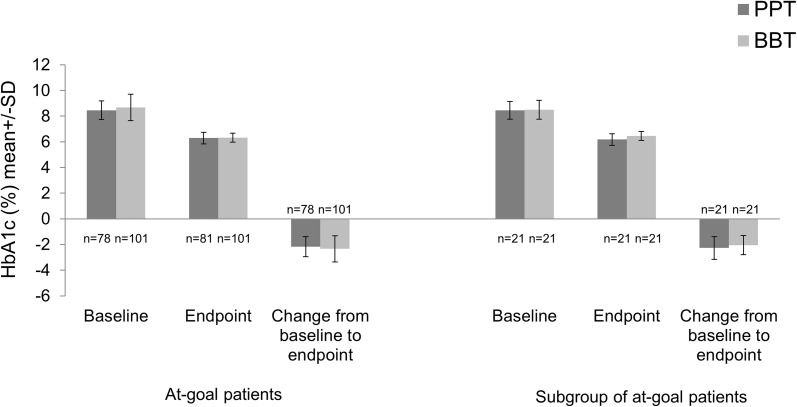
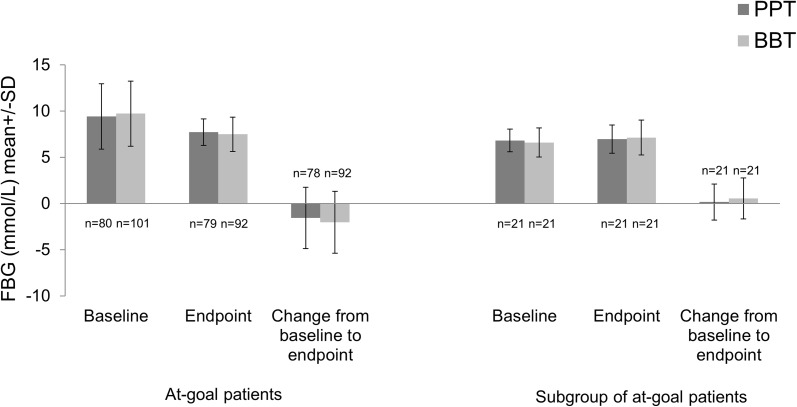
Baseline characteristics of overall at-goal patients were comparable between PPT and BBT groups. The SIDES algorithm identified patients with race other than Caucasian (i.e., African-American, Asian, and Hispanic) and baseline fasting blood glucose (FBG) <8.89 mmol/L as a subgroup that could respond better to PPT relative to BBT than the overall at-goal patient population. In this identified subgroup population, the HbA1c mean (standard deviation) changes from baseline to endpoint in PPT and BBT groups were -2.27 (0.88)% versus -2.05 (0.75)%; p = 0.40, respectively; while in the overall at-goal patients, the HbA1c changes were -2.17 (0.79)% versus -2.34 (1.00)%; p = 0.19, respectively.
The preliminary results showed that the subgroup of patients with race other than Caucasian and FBG <8.89 mmol/L may respond better to premixed intensification therapy. This result provides some preliminary information for further investigation in prospective studies.
Eli Lilly and Company.
Clinicaltrials.gov ID number: NCT00110370.
识别可能从特定治疗中获益最大的患者亚组很重要,因为个体治疗反应因多种因素而异。本研究使用基于差异效应搜索(SIDES)算法的亚组识别方法,来确定对胰岛素强化治疗有不同反应的亚组。
这是一项对一项为期24周、多中心、开放标签、随机、平行研究的事后分析,该研究比较了餐时预混胰岛素治疗(PPT)与基础-餐时胰岛素治疗(BBT)。2型糖尿病患者被随机分配接受PPT(赖脯胰岛素50/50每日三次随餐服用)或BBT(睡前甘精胰岛素加餐时赖脯胰岛素)胰岛素强化治疗。使用SIDES算法从达标患者[24周结束时糖化血红蛋白(HbA1c)<7.0%(53.0 mmol/mol);n = 182]中识别出可能从胰岛素强化治疗中获益的亚组。
PPT组和BBT组总体达标患者的基线特征具有可比性。SIDES算法识别出非白种人(即非裔美国人、亚洲人和西班牙裔)且基线空腹血糖(FBG)<8.89 mmol/L的患者作为一个亚组,相对于总体达标患者群体,该亚组对PPT的反应优于BBT。在这个识别出的亚组人群中,PPT组和BBT组从基线到终点的HbA1c平均(标准差)变化分别为-2.27(0.88)%和-2.05(0.75)%;p = 0.40;而在总体达标患者中,HbA1c变化分别为-2.17(0.79)%和-2.34(1.00)%;p = 0.19。
初步结果表明,非白种人且FBG<8.89 mmol/L的患者亚组可能对预混胰岛素强化治疗反应更好。这一结果为前瞻性研究的进一步调查提供了一些初步信息。
礼来公司。
Clinicaltrials.gov标识符:NCT00110370。