Kim Jong Gug, Nonneman Dan, Kim Doo-Wan, Shin Sangsu, Rohrer Gary A
Department of Animal Sciences, College of Agriculture and Life Science, and Institute of Molecular Biology and Genetics, Chonbuk National University, Jeonju 54896, Korea.
U.S. Department of Agriculture, Agricultural Research Service, U.S. Meat Animal Research Center, Clay Center, NE 68933-0166, USA.
Asian-Australas J Anim Sci. 2017 Aug;30(8):1086-1092. doi: 10.5713/ajas.17.0143. Epub 2017 Jun 22.
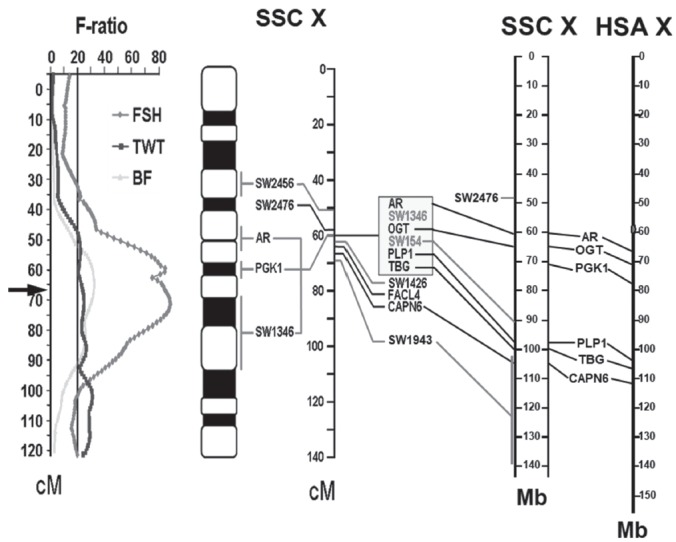
O-linked N-acetylglucosamine (O-GlcNAc) transferase (OGT) catalyzes the addition of O-GlcNAc and GlcNAcylation has extensive crosstalk with phosphorylation to regulate signaling and transcription. Pig is located near the region of chromosome X that affects follicle stimulating hormone level and testes size. The objective of this study was to find the variations of between European and Chinese pigs.
Pigs were tested initially for polymorphism in among European and Chinese pigs by polymerase chain reaction and sequencing at the U.S. Meat Animal Research Center (USMARC). The polymorphism was also determined in an independent population of pigs including European and Chinese Meishan (ME) breeds at the National Institute of Animal Science (NIAS, RDA, Korea).
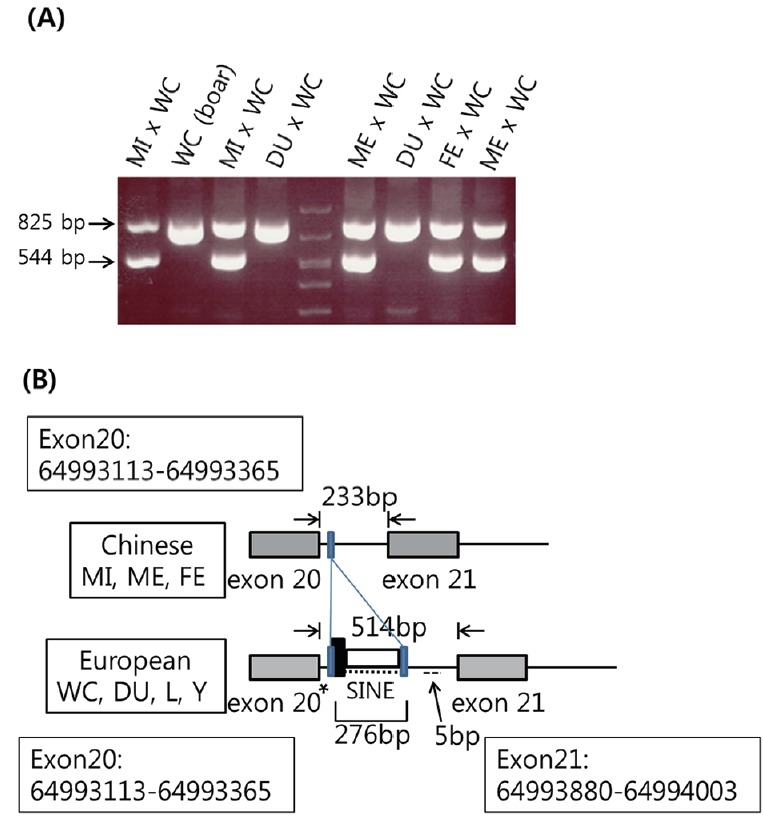
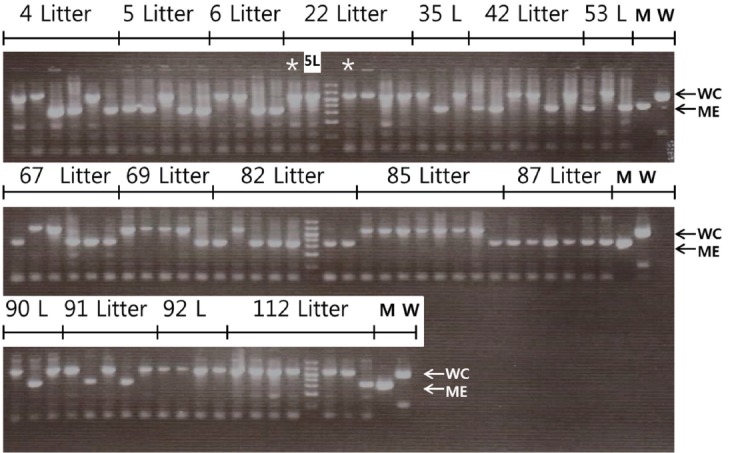
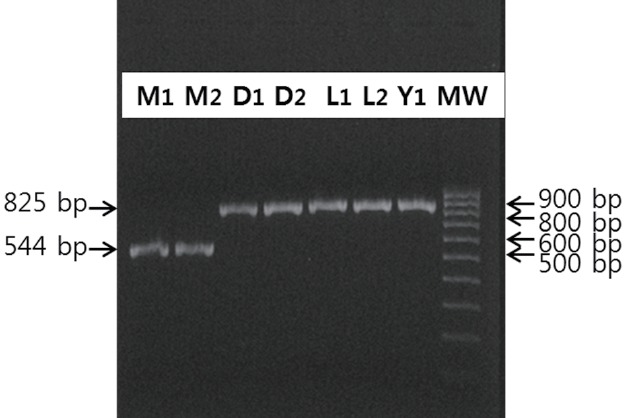
The intron 20 of from European and Chinese pigs was 514 and 233 bp, respectively, in the pigs tested initially. They included 1 White composite (WC) boar and 7 sows (2 Minzu×WC, 2 Duroc [DU]×WC, 2 ME×WC, 1 Fengzing×WC) at USMARC. The 281-bp difference was due to an inserted 276-bp element and GACTT in European pigs. When additional WC and ME boars, the grandparents that were used to generate the 1/2ME×1/2WC parents, and the 84 boars of 16 litters from mating of 1/2ME×1/2WC parents were analyzed, the breeds of origin of X chromosome quantitative trait locus (QTL) were confirmed. The polymorphism was determined in an independent population of pigs including DU, Landrace, Yorkshire, and ME breeds at NIAS. was placed at position 67 cM on the chromosome X of the USMARC swine linkage map.
There was complete concordance with the insertion in European pigs at USMARC and NIAS. This polymorphism could be a useful marker to identify the breed of origin of X chromosome QTL in pigs produced by crossbreeding Chinese and European pigs.
O-连接的N-乙酰葡糖胺(O-GlcNAc)转移酶(OGT)催化O-GlcNAc的添加,并且糖基化与磷酸化存在广泛的相互作用以调节信号传导和转录。Pig位于影响促卵泡激素水平和睾丸大小的X染色体区域附近。本研究的目的是找出欧洲猪和中国猪之间该基因的变异情况。
在美国肉类动物研究中心(USMARC),通过聚合酶链反应和测序对欧洲猪和中国猪的该基因多态性进行初步检测。在韩国农村振兴厅国家动物科学研究所(NIAS),对包括欧洲猪和中国梅山猪(ME)品种的独立猪群也进行了该多态性的检测。
在最初检测的猪中,欧洲猪和中国猪该基因的第20内含子分别为514 bp和233 bp。其中包括USMARC的1头白色复合(WC)公猪和7头母猪(2头民猪×WC、2头杜洛克猪[DU]×WC、2头梅山猪×WC、1头枫泾猪×WC)。281 bp的差异是由于欧洲猪中插入了一个276 bp的元件和GACTT。当分析额外的WC和梅山公猪、用于产生1/2梅山猪×1/2WC亲本的祖代猪以及1/2梅山猪×1/2WC亲本交配产生的16窝84头公猪时,确认了X染色体数量性状位点(QTL)的起源品种。在NIAS对包括杜洛克猪、长白猪、约克夏猪和梅山猪品种的独立猪群进行了该多态性的检测。该基因位于USMARC猪连锁图谱X染色体上67 cM处。
USMARC和NIAS的欧洲猪中的插入情况完全一致。这种多态性可能是一个有用的标记,用于鉴定中国猪和欧洲猪杂交产生的猪中X染色体QTL的起源品种。