Foley John F, Nair Kavita V, Vollmer Timothy, Stephenson Judith J, Niecko Timothy, Agarwal Sonalee S, Watson Crystal
Rocky Mountain Multiple Sclerosis Clinic, Salt Lake City, UT, USA.
Skaggs School of Pharmacy and Pharmaceutical Sciences, University of Colorado Denver, Aurora, CO, USA.
Patient Prefer Adherence. 2017 Jun 16;11:1035-1048. doi: 10.2147/PPA.S134865. eCollection 2017.
Multiple sclerosis (MS) patients experience lower health-related quality of life (HRQoL) than the general population. In clinical trials, natalizumab significantly improved HRQoL and reduced relapse rates and disability progression in patients with relapsing MS. In a 1-year analysis of patients included in the current study, HRQoL improvement occurred within 3 months of natalizumab initiation and continued for 1 year thereafter. However, natalizumab's long-term efficacy in improving HRQoL has not been studied.
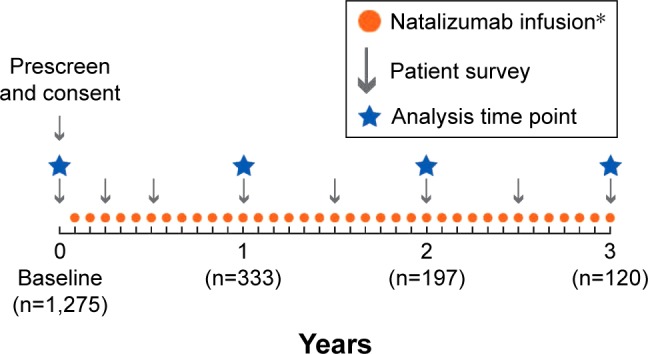
In this longitudinal, observational, single-arm US study, HRQoL and treatment satisfaction were evaluated in MS patients receiving intravenous natalizumab 300 mg every 4 weeks in clinical settings. Patients completed surveys at baseline and every 6 months for 3 years and reported the following measures: Short Form-12 Version 2 (SF-12v2), Multiple Sclerosis Impact Scale (MSIS-29), and Treatment Satisfaction Questionnaire for Medication.
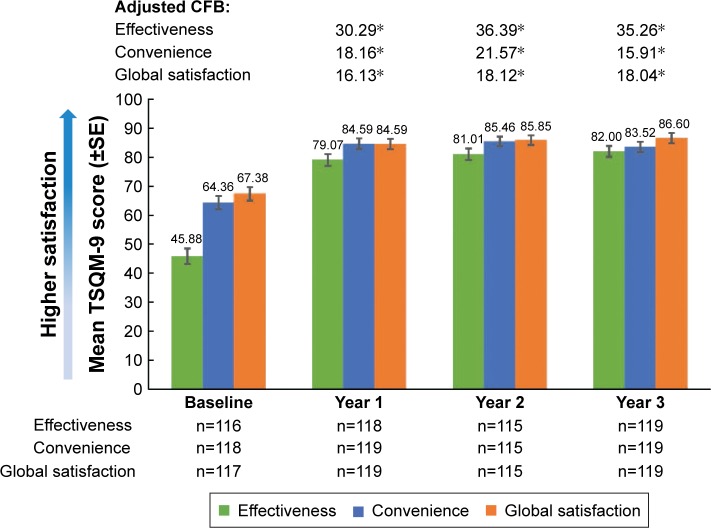
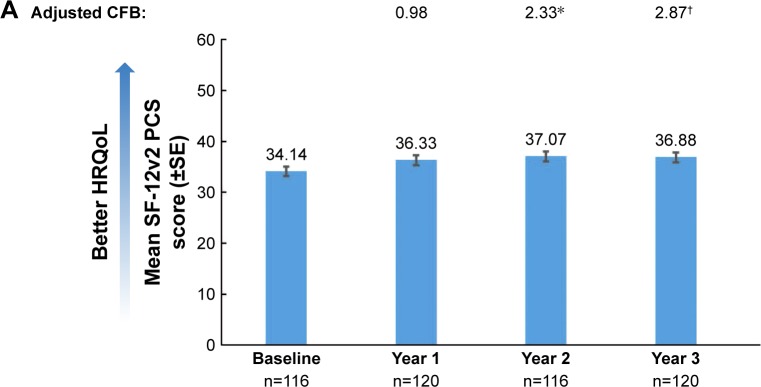
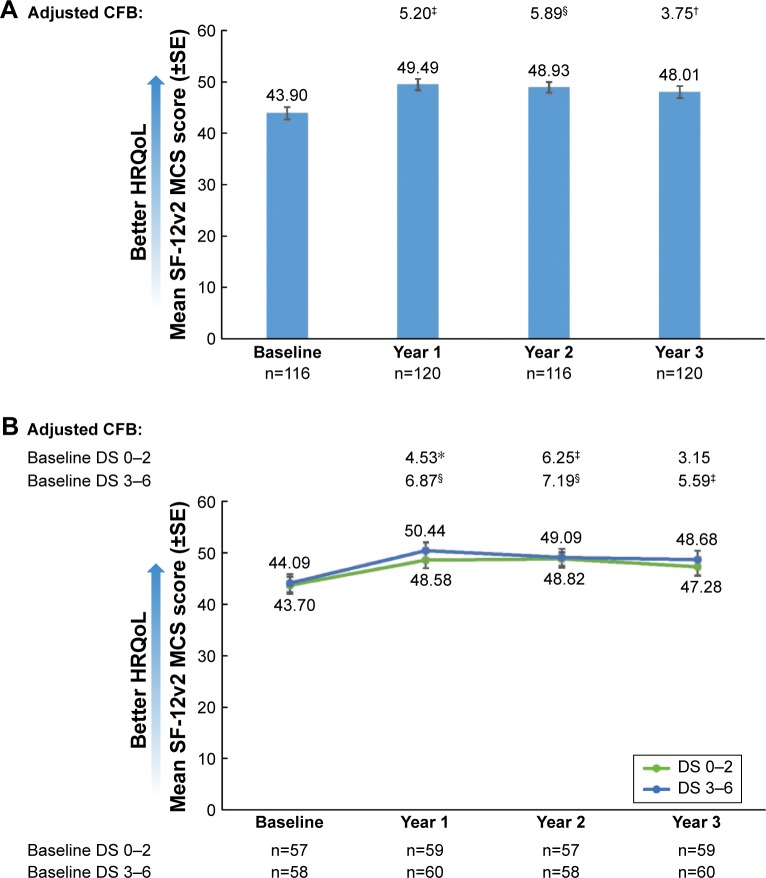
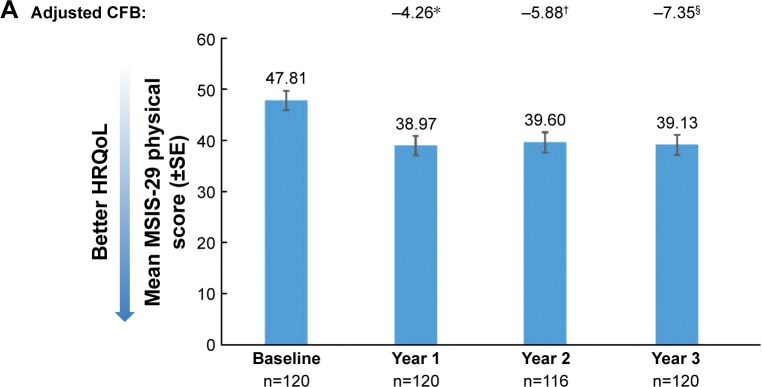
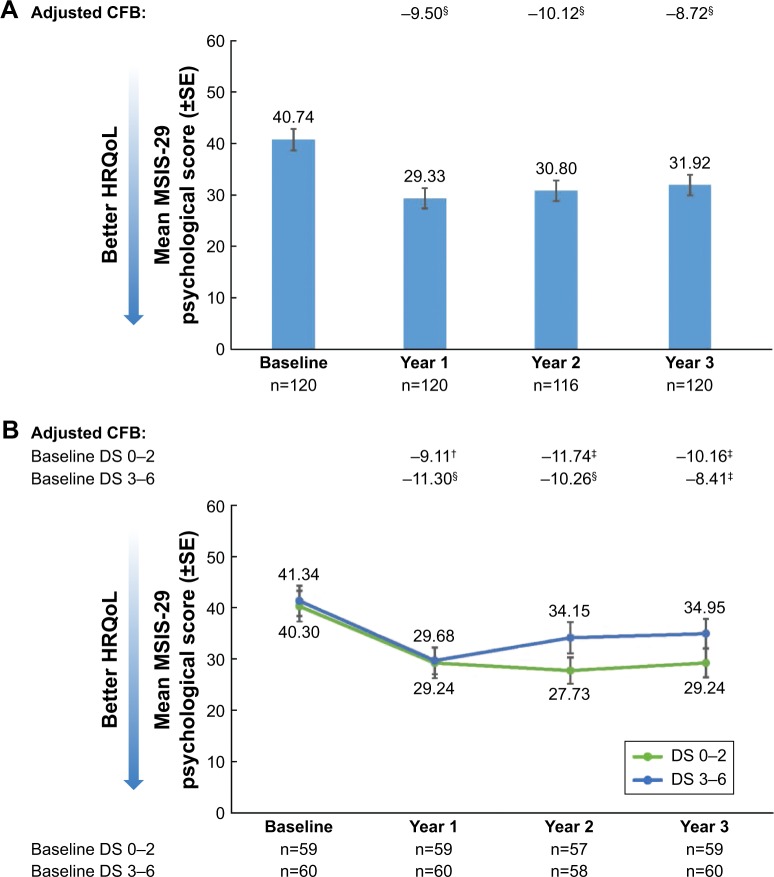
In this study, 120 patients completed ≥3 years of natalizumab treatment. Significant HRQoL improvements were evident from baseline to year 3 by increases in SF-12v2 Physical Component Summary (PCS) and Mental Component Summary scores (<0.01) and decreases in MSIS-29 physical and psychological scores (<0.0001). Patients with less physical disability (baseline Disease Steps [DS] 0-2) had significant improvement from baseline to year 3 in SF-12v2 PCS (<0.05) and MSIS-29 physical scores (<0.05). Physical HRQoL outcomes in patients with baseline DS 3-6 remained stable over 3 years. Treatment satisfaction increased significantly from baseline to year 1 (<0.0001) and was maintained in the following 2 years.
Patients reported physical and psychological HRQoL improvements over 3 years of natalizumab treatment, supporting the long-term efficacy of natalizumab in real-world settings. Lower baseline disease activity and earlier treatment were related to better outcomes, indicating the importance of starting natalizumab early in the disease course. Treatment satisfaction increased after natalizumab initiation and remained high over 3 years of treatment.
与普通人群相比,多发性硬化症(MS)患者的健康相关生活质量(HRQoL)较低。在临床试验中,那他珠单抗显著改善了复发型MS患者的HRQoL,并降低了复发率和残疾进展。在对本研究纳入患者的1年分析中,HRQoL的改善在开始使用那他珠单抗后的3个月内出现,并在此后持续了1年。然而,那他珠单抗在改善HRQoL方面的长期疗效尚未得到研究。
在这项纵向、观察性、单臂美国研究中,对临床环境中每4周静脉注射300mg那他珠单抗的MS患者的HRQoL和治疗满意度进行了评估。患者在基线时以及每6个月完成一次调查,为期3年,并报告以下指标:简明健康调查简表第2版(SF-12v2)、多发性硬化症影响量表(MSIS-29)和药物治疗满意度问卷。
在本研究中,120名患者完成了≥3年的那他珠单抗治疗。从基线到第3年,SF-12v2身体成分总结(PCS)和心理成分总结得分增加(<0.01),MSIS-29身体和心理得分降低(<0.0001),HRQoL有显著改善。身体残疾程度较轻(基线疾病阶段[DS]0-2)的患者从基线到第3年,SF-12v2 PCS(<0.05)和MSIS-29身体得分(<0.05)有显著改善。基线DS为3-6的患者的身体HRQoL结果在3年内保持稳定。治疗满意度从基线到第1年显著提高(<0.0001),并在随后的2年中保持。
患者报告在接受那他珠单抗治疗的3年中,身体和心理HRQoL均有改善,支持那他珠单抗在现实环境中的长期疗效。较低的基线疾病活动度和早期治疗与更好的结果相关,表明在疾病进程早期开始使用那他珠单抗的重要性。开始使用那他珠单抗后治疗满意度增加,并在3年治疗期间保持较高水平。