Yu Hongliang, Pei Dong, Chen Longyun, Zhou Xiaoxiang, Zhu Haiwen
Department of Radiation Oncology, Jiangsu Cancer Hospital and Jiangsu Institute of Cancer Research, The Affiliated Cancer Hospital of Nanjing Medical University, Nanjing.
Department of Radiation Oncology, Yancheng Third People's Hospital, Yancheng, Jiangsu, People's Republic of China.
Onco Targets Ther. 2017 Jun 16;10:3017-3027. doi: 10.2147/OTT.S132071. eCollection 2017.
Dedifferentiated liposarcoma (DDLPS) is one of the most deadly types of soft tissue sarcoma. To date, there have been few studies dedicated to elucidating the molecular mechanisms behind the disease; therefore, the molecular mechanisms behind this malignancy remain largely unknown.
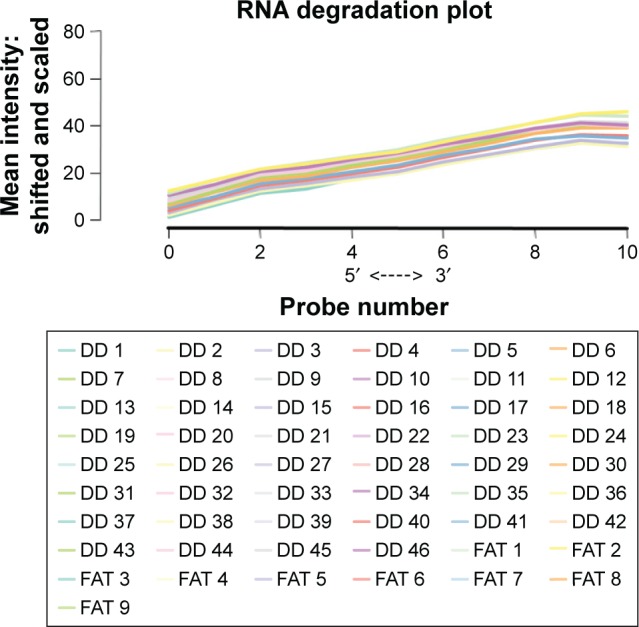
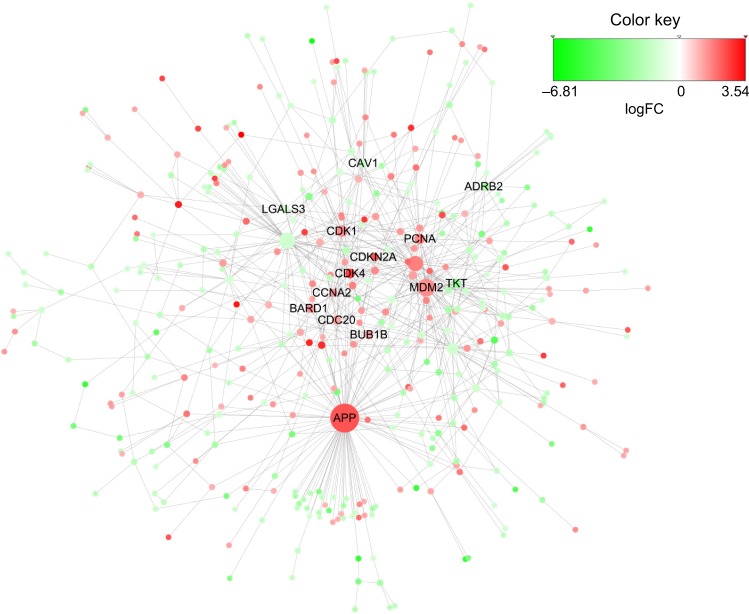
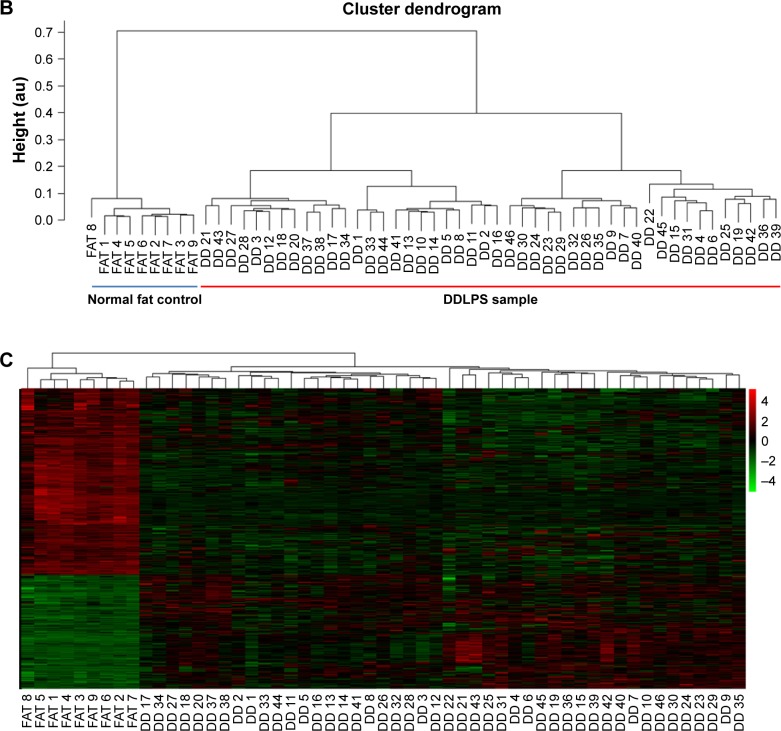
Microarray profiles of 46 DDLPS samples and nine normal fat controls were extracted from Gene Expression Omnibus (GEO). Quality control for these microarray profiles was performed before analysis. Hierarchical clustering and principal component analysis were used to distinguish the general differences in gene expression between DDLPS samples and the normal fat controls. Differentially expressed genes (DEGs) were identified using the Limma package in R. Next, the enriched Gene Ontology (GO) terms and Kyoto Encyclopedia of Genes and Genomes (KEGG) pathways were obtained using the online tool DAVID (http://david.abcc.ncifcrf.gov/). A protein-protein interaction (PPI) network was constructed using the STRING database and Cytoscape software. Furthermore, the hub genes within the PPI network were identified.
All 55 microarray profiles were confirmed to be of high quality. The gene expression pattern of DDLPS samples was significantly different from that of normal fat controls. In total, 700 DEGs were identified, and 83 enriched GO terms and three KEGG pathways were obtained. Specifically, within the DEGs of DDLPS samples, several pathways were identified as being significantly enriched, including the PPAR signaling pathway, cell cycle pathway, and pyruvate metabolism pathway. Furthermore, the dysregulated PPI network of DDLPS was constructed, and 14 hub genes were identified. Characteristic of DDLPS, the genes and were universally found to be up-regulated and amplified in gene copy number.
This study used bioinformatics to comprehensively mine DDLPS microarray data in order to obtain a deeper understanding of the molecular mechanism of DDLPS.
去分化脂肪肉瘤(DDLPS)是最致命的软组织肉瘤类型之一。迄今为止,致力于阐明该疾病背后分子机制的研究很少;因此,这种恶性肿瘤背后的分子机制在很大程度上仍然未知。
从基因表达综合数据库(GEO)中提取46个DDLPS样本和9个正常脂肪对照的微阵列谱。在分析之前对这些微阵列谱进行质量控制。使用层次聚类和主成分分析来区分DDLPS样本和正常脂肪对照之间基因表达的总体差异。使用R中的Limma软件包鉴定差异表达基因(DEG)。接下来,使用在线工具DAVID(http://david.abcc.ncifcrf.gov/)获得富集的基因本体(GO)术语和京都基因与基因组百科全书(KEGG)通路。使用STRING数据库和Cytoscape软件构建蛋白质-蛋白质相互作用(PPI)网络。此外,鉴定了PPI网络中的枢纽基因。
所有55个微阵列谱均被确认为高质量。DDLPS样本的基因表达模式与正常脂肪对照有显著差异。总共鉴定出700个DEG,并获得83个富集的GO术语和3条KEGG通路。具体而言,在DDLPS样本的DEG中,鉴定出几个显著富集的通路,包括PPAR信号通路、细胞周期通路和丙酮酸代谢通路。此外,构建了DDLPS失调的PPI网络,并鉴定出14个枢纽基因。DDLPS的特征是,基因 和 在基因拷贝数上普遍上调和扩增。
本研究使用生物信息学全面挖掘DDLPS微阵列数据,以更深入地了解DDLPS的分子机制。